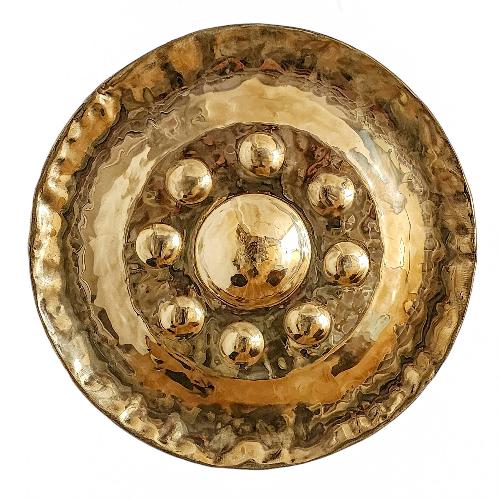
Burmese Gong, [Hand Beaten] small, Nipple Gong, The Javanese gong
| Dimensions: | 27x27x6 cm (10.6 × 10.6 × 2.4 inches) |
| Gross Weight: | 1 kg (2.2 lbs) |
| Material: | 7 metal Bronze |
| Iconography / Artist: | Nipple gong |
| Craft Origin: | Kathmandu Valley, Nepal • Ancient Heritage Technique |
| Cataloged On: | Oct 23, 2019 |
Nipple gong
Nipple gongs have a rich history and are commonly found in different cultural contexts. They are used in Chinese temples for worship and have significance in Buddhist temples throughout Southeast Asia. In traditional Philippine music, especially in kulintang ensembles, nipple gongs are a primary instrument and play a crucial role in producing the traditional melodic and rhythmic patterns. Additionally, in Indonesian gamelan ensembles, gongs come in various sizes and serve different functions, with nipple gongs being an integral part of the ensemble.
Uses:
The nipple gong is an essential instrument in various religious and cultural practices. In Chinese and Southeast Asian temples, it is used for worship and ceremonial purposes, adding a distinctive sound to sacred rituals. In Philippine kulintang music, sets of smaller, tuned nipple gongs are utilized to play intricate and melodious melodies, contributing to the ensemble's rich sound. Similarly, in Indonesian gamelan ensembles, nipple gongs serve different roles depending on their size, pitch, and function. The larger gong ageng, with its deep pitch, is played less frequently and creates a foundation for the ensemble, while smaller gongs like the gong suwukan and kempul add higher tones and more frequent accents.
How to Play:
Playing the nipple gong requires precision and technique to achieve the desired tones and sounds. Percussionists typically strike the gong with mallets, choosing between striking the central boss or the area next to it to produce different tones. Striking the boss creates a deeper, resonant sound, while striking the gong's surface next to the boss yields a brighter and more vibrant tone. In ensembles, players coordinate their strikes to create intricate rhythms and melodies. To play a melody, sets of smaller, tuned nipple gongs are used, with each gong producing a specific pitch. By striking the nipple gongs in sequence, performers can create beautiful and captivating musical phrases that define the character of the traditional music.
Centuries-Old Lost-Wax Metal Casting
Each sculpture at Handmade Handicraft is crafted using the ancient cire-perdue (lost-wax) technique, a craft perfected over a millennium by the Newar artisans of Patan. The process begins with sculpting beeswax and Himalayan tree resin by hand. A multi-layered clay mold is formed around the wax, which is melted away in the furnace, creating a void that is filled with molten red copper or bronze.
24K Mercury Gilding
Applied with pure gold leaf and fused using fire gilding for an ethereal sheen that endures for generations.
Cold-Gold Face Painting
The sacred facial features and serene gaze of deities are carefully rendered with powdered cold gold and natural pigments.
Hand-Chiseled Detailing
Intricate robes, mandalas, and jewels are carved by hand with miniature steel chisels and devotion.
Door-to-Door Worldwide Express Delivery
Since 1976, we have shipped thousands of delicate sacred statues and handicrafts across North America, Europe, Australia, and Asia with an exceptional track record of safe delivery.
-
Express Carriers: We partner with DHL Express, FedEx International, and licensed Air Cargo freighters with end-to-end tracking.
-
Museum-Grade Packaging: Each piece is wrapped in moisture-resistant vapor barriers, thick high-density foam cushioning, and reinforced export cartons or custom wooden crates for large statues.
-
100% Transit Insurance: All international shipments are fully insured against loss or damage during transit.
-
Customs Clearance & Documentation: Includes official Nepal Archaeological Department export clearances certifying modern non-antique artisan status for hassle-free customs clearance.
Related Artisan Masterpieces

Burmese Gong, [Hand Beaten] Large, Nipple Gong, The Javanese gong

Burmese Gong, [Hand Beaten] Large, Nipple Gong with Flower Design, The Javanese gong

Burmese Gong, [Hand Beaten], Nipple Gong with Flower Design, The Javanese gong