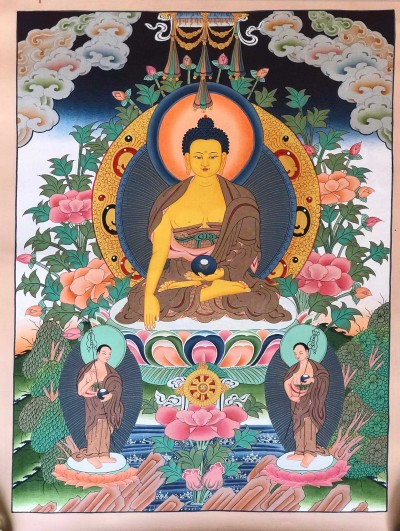
Tibetan Thangka of Mantra Mandala
| Dimensions: | 30x30 cm (11.8 × 11.8 inches) |
| Gross Weight: | 0.1 kg (0.22 lbs) |
| Material: | Cotton Canvas |
| Iconography / Artist: | tk-Thangka |
| Craft Origin: | Kathmandu Valley, Nepal • Ancient Heritage Technique |
| Cataloged On: | Jul 07, 2020 |
tk-Thangka
Thangkas come in various sizes, ranging from small pieces resembling Western half-length portraits to grand-scale creations spanning several meters in each dimension. While the larger thangkas are intended for temporary display during religious festivals, the majority of these artworks are designed for personal meditation or as educational aids for monastic students. The compositions of thangkas are meticulously crafted, featuring intricate details and often incorporating numerous small figures. A central deity or focal point is typically surrounded by a symmetrical arrangement of other divine beings, symbols, or narrative elements that convey profound spiritual teachings.
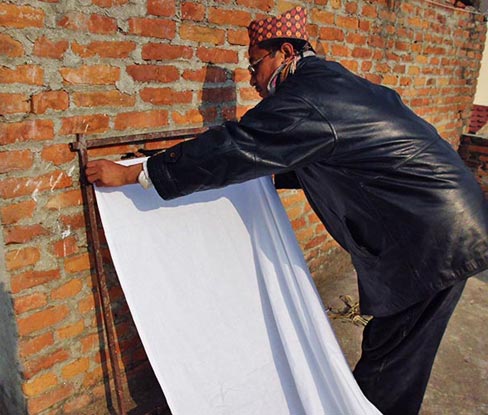
First, the canvas on which the painting is to be executed is laid on a wooden frame to determine the required dimensions. This canvas is an extremely finely woven cotton material, referred to in the Holy Scriptures as "Çura Canvas".
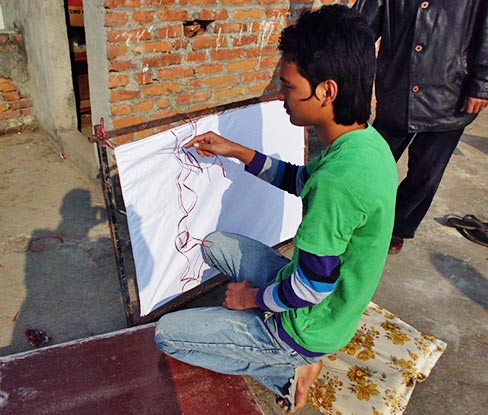
Then the canvas is cut, hemmed and, with the use of sturdy strings, very tightly mounted in the wooden frame. Painting is carried out with the frame in an upright position, without any further rigid support or backing.
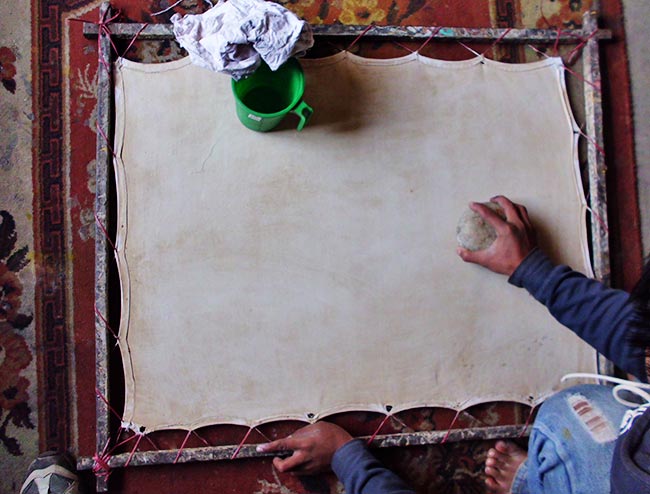
In this studio, our primary artist, who works virtually exclusively for us, applies the undercoat consisting of a mixture of chalk and glue to the canvas by hand. Other Thangka workshops have turned to mainly using industrially pre-primed canvas.
This photo shows how the canvas, after receiving its base coat followed by a second coating of bone glue, is polished and smoothed by hand with a stone to attain a perfectly smooth, featureless painting surface. Through this process the canvas becomes quite rigid, thereby providing perfect conditions to evoke very finest artistic detail and over-all superior painting quality.
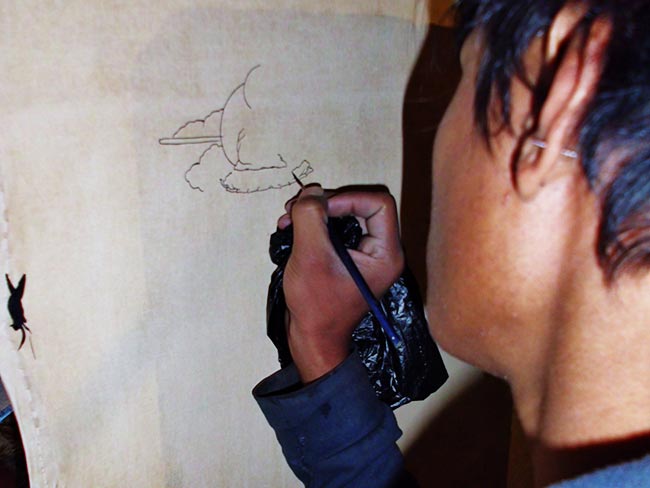
Using a different Thangka, we see how, after mounting, the complete basic pattern of the respective theme is applied to the canvas.
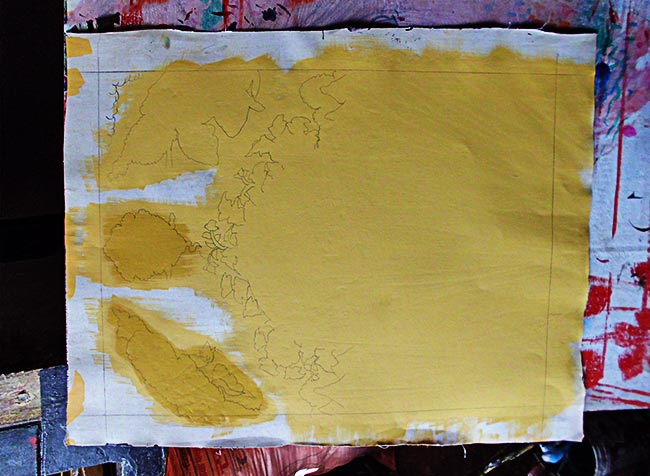
The following picture shows the steps in creating a gold-based Thangka, such as our No PH 9, the "Holy Mount Kailash". To achieve more intensive colour, yet another prime coat, in ochre, is applied, followed by a coat of pure gold. The so-called Thangka painting gold is traditionally produced by members of the Newar people in Nepal. 24-karat gold is ground to finest powder and mixed with bone glue and water in proportions suitable for direct use in painting. Thus, the Thangka gold is not gold leaf at all! Silver can be processed and used in the same way: Mount Kailash and the surrounding peaks in our completed Thangka were not painted with white paint, rather with precious silver.
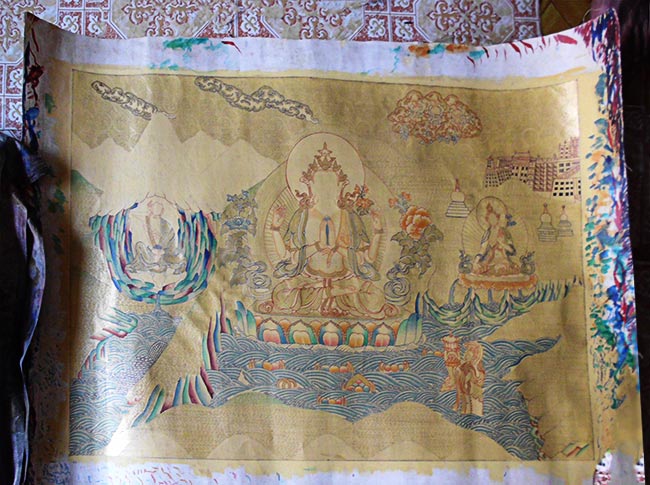
Here, the nearly completed piece has been removed from the wooden frame. Now only the very finest finishing touches remain to be added, such as compacting the gold and giving Mount Kailash its silver mantle.
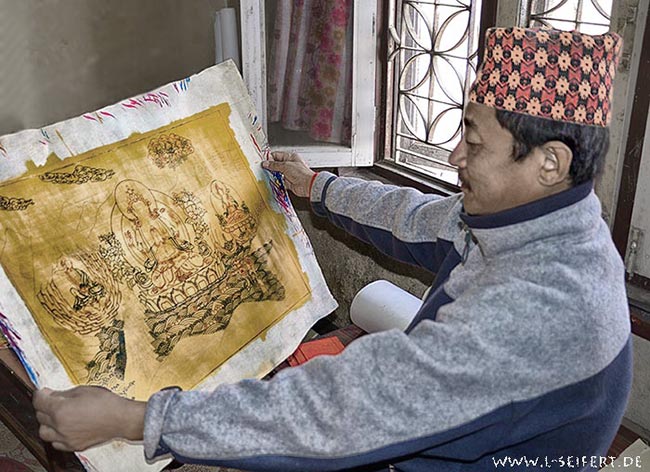
K. Lama regarded his already half-finished thangka proudly
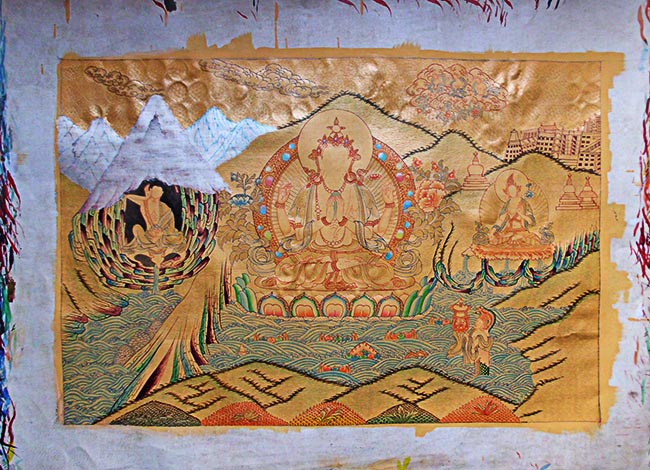
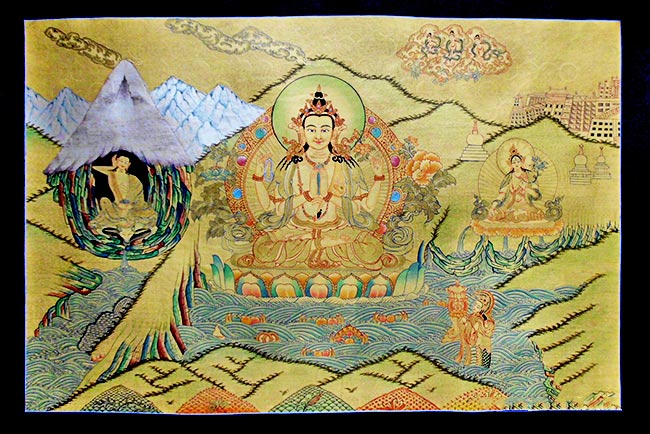
The Mount Kailash Thangka, including the black margin (which can also facilitate the fastening of a traditional brocade frame), is now complete. Only the background gold must be compacted in the places where it is later intended to exhibit a sheen.
Here we see an old ballpoint pen casing into which a specially cut agate has been fitted. The back of this semi-precious stone is slightly concave and can be used to compact gold over extensive areas of the Thangka, while the blunt point is used to lineally compact gold, thus creating a shiny effect.
In this way, through partial compaction of the gold or refraining from compaction, nearly three-dimensional effects can be achieved. The glorious sheen of gold artistically treated in this way richly rewards the beholder or meditator with a Thangka possessed of an extraordinarily aesthetic aura.
Thangka Making Video
Centuries-Old Lost-Wax Metal Casting
Each sculpture at Handmade Handicraft is crafted using the ancient cire-perdue (lost-wax) technique, a craft perfected over a millennium by the Newar artisans of Patan. The process begins with sculpting beeswax and Himalayan tree resin by hand. A multi-layered clay mold is formed around the wax, which is melted away in the furnace, creating a void that is filled with molten red copper or bronze.
24K Mercury Gilding
Applied with pure gold leaf and fused using fire gilding for an ethereal sheen that endures for generations.
Cold-Gold Face Painting
The sacred facial features and serene gaze of deities are carefully rendered with powdered cold gold and natural pigments.
Hand-Chiseled Detailing
Intricate robes, mandalas, and jewels are carved by hand with miniature steel chisels and devotion.
Door-to-Door Worldwide Express Delivery
Since 1976, we have shipped thousands of delicate sacred statues and handicrafts across North America, Europe, Australia, and Asia with an exceptional track record of safe delivery.
-
Express Carriers: We partner with DHL Express, FedEx International, and licensed Air Cargo freighters with end-to-end tracking.
-
Museum-Grade Packaging: Each piece is wrapped in moisture-resistant vapor barriers, thick high-density foam cushioning, and reinforced export cartons or custom wooden crates for large statues.
-
100% Transit Insurance: All international shipments are fully insured against loss or damage during transit.
-
Customs Clearance & Documentation: Includes official Nepal Archaeological Department export clearances certifying modern non-antique artisan status for hassle-free customs clearance.
Related Artisan Masterpieces