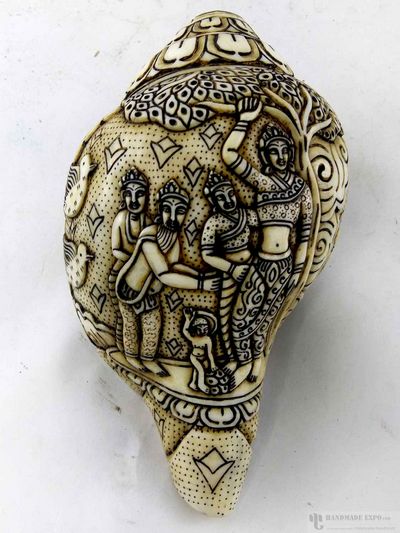
Tibetan Conch Shell with Chenrezig [Hand Carved]
| Dimensions: | 20 cm (7.9 inches) |
| Gross Weight: | 0.8 kg (1.76 lbs) |
| Material: | Conch shell |
| Iconography / Artist: | Conch shell |
| Craft Origin: | Kathmandu Valley, Nepal • Ancient Heritage Technique |
| Cataloged On: | Oct 27, 2020 |
Conch shell
Buddhist monk blowing conch shell at Mindrolling Monastery
In addition to Buddha's throat, the conch also appears as an auspicious mark on the soles, palms, limbs, breast or forehead of a divinely endowed being.
The fourfold caste division is also applied as follows:
The smooth white conch represents the Brahmin caste (priests)
The red conch, the kshatriyas (warriors)
The yellow conch, the vaishyas (merchants)
The grey conch, the shudras (labourers)
Additionally, there is a fundamental classification of conch shells occurring in nature: those that turn to the left and those which turn to the right. Shells which spiral to the right in a clockwise direction are a rarity and are considered especially sacred. The right-spiralling movement of such a conch is believed to echo the celestial motion of the sun, moon, planets and stars across the heavens. The hair whorls on Buddha's head spiral to the right, as do his fine body hairs, the long curl between his eyebrows (urna), and also the conch-like swirl of his navel.
Arjuna's (hero of the Mahabharata) mighty conch was known as Devadatta, whose triumphant blast brought terror to the enemy. As a proclaiming battle horn, the conch is akin to the bugle. It is an emblem of power, authority and sovereignty whose blast is believed to banish evil spirits, avert natural disasters, and scare away poisonous creatures.
Today, in its greatly tamed avatar, the conch is used in Tibetan Buddhism to call together religious assemblies. During the actual practise of rituals, it is used both as a musical instrument and as a container for holy water.
Ancient Indian belief classifies the conch into male and female varieties. The thicker-shelled bulbous one is thought to be the male (purusha), and the thin-shelled slender conch to be the female (shankhini).
Centuries-Old Lost-Wax Metal Casting
Each sculpture at Handmade Handicraft is crafted using the ancient cire-perdue (lost-wax) technique, a craft perfected over a millennium by the Newar artisans of Patan. The process begins with sculpting beeswax and Himalayan tree resin by hand. A multi-layered clay mold is formed around the wax, which is melted away in the furnace, creating a void that is filled with molten red copper or bronze.
24K Mercury Gilding
Applied with pure gold leaf and fused using fire gilding for an ethereal sheen that endures for generations.
Cold-Gold Face Painting
The sacred facial features and serene gaze of deities are carefully rendered with powdered cold gold and natural pigments.
Hand-Chiseled Detailing
Intricate robes, mandalas, and jewels are carved by hand with miniature steel chisels and devotion.
Door-to-Door Worldwide Express Delivery
Since 1976, we have shipped thousands of delicate sacred statues and handicrafts across North America, Europe, Australia, and Asia with an exceptional track record of safe delivery.
-
Express Carriers: We partner with DHL Express, FedEx International, and licensed Air Cargo freighters with end-to-end tracking.
-
Museum-Grade Packaging: Each piece is wrapped in moisture-resistant vapor barriers, thick high-density foam cushioning, and reinforced export cartons or custom wooden crates for large statues.
-
100% Transit Insurance: All international shipments are fully insured against loss or damage during transit.
-
Customs Clearance & Documentation: Includes official Nepal Archaeological Department export clearances certifying modern non-antique artisan status for hassle-free customs clearance.
Related Artisan Masterpieces