

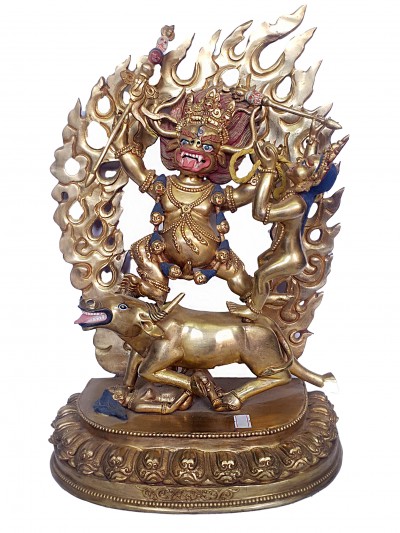


[HQ], Statue of Yamantaka - Heruka with consort, [Shakti], Yab-Yum, [full Gold Plated]
| Dimensions: | 37x24x12 cm (14.6 × 9.4 × 4.7 inches) |
| Gross Weight: | 5.3 kg (11.68 lbs) |
| Material: | Copper and Gold |
| Iconography / Artist: | Yamantaka |
| Craft Origin: | Kathmandu Valley, Nepal • Ancient Heritage Technique |
| Cataloged On: | Dec 25, 2020 |
Yamantaka
Mantra of Yamantaka
OM AH RA PA TSA NA DHIH
His sister Yami holds a skullcap [Skt. Kapala] held at his heart in his right hand hold red rejuvenating blood of Great Bliss called Raktavarna[skt.] representing 'wisdom'. The white breast ornament represents the wheel of life [Skt. Jivan Chakra] Jivan is a Sanskrit word meaning soul. Chakra means wheel. The wheel of Life is often called the Bhavacakra. Bhava means container or receptacle in the sense of body or form. The degree of wrath & and tantric power a deity has is often measured by the quantity of flame in the aureole of flame surrounding body. Yama is surrounded by a Fire Wheel [Tib. Me-Khor] which represents his ability to annihilate anything or anyone that crosses his path, but especially the obscuration to pure conscious enlightenment of which ignorance is considered the chief poison. The fire wheel radiate as pure psychic energy whose potency is alluded to in Yama's erect penis. Nothing can withstand Yama's fire wheel. In the foreground there are the Three Skull Offerings which represent the items necessary for rebirth. The left & right skulls are traditionally mounted on three smaller skulls. The left blue blood represents semen & the right red blood fertile uterine blood with the central skull contains the offering of the five senses representing the consciousness. The five senses are 1. the heart representing touch, 2. the eyes - sight, 3. tongue - taste, 4. nose - smell & 5. ears - sound. The attached hair indicates its freshness. The offering of the five senses is key to Yama's purpose; the offering is about rebirth the beginning of something new life.
Centuries-Old Lost-Wax Metal Casting
Each sculpture at Handmade Handicraft is crafted using the ancient cire-perdue (lost-wax) technique, a craft perfected over a millennium by the Newar artisans of Patan. The process begins with sculpting beeswax and Himalayan tree resin by hand. A multi-layered clay mold is formed around the wax, which is melted away in the furnace, creating a void that is filled with molten red copper or bronze.
24K Mercury Gilding
Applied with pure gold leaf and fused using fire gilding for an ethereal sheen that endures for generations.
Cold-Gold Face Painting
The sacred facial features and serene gaze of deities are carefully rendered with powdered cold gold and natural pigments.
Hand-Chiseled Detailing
Intricate robes, mandalas, and jewels are carved by hand with miniature steel chisels and devotion.
Door-to-Door Worldwide Express Delivery
Since 1976, we have shipped thousands of delicate sacred statues and handicrafts across North America, Europe, Australia, and Asia with an exceptional track record of safe delivery.
-
Express Carriers: We partner with DHL Express, FedEx International, and licensed Air Cargo freighters with end-to-end tracking.
-
Museum-Grade Packaging: Each piece is wrapped in moisture-resistant vapor barriers, thick high-density foam cushioning, and reinforced export cartons or custom wooden crates for large statues.
-
100% Transit Insurance: All international shipments are fully insured against loss or damage during transit.
-
Customs Clearance & Documentation: Includes official Nepal Archaeological Department export clearances certifying modern non-antique artisan status for hassle-free customs clearance.
Related Artisan Masterpieces


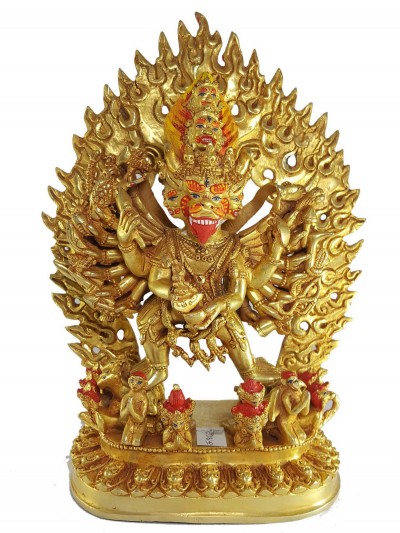
Tibetan Statue of Yamantaka - Heruka Vajrabhairava, [Full Gold Plated], [Painted Face]
