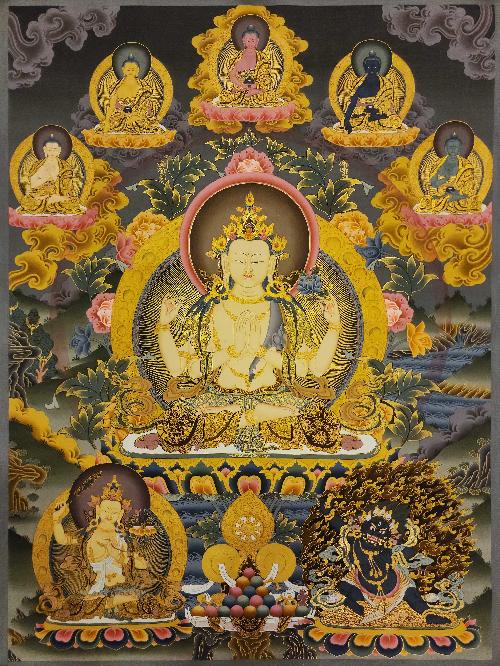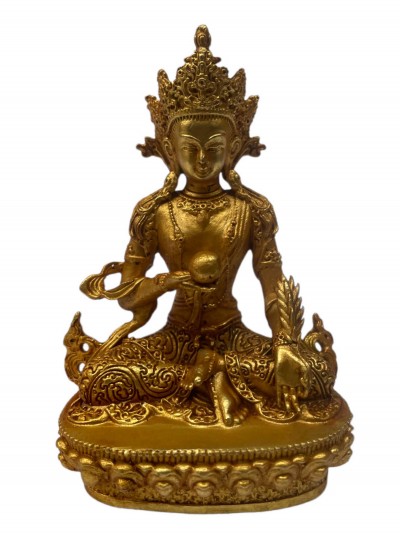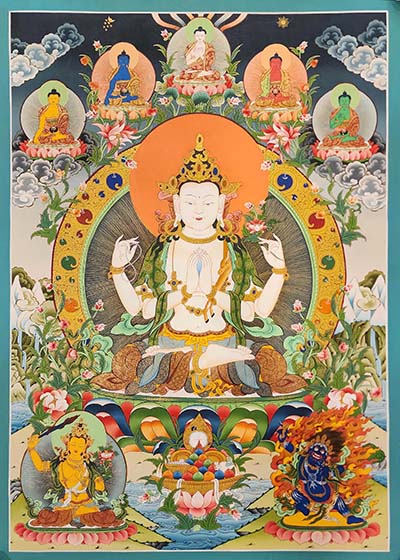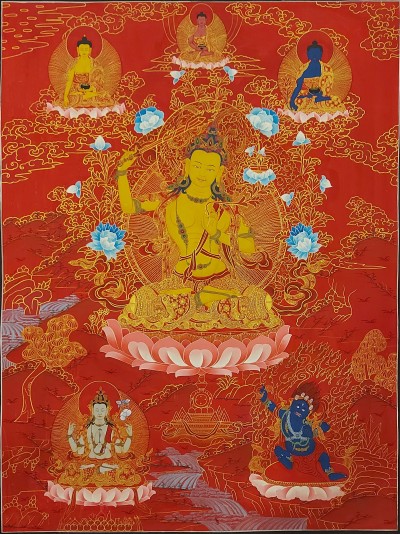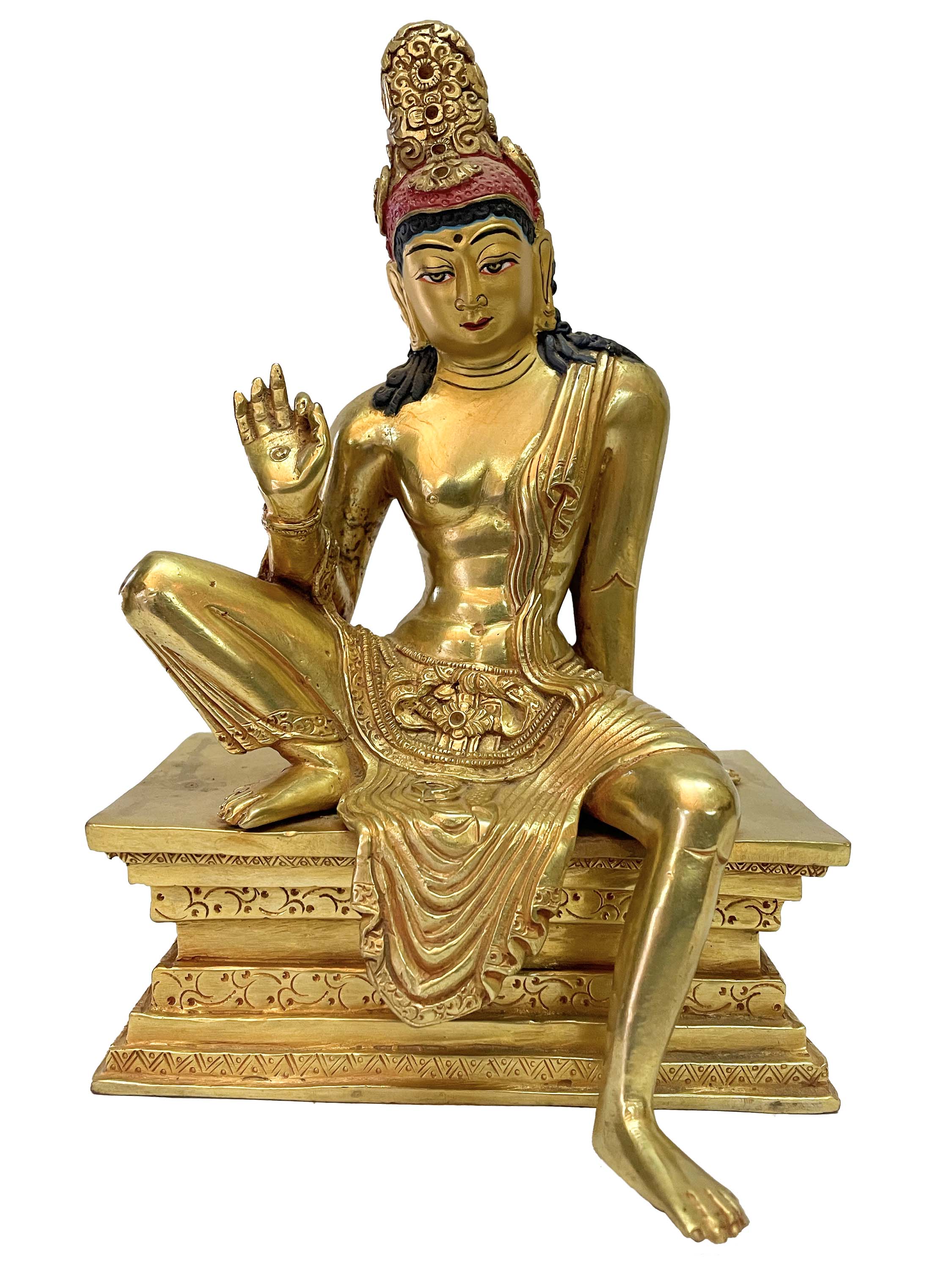
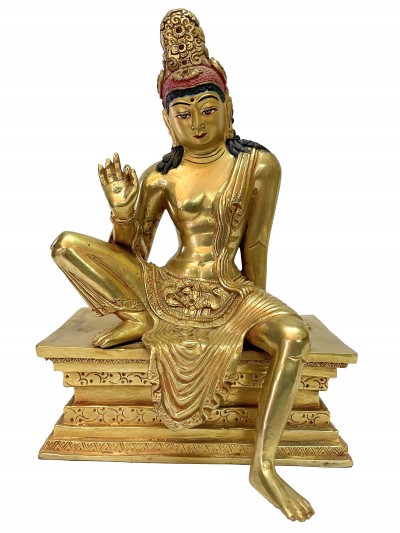
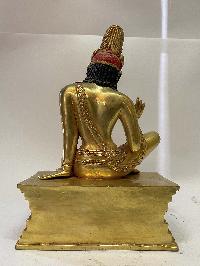
Nepali Handmade Statue Of Bodhisattva, [Fire Gold Plated]
| Dimensions: | 22x14x12 cm (8.7 × 5.5 × 4.7 inches) |
| Gross Weight: | 1.6 kg (3.53 lbs) |
| Material: | Copper Gold Plated |
| Iconography / Artist: | Bodhisattva |
| Craft Origin: | Kathmandu Valley, Nepal • Ancient Heritage Technique |
| Cataloged On: | Jan 08, 2021 |
Bodhisattva
Bodhisattvas are usually depicted as less austere or inward than the Buddha. Renouncing their own salvation and immediate entrance into nirvana, they devote all their power and energy to saving suffering beings in this world. As the deity of compassion, Bodhisattvas are typically represented with precious jewelry, elegant garments and graceful postures.
Ariyapariyesana Sutta
While Maitreya is mentioned in the Pāli canon, he is not referred to as a bodhisattva, but simply the next fully awakened Buddha to come into existence long after the current teachings of the Buddha are lost.
In later Theravāda literature, the term "bodhisatta" is used fairly frequently in the sense of someone on the path to liberation. The later tradition of commentary also recognizes the existence of two additional types of bodhisattas: the paccekabodhisatta who will attain Paccekabuddhahood, and the savakabodhisatta who will attain enlightenment as a disciple of a Buddha. According to the Theravāda teacher Bhikkhu Bodhi the bodhisattva path was not taught by Buddha
Mahāyāna Buddhism is based principally upon the path of a bodhisattva. The term Mahāyāna was originally synonym for Bodhisattvayāna, or the "Bodhisattva Vehicle."The holly book of Mahayana contains a simple and brief definition for the term bodhisattva, which is also the earliest known Mahāyāna definition. This definition is given as the following.
"Because he has enlightenment as his aim, a bodhisattva-mahāsattva is so called."
Mahāyāna Buddhism encourages everyone to become bodhisattvas and to take the bodhisattva vows. With these vows, one makes the promise to work for the complete enlightenment of all sentient beings by practicing the six perfections. Indelibly entwined with the bodhisattva vow is merit transference
In Mahāyāna Buddhism life in this world is compared to people living in a house that is on fire. People take this world as reality pursuing worldly projects and pleasures without realizing that the house is on fire and will soon burn down (due to the inevitability of death). A bodhisattva is one who has a determination to free sentient beings from universe and its cycle of death, rebirth and suffering. This type of mind is known as the mind of awakening (bodhicitta). Bodhisattvas take bodhisattva vows in order to progress on the spiritual path towards buddhahood.
There are a variety of different conceptions of the nature of a bodhisattva in Mahāyāna. According to some Mahāyāna sources a bodhisattva is someone on the path to full Buddhahood. Others speak of bodhisattvas renouncing Buddhahood.
A bodhisattva can choose any of three paths to help sentient beings in the process of achieving buddhahood. They are:
king-like bodhisattva - one who aspires to become buddha as soon as possible and then help sentient beings in full fledge;
boatman-like bodhisattva - one who aspires to achieve buddhahood along with other sentient beings and
shepherd-like bodhisattva - one who aspires to delay buddhahood until all other sentient beings achieve buddhahood. Bodhisattvas like Avalokiteśvara and Śāntideva are believed to fall in this category.
Great Joy: It is said that being close to enlightenment and seeing the benefit for all sentient beings, one achieves great joy, hence the name. In this bhūmi the bodhisattvas practice all perfections (pāramitās), but especially emphasizing generosity .
Stainless: In accomplishing the second bhūmi, the bodhisattva is free from the stains of immorality, therefore, this bhūmi is named "stainless". The emphasized perfection is moral discipline.
Luminous: The third ground is named "luminous", because, for a bodhisattva who accomplishes this bhūmi, the light of Dharma is said to radiate for others from the bodhisattva. The emphasized perfection is patience .
Radiant: This ground is called "radiant", because it is said to be like a radiating light that fully burns that which opposes enlightenment. The emphasized perfection is vigor.
Very difficult to train: Bodhisattvas who attain this bhūmi strive to help sentient beings attain maturity, and do not become emotionally involved when such beings respond negatively, both of which are difficult to do. The emphasized perfection is meditative concentration.
Obviously Transcendent: By depending on the perfection of wisdom, [the bodhisattva] does not abide in either saṃsāra or nirvāṇa, so this state is "obviously transcendent". The emphasized perfection is wisdom.
Gone afar: Particular emphasis is on the perfection of skillful means (upāya), to help others.
Immovable: The emphasized virtue is aspiration. This, the "immovable" bhūmi, is the bhūmi at which one becomes able to choose his place of rebirth.
Good Discriminating Wisdom: The emphasized virtue is power.
Cloud of Dharma: The emphasized virtue is the practice of primordial wisdom.
Centuries-Old Lost-Wax Metal Casting
Each sculpture at Handmade Handicraft is crafted using the ancient cire-perdue (lost-wax) technique, a craft perfected over a millennium by the Newar artisans of Patan. The process begins with sculpting beeswax and Himalayan tree resin by hand. A multi-layered clay mold is formed around the wax, which is melted away in the furnace, creating a void that is filled with molten red copper or bronze.
24K Mercury Gilding
Applied with pure gold leaf and fused using fire gilding for an ethereal sheen that endures for generations.
Cold-Gold Face Painting
The sacred facial features and serene gaze of deities are carefully rendered with powdered cold gold and natural pigments.
Hand-Chiseled Detailing
Intricate robes, mandalas, and jewels are carved by hand with miniature steel chisels and devotion.
Door-to-Door Worldwide Express Delivery
Since 1976, we have shipped thousands of delicate sacred statues and handicrafts across North America, Europe, Australia, and Asia with an exceptional track record of safe delivery.
-
Express Carriers: We partner with DHL Express, FedEx International, and licensed Air Cargo freighters with end-to-end tracking.
-
Museum-Grade Packaging: Each piece is wrapped in moisture-resistant vapor barriers, thick high-density foam cushioning, and reinforced export cartons or custom wooden crates for large statues.
-
100% Transit Insurance: All international shipments are fully insured against loss or damage during transit.
-
Customs Clearance & Documentation: Includes official Nepal Archaeological Department export clearances certifying modern non-antique artisan status for hassle-free customs clearance.
Related Artisan Masterpieces