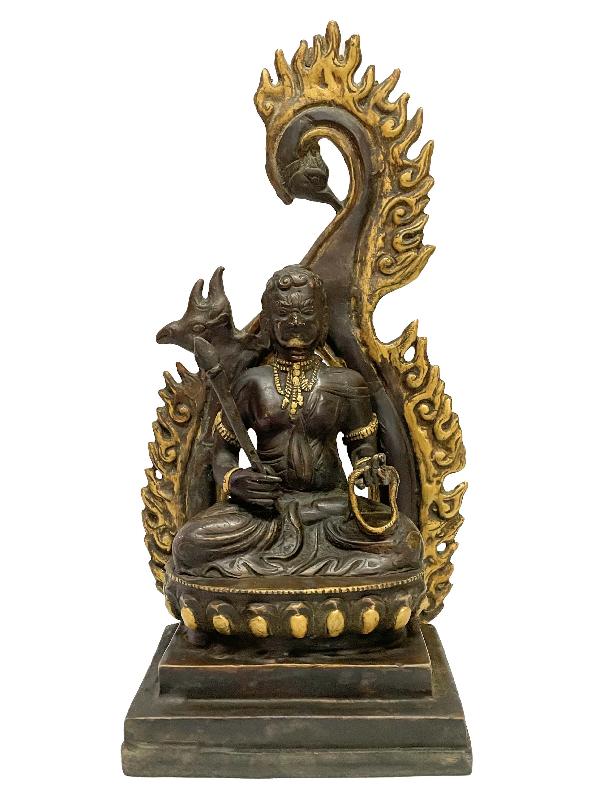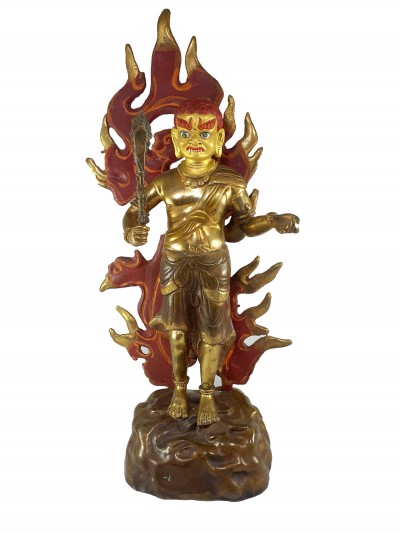


Buddhist Statue of Achala Yamaraj [Partly Gold Plated], [Painted Face]
| Dimensions: | 38x4x4 cm (15 × 1.6 × 1.6 inches) |
| Gross Weight: | 3 kg (6.61 lbs) |
| Material: | Copper |
| Iconography / Artist: | Achala |
| Craft Origin: | Kathmandu Valley, Nepal • Ancient Heritage Technique |
| Cataloged On: | Mar 19, 2021 |
Achala

Wooden sculpture of Acala. Japan, late Heian Period, 12th century

Wooden sculpture of Acala. Japan, late Heian Period, 12th century

Acala at Buddha Tooth Relic Temple and Museum, Singapore

Statue of Acala, from 12th century Japan. Currently in Rietberg Museum (Zürich,Switzerland)
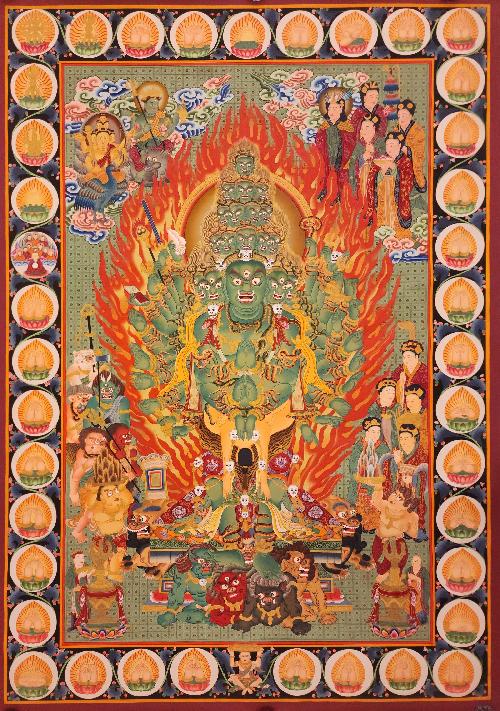
The deity has been popular throughout the Middle Ages and into modern times in Nepal, Tibet, and Japan, where sculptural and pictorial representations of him are most often found. Much of the iconography comes from Japan.
In Tibetan Buddhism and art, the Buddha Akshobhya, whose name also means "the immovable one", presides over the clan of deities to which Ācala belongs. Other sources refer to the Acala and Caṇḍaroṣaṇa as an "emanation" of Akshobhya
He evolves into a deity invoked in Buddhist rituals to "frighten gods, titans, men and destroy the strength of demons", and he slays all ghosts and evil spirits. In some Buddhist texts such as the Sādhanamālā, the Hindu gods Vishnu, Shiva, Brahma, and Kandarpa (god of love) are said to be "wicked" because they cause endless rebirth, and these gods are terrified of Acala because he carries a rope to bind them. In other texts, such as the Mahāvairocana Sūtra, one dedicated to the Buddha is instructed to visualize the left foot of Acala on his head during meditation, to prevent obstacles in his reaching Prajñā .
In the Nepalese and Tibetan Buddhist traditions, Viśvavajrī becomes Acala's consort.
Centuries-Old Lost-Wax Metal Casting
Each sculpture at Handmade Handicraft is crafted using the ancient cire-perdue (lost-wax) technique, a craft perfected over a millennium by the Newar artisans of Patan. The process begins with sculpting beeswax and Himalayan tree resin by hand. A multi-layered clay mold is formed around the wax, which is melted away in the furnace, creating a void that is filled with molten red copper or bronze.
24K Mercury Gilding
Applied with pure gold leaf and fused using fire gilding for an ethereal sheen that endures for generations.
Cold-Gold Face Painting
The sacred facial features and serene gaze of deities are carefully rendered with powdered cold gold and natural pigments.
Hand-Chiseled Detailing
Intricate robes, mandalas, and jewels are carved by hand with miniature steel chisels and devotion.
Door-to-Door Worldwide Express Delivery
Since 1976, we have shipped thousands of delicate sacred statues and handicrafts across North America, Europe, Australia, and Asia with an exceptional track record of safe delivery.
-
Express Carriers: We partner with DHL Express, FedEx International, and licensed Air Cargo freighters with end-to-end tracking.
-
Museum-Grade Packaging: Each piece is wrapped in moisture-resistant vapor barriers, thick high-density foam cushioning, and reinforced export cartons or custom wooden crates for large statues.
-
100% Transit Insurance: All international shipments are fully insured against loss or damage during transit.
-
Customs Clearance & Documentation: Includes official Nepal Archaeological Department export clearances certifying modern non-antique artisan status for hassle-free customs clearance.
Related Artisan Masterpieces