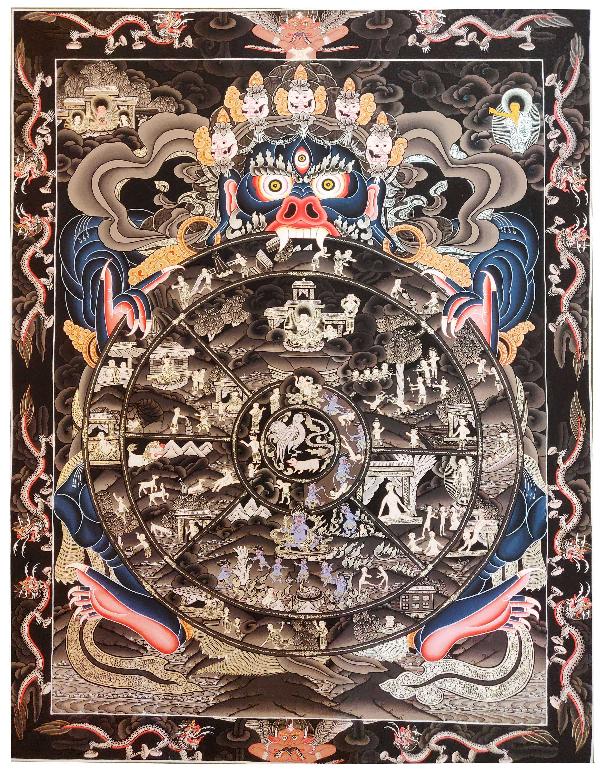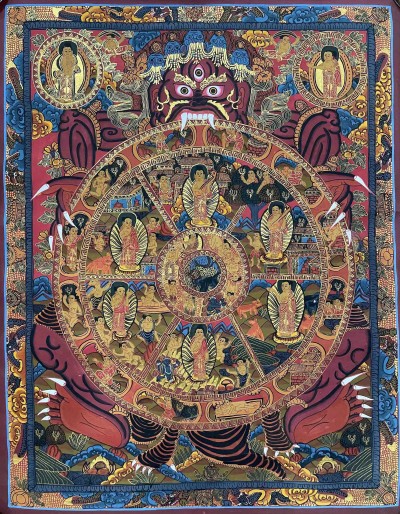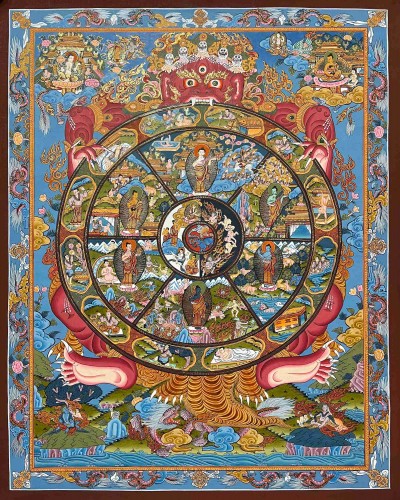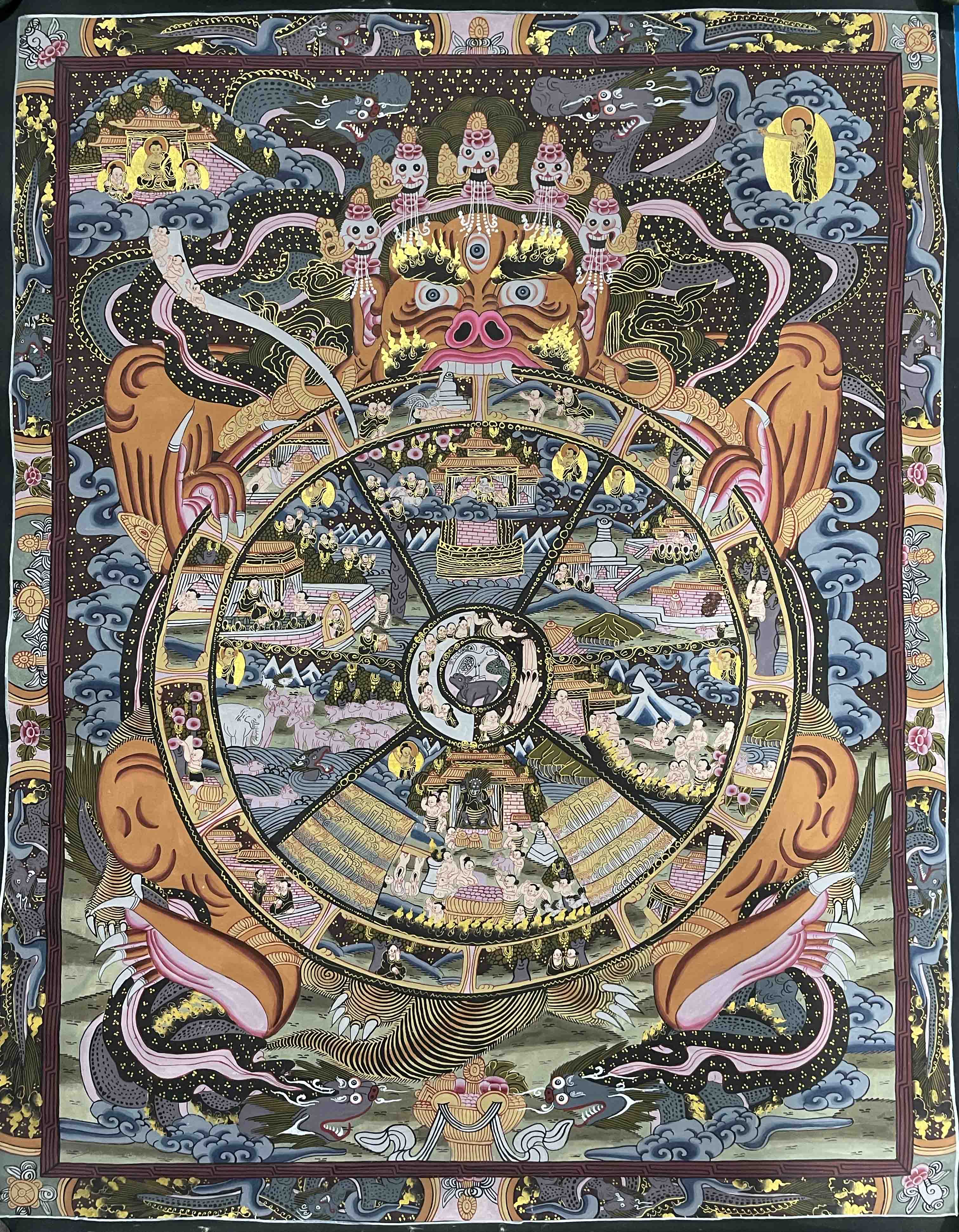
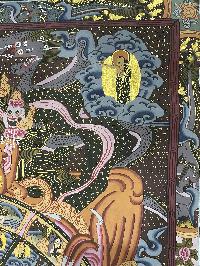
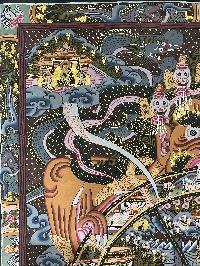
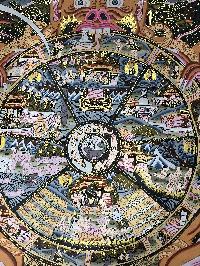
Buddhist Handmade Thangka of Wheel Of Life Thangka
| Dimensions: | 71x59 cm (28 × 23.2 inches) |
| Gross Weight: | 0.1 kg (0.22 lbs) |
| Material: | Cotton Canvas & Natural Color |
| Iconography / Artist: | Wheel of Life |
| Craft Origin: | Kathmandu Valley, Nepal • Ancient Heritage Technique |
| Cataloged On: | Jul 13, 2021 |
Wheel of Life
Second Layer Karma
The second layer of the wheel shows two-half circles:
One half-circle (usually light) shows contented people moving upwards to higher states, possibly to the higher realms.
The other half-circle (usually dark) shows people in a miserable state being led downwards to lower states, possibly to the lower realms.
These images represent karma, the law of cause and effect. The light half-circle indicates people experiencing the results of positive actions. The dark half-circle indicates people experiencing the results of negative actions.
God realm:the gods lead long and enjoyable lives full of pleasure and abundance, but they spend their lives pursuing meaningless distractions and never think to practice the dharma. When death comes to them, they are completely unprepared; without realizing it, they have completely exhausted their good karma (which was the cause for being reborn in the god realm) and they suffer through being reborn in the lower realms
Demi-god realm:the demi-gods have pleasure and abundance almost as much as the gods, but they spend their time fighting among themselves or making war on the gods. When they make war on the gods, they always lose, since the gods are much more powerful. The demi-gods suffer from constant fighting and jealousy, and from being killed and wounded in their wars with each other and with the gods.
Human realm: humans suffer from hunger, thirst, heat, cold, separation from friends, being attacked by enemies, not getting what they want, and getting what they don't want. They also suffer from the general sufferings of birth, old age, sickness and death. Yet the human realm is considered to be the most suitable realm for practicing the dharma, because humans are not completely distracted by pleasure (like the gods or demi-gods) or by pain and suffering (like the beings in the lower realms).
The three lower realms are:
Animal realm: wild animals suffer from being attacked and eaten by other animals; they generally lead lives of constant fear. Domestic animals suffer from being exploited by humans; for example, they are slaughtered for food, overworked, and so on.
Hungry ghost realm: hungry ghosts suffer from extreme hunger and thirst. They wander constantly in search of food and drink, only to be miserably frustrated any time them come close to actually getting what they want. For example, they see a stream of pure, clear water in the distance, but by the time the get there the stream has dried up. Hungry ghosts have huge bellies and long thin necks. On the rare occasions that they do manage to find something to eat or drink, the food or water burns their neck as it goes down to their belly, causing them intense agony.
Hell realm: hell beings endure unimaginable suffering for eons of time. There are actually eighteen different types of hells, each inflicting a different kind of torment. In the hot hells, beings suffer from unbearable heat and continual torments of various kinds. In the cold hells, beings suffer from unbearable cold and other torments.
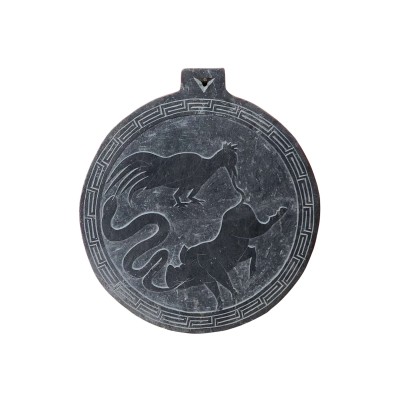
Generally speaking, each realm is said to be the result of one of the six main negative emotions: pride, jealousy, desire, ignorance, greed, and anger. Dzongsar Khyentse states:
So we have six realms. Loosely, you can say when the perception comes more from aggression, you experience things in a hellish way. When your perception is filtered through attachment, grasping or miserliness, you experience the hungry ghost realm. When your perception is filtered through ignorance, then you experience the animal realm. When you have a lot of pride, you are reborn in the god realm. When you have jealousy, you are reborn in the asura (demi-god) realm. When you have a lot of passion, you are reborn in the human realm. Among the six realms, the human realm is considered to offer the best opportunity to practice the dharma. Dzongsar Khyentse states:
If we need to judge the value of these six realms, the Buddhists would say the best realm is the human realm. Why is this the best realm? Because you have a choice... The gods don't have a choice. Why? They're too happy. When you are too happy you have no choice. You become arrogant. The hell realm: no choice, too painful. The human realm: not too happy and also not too painful. When you are not so happy and not in so much pain, what does that mean? A step closer to the normality of mind, remember? When you are really, really excited and in ecstasy, there is no normality of mind. And when you are totally in pain, you don't experience normality of mind either. So someone in the human realm has the best chance of acquiring that normality of mind. And this is why in Buddhist prayers you will always read: ideally may we get out of this place, but if we can't do it within this life, may we be reborn in the human realm, not the others.
Sometimes, the wheel is represented as only having five realms because the God realm and the Demi-god realm are combined into a single realm.
In some representations of the wheel, there is a buddha or bodhisattva depicted within each realm, trying to help sentient beings find their way to nirvana.
Centuries-Old Lost-Wax Metal Casting
Each sculpture at Handmade Handicraft is crafted using the ancient cire-perdue (lost-wax) technique, a craft perfected over a millennium by the Newar artisans of Patan. The process begins with sculpting beeswax and Himalayan tree resin by hand. A multi-layered clay mold is formed around the wax, which is melted away in the furnace, creating a void that is filled with molten red copper or bronze.
24K Mercury Gilding
Applied with pure gold leaf and fused using fire gilding for an ethereal sheen that endures for generations.
Cold-Gold Face Painting
The sacred facial features and serene gaze of deities are carefully rendered with powdered cold gold and natural pigments.
Hand-Chiseled Detailing
Intricate robes, mandalas, and jewels are carved by hand with miniature steel chisels and devotion.
Door-to-Door Worldwide Express Delivery
Since 1976, we have shipped thousands of delicate sacred statues and handicrafts across North America, Europe, Australia, and Asia with an exceptional track record of safe delivery.
-
Express Carriers: We partner with DHL Express, FedEx International, and licensed Air Cargo freighters with end-to-end tracking.
-
Museum-Grade Packaging: Each piece is wrapped in moisture-resistant vapor barriers, thick high-density foam cushioning, and reinforced export cartons or custom wooden crates for large statues.
-
100% Transit Insurance: All international shipments are fully insured against loss or damage during transit.
-
Customs Clearance & Documentation: Includes official Nepal Archaeological Department export clearances certifying modern non-antique artisan status for hassle-free customs clearance.
Related Artisan Masterpieces