


Buddhist Thangka of Padmasambhava Thangka, [With Brocade and Oil Painting], Lama`s Art
| Dimensions: | 110x83 cm (43.3 × 32.7 inches) |
| Gross Weight: | 0.5 kg (1.1 lbs) |
| Material: | Cotton Canvas & Natural Color |
| Iconography / Artist: | Padmasambhava |
| Craft Origin: | Kathmandu Valley, Nepal • Ancient Heritage Technique |
| Cataloged On: | Jul 21, 2021 |
Padmasambhava
Mantra of Padmasambhava
(Om Ah Hum Vajra Guru Padma Siddhi Hum)
His two eyes are wide open in a piercing gaze. On his body he wears a white vajra undergarment and, on top of this, in layers, a red robe, a dark blue mantrayana tunic, a red monastic shawl decorated with a golden flower pattern, and a maroon cloak of silk brocade. He has one face and two hands.
In his right hand, he holds a five-pronged vajra at his heart; and in his left, which rests in the gesture of equanimity, he holds a skull-cup in the centre of which is a vase of longevity filled with the nectar of deathless wisdom. Cradled in his left arm is a three-pointed khatvanga representing the consort Mandarava. On his head, he wears a five-petalled lotus hat. Wrathful and smiling, he blazes magnificently with the splendour of the major and minor marks. He is seated with his two feet in the royal posture.
His fame became known to Trisong Detsen, the 38th king of the Yarlung dynasty, and the first Emperor of Tibet (742–797), whose kingdom was beset by evil mountain deities. The king invited Padmasambhava to Tibet where he used his tantric powers to subdue the evil deities he encountered along the way, eventually receiving the Emperor's wife, identified with the dakini Yeshe Tsogyal, as a consort. This was in accordance with the tantric principle of not eliminating negative forces but redirecting them to fuel the journey toward spiritual awakening. In Tibet he founded the first monastery in the country, Samye Gompa, initiated the first monks, and introduced the people to the practice of Tantric Buddhism.
Padmasambhava had five major female tantric companions, the so-called 'Five Wisdom Dakinis' (Wylie: Ye-shes mKha-'gro lnga) or 'Five Consorts.' In Padmasambhava's biography - they are described as the five women "who had access to the master's heart", and practiced tantric rites which are considered to have exorcised the previous demons of Tibet and converted them into protectors of the country.' They were: Mandarava of Zahor - the emanation of Vajravarahi's Body; Belwong Kalasiddhi of (North-West) India - the emanation of Vajravarahi's Quality, Belmo Sakya Devi of Nepal; the emanation of Vajravarahi's Mind, Yeshe Tsogyal of Tibet; the emanation of Vajravarahi's Speech and Mangala or Tashi Kyedren of "the Himalayas" - the emanation of Vajravarahi's Activity.
In Bhutan he is associated with the famous Paro Taktsang or "Tiger's Nest" monastery built on a sheer cliff wall about 500m above the floor of Paro valley. It was built around the Taktsang Senge Samdup (stag tshang seng ge bsam grub) cave where he is said to have meditated in the 8th Century. He flew there from Tibet on the back of Yeshe Tsogyal, whom he transformed into a flying tigress for the purpose of the trip. Later he travelled to Bumthang district to subdue a powerful deity offended by a local king. Padmasambhava's body imprint can be found in the wall of a cave at nearby Kurje Lhakhang temple.
Padmasambhava also hid a number of religious treasures (termas) in lakes, caves, fields and forests of the Himalayan region to be found and interpreted by future tertöns or spiritual treasure-finders. According to Tibetan tradition, the Bardo Thodol (commonly referred to as the Tibetan Book of the Dead) was among these hidden treasures, subsequently discovered by a Tibetan terton, Karma Lingpa.
Tantric cycles related to Padmasambhava are not just practiced by the Nyingma, they even gave rise to a new offshoot of Bön which emerged in the 14th century called the New Bön. Prominent figures of the Sarma (new translation) schools such as the Karmapas and Sakya lineage heads have practiced these cycles and taught them. Some of the greatest tertons revealing teachings related to Padmasambhava have been from the Kagyu or Sakya lineages. The hidden lake temple of the Dalai Lamas behind the Potala called Lukhang is dedicated to Dzogchen teachings and has murals depicting the eight manifestations of Padmasambhava. Padmasambhava established Vajrayana Buddhism and the highest forms of Dzogchen (Mengagde) in Tibet and transformed the entire nation.
On Padmasambhava's consort practice with Princess Sakya Devi from Nepal it is said: "In a state of intense bliss, Padmasambhava and Sakyadevi realized the infinite reality of the Primordial Buddha Mind, the All-Beneficent Lord (Samantabhadra), whose absolute love is the unimpeded dynamo of existence. Experiencing the succession of the four stages of ecstasy, their mutual state of consciousness increased from height to height. And thus, meditating on Supreme Vajrasattva Heruka as the translucent image of compassionate wrathful (energized) activity, they together acquired the mahamudra of Divinity and attained complete Great Enlightenmen
Centuries-Old Lost-Wax Metal Casting
Each sculpture at Handmade Handicraft is crafted using the ancient cire-perdue (lost-wax) technique, a craft perfected over a millennium by the Newar artisans of Patan. The process begins with sculpting beeswax and Himalayan tree resin by hand. A multi-layered clay mold is formed around the wax, which is melted away in the furnace, creating a void that is filled with molten red copper or bronze.
24K Mercury Gilding
Applied with pure gold leaf and fused using fire gilding for an ethereal sheen that endures for generations.
Cold-Gold Face Painting
The sacred facial features and serene gaze of deities are carefully rendered with powdered cold gold and natural pigments.
Hand-Chiseled Detailing
Intricate robes, mandalas, and jewels are carved by hand with miniature steel chisels and devotion.
Door-to-Door Worldwide Express Delivery
Since 1976, we have shipped thousands of delicate sacred statues and handicrafts across North America, Europe, Australia, and Asia with an exceptional track record of safe delivery.
-
Express Carriers: We partner with DHL Express, FedEx International, and licensed Air Cargo freighters with end-to-end tracking.
-
Museum-Grade Packaging: Each piece is wrapped in moisture-resistant vapor barriers, thick high-density foam cushioning, and reinforced export cartons or custom wooden crates for large statues.
-
100% Transit Insurance: All international shipments are fully insured against loss or damage during transit.
-
Customs Clearance & Documentation: Includes official Nepal Archaeological Department export clearances certifying modern non-antique artisan status for hassle-free customs clearance.
Related Artisan Masterpieces

Padmasambhava Buddhist Handmade Statue, Full Gold Plated, Face Painted, High Quality
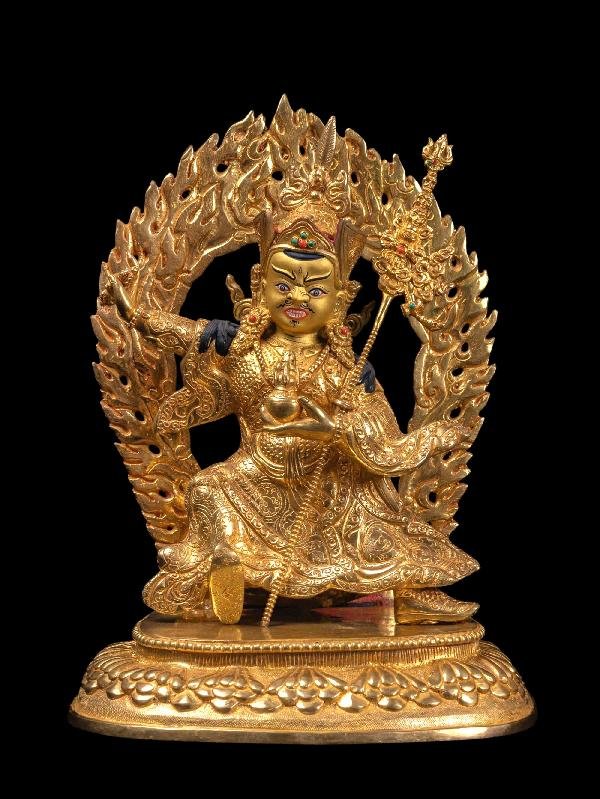
[Padmasambhava] Handmade Nepali Buddhist Statue, [Full Gold Plated], [Hand Painted Face]

