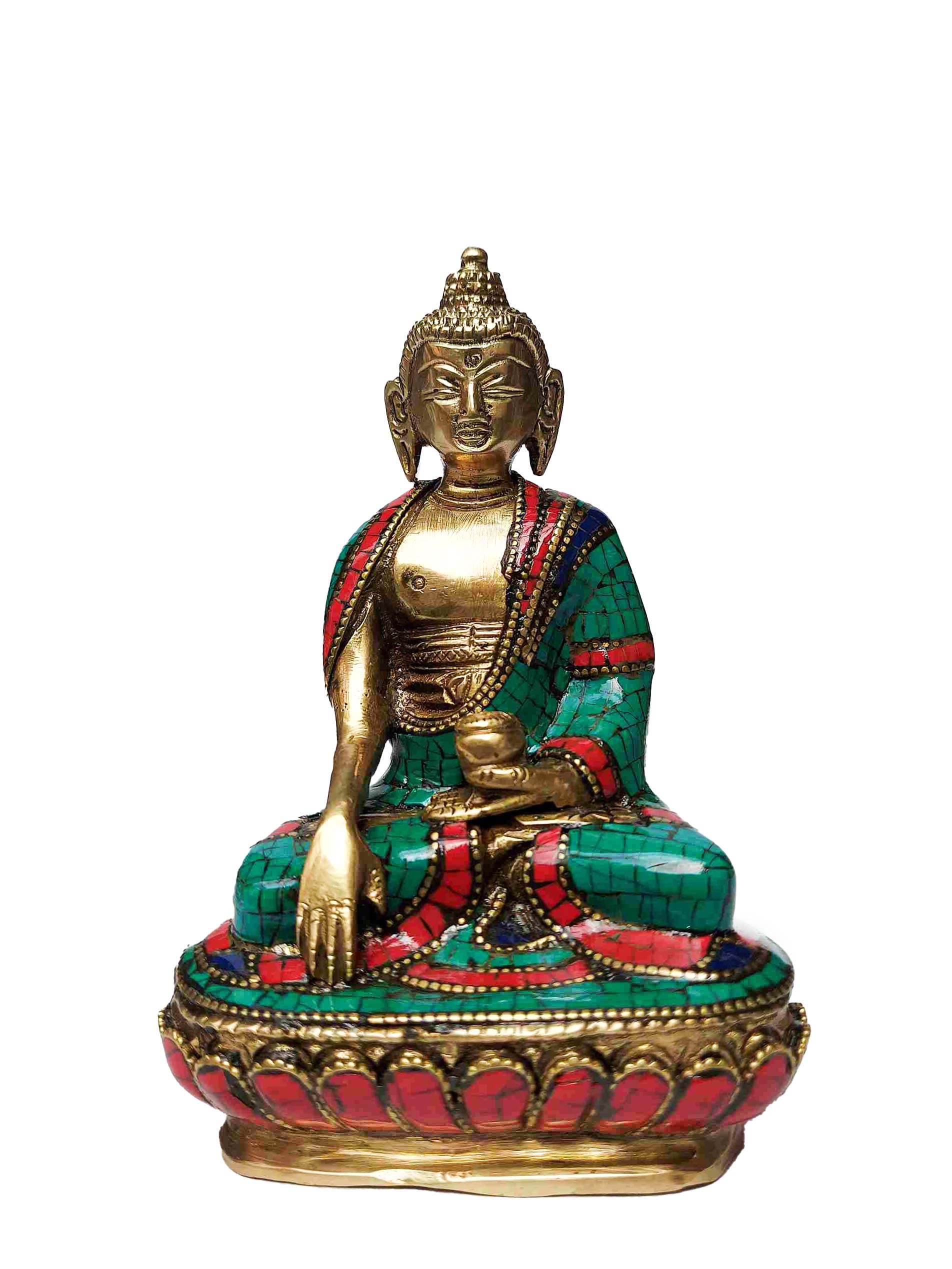
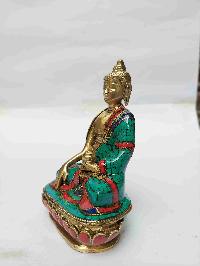
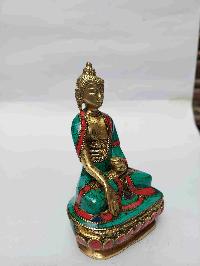
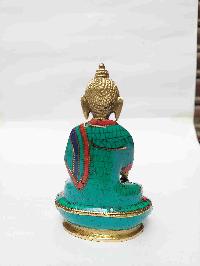
Buddhist Miniature Statue Of Shakyamuni Buddha, [Stone Setting]
| Dimensions: | 14x9x6 cm (5.5 × 3.5 × 2.4 inches) |
| Gross Weight: | 0.73 kg (1.61 lbs) |
| Material: | Copper |
| Iconography / Artist: | Shakyamuni Buddha |
| Craft Origin: | Kathmandu Valley, Nepal • Ancient Heritage Technique |
| Cataloged On: | Aug 05, 2022 |
Shakyamuni Buddha
Mantra of Shakyamuni buddha
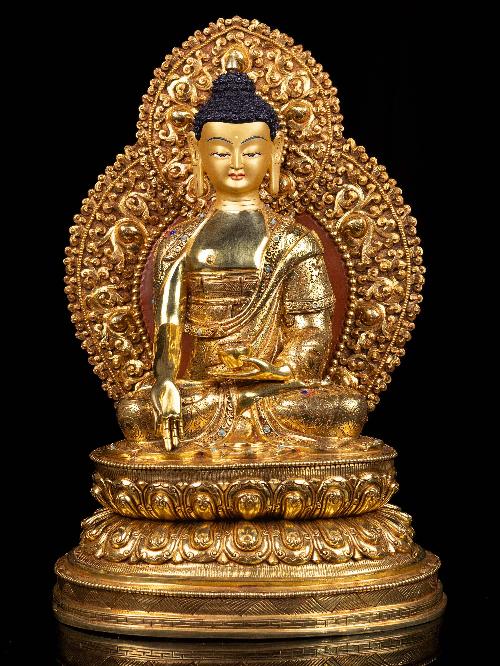
Gautama is painted with golden skin sitting in a lotus seat [Skt. Padmasana] also called the meditative seat [Skt. Dhyanasana] & upon a white moon disc which represents the male principle of method which itself is upon a lotus throne. His left hand touches the ground in what is called bhumisparse mudra which symbolises his own recognition of enlightened mind in one of the most iconic images in all Buddhism. The palm always faces inwards. His feet are deliberately drawn level with one another & enlarged, being specific marks of a Buddha. His right hand supports an alms bowl [Skt. Patra], containing the liquid elixir of eternal life. Somehow the simple image of the bowl reflects his overwhelming humility & kindness. He wears the traditionally maroon gold monk's patched robe [Skt. Samghati] made of twenty five pieces of cloth which the first Buddhist monks sewed together. The Buddha has a green nimbus and blue aureole around his body signifying the highest level of understanding. Siddhartha is surrounded by Pink Lotuses [Skt. Padma]. This kind of lotus is connected with loving kindness & a flowering of pure consciousness. The closed bud to his right side represents the past or originating mind, the blooming flower represents the present & the buds represents the future Buddha Maitreya and forthcoming realisations. His elongated earlobes depict his royal connection; his knotted black hair & topknot symbolise his abandonment of worldly possessions; the dot [Skt. Urna] on his brow on the command chakra [Skt. Ajna] represents his transcendent wisdom, the 31st mark of a Buddha.
He studied Buddhist Ideas in several locations in Kashmir & Northern India which to may seem a contradiction in terms, this is because to many Gautama Buddha is what Buddhism is. There are in fact two basic schools of thought. 1. That Gautama is recognised for his enlightened reasoning who according to Theravada Buddhism was the 28th Buddha. 2. That he is the Supreme Buddha [Skt. Sammasambuddha] of our age & that he is the be all & end all of Buddhist Doctrine, & closely follow his progress or 'life story' & to how he in how became full awoken. In Hinduism he is considered to be the ninth avatar of God Vishnu.
At the age of 29 Siddhartha left his palace in order to meet his people. Despite his father's effort to remove the sick, aged & impoverished, Siddhartha encountered an old man. Disturbed by this, when told that all people would eventually grow old by his charioteer Channa, variously, a diseased man, a decaying corpse, and an ascetic. Deeply depressed by these sights, he sought to overcome old age, illness, and death by living the life of an ascetic. He left his palace leaving behind this royal life to become a mendicant. Siddhartha left Rajagaha and practised under two hermit teachers. After mastering the teachings of Alara Kalama Siddhartha was asked by Kalama to succeed him, but moved on.
He then became a student of Uddaka Ramaputta, but although he achieved high levels of meditative consciousness and was asked to succeed Ramaputta, he was still not satisfied with his path, and moved on. He initially became as ascetic but then After asceticism and concentrating on meditation and Anapana-sati (awareness of breathing in and out), Siddhartha is said to have discovered what Buddhists call the Middle Way- a path of moderation away from the extremes of self-indulgence and self-mortification.
Gautama thus journeyed to Deer Park near Varanasi (Benares) in northern India, he set in motion the Wheel of Dharma by delivering his first sermon to the group of five companions with whom he had previously sought enlightenment. They, together with the Buddha, formed the first sangha, the company of Buddhist monks. For the remaining 45 years of his life, the Buddha is said to have traveled in the Gangetic Plain, in what is now Uttar Pradesh, Bihar & southern Nepal, teaching to an extremely diverse range of people, from nobles to outcaste street sweepers, mass murderers such as Angulimala & cannibals such as Alavaka. The sangha travelled from place to place in India, expounding the dharma.
2nd Commentary Gautama's entire Teachings revolve around: The Principle of the Three marks of existence; 1. Dukkha (Sanskrit: du?kha): That all beings suffer from all situations due to unclear mind. 2. Anicca (Sanskrit: anitya): That all things are impermanent. 3. Anatta (Sanskrit: anatman): That the perception of a constant "self" is an illusion. Gautama considers the arising of this suffering, & explains that this is caused by a misunderstanding of phenomena (the world around us) which is impermanent [Anicca] which he then related to the illusion of the ego, which is actually nothing but an illusion. [Anatta]. He shows that by understanding the nature of the suffering, & specifically its arising, we can alleviate this or extinguish it altogether.
Centuries-Old Lost-Wax Metal Casting
Each sculpture at Handmade Handicraft is crafted using the ancient cire-perdue (lost-wax) technique, a craft perfected over a millennium by the Newar artisans of Patan. The process begins with sculpting beeswax and Himalayan tree resin by hand. A multi-layered clay mold is formed around the wax, which is melted away in the furnace, creating a void that is filled with molten red copper or bronze.
24K Mercury Gilding
Applied with pure gold leaf and fused using fire gilding for an ethereal sheen that endures for generations.
Cold-Gold Face Painting
The sacred facial features and serene gaze of deities are carefully rendered with powdered cold gold and natural pigments.
Hand-Chiseled Detailing
Intricate robes, mandalas, and jewels are carved by hand with miniature steel chisels and devotion.
Door-to-Door Worldwide Express Delivery
Since 1976, we have shipped thousands of delicate sacred statues and handicrafts across North America, Europe, Australia, and Asia with an exceptional track record of safe delivery.
-
Express Carriers: We partner with DHL Express, FedEx International, and licensed Air Cargo freighters with end-to-end tracking.
-
Museum-Grade Packaging: Each piece is wrapped in moisture-resistant vapor barriers, thick high-density foam cushioning, and reinforced export cartons or custom wooden crates for large statues.
-
100% Transit Insurance: All international shipments are fully insured against loss or damage during transit.
-
Customs Clearance & Documentation: Includes official Nepal Archaeological Department export clearances certifying modern non-antique artisan status for hassle-free customs clearance.
Related Artisan Masterpieces
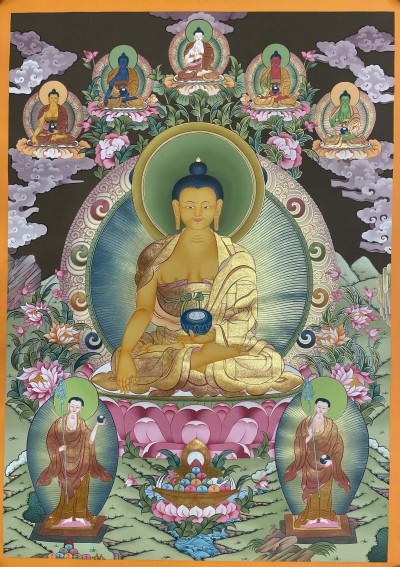
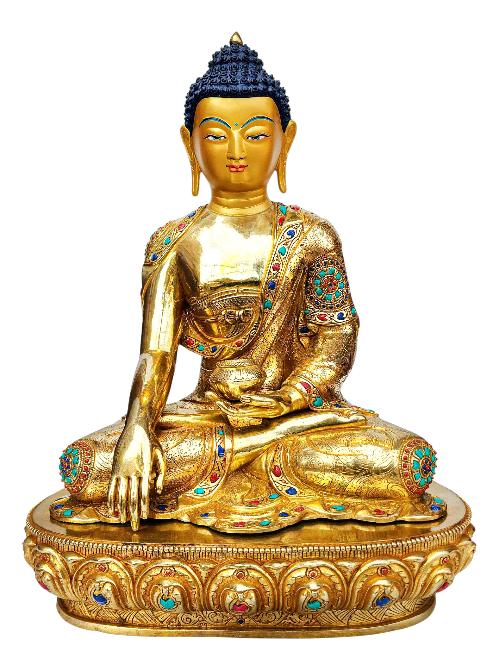
Premium Shakyamuni Buddha Handmade Statue, Full Gold Plated, Stone Setting, Face Painted
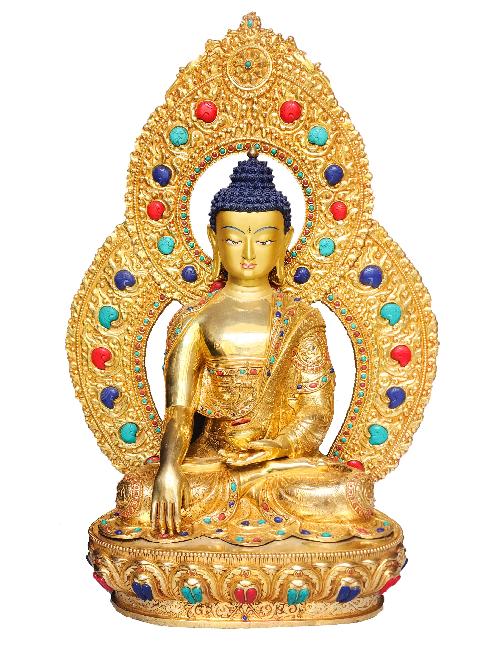
[Shakyamuni Buddha], Buddhist Handmade Statue, [Face painted] and [Gold plated], [Stone setting]