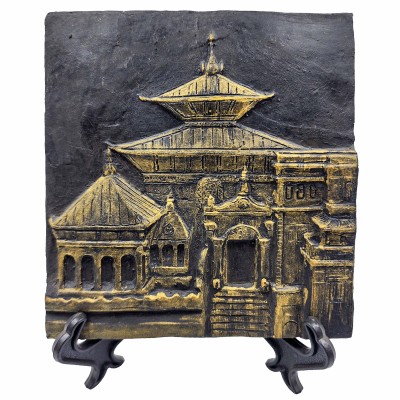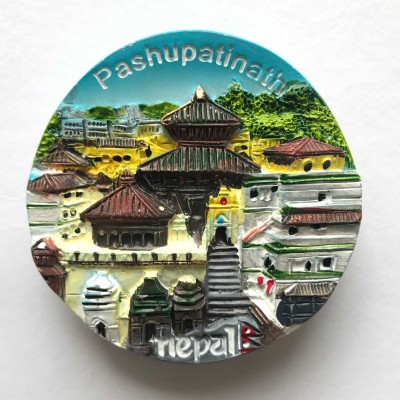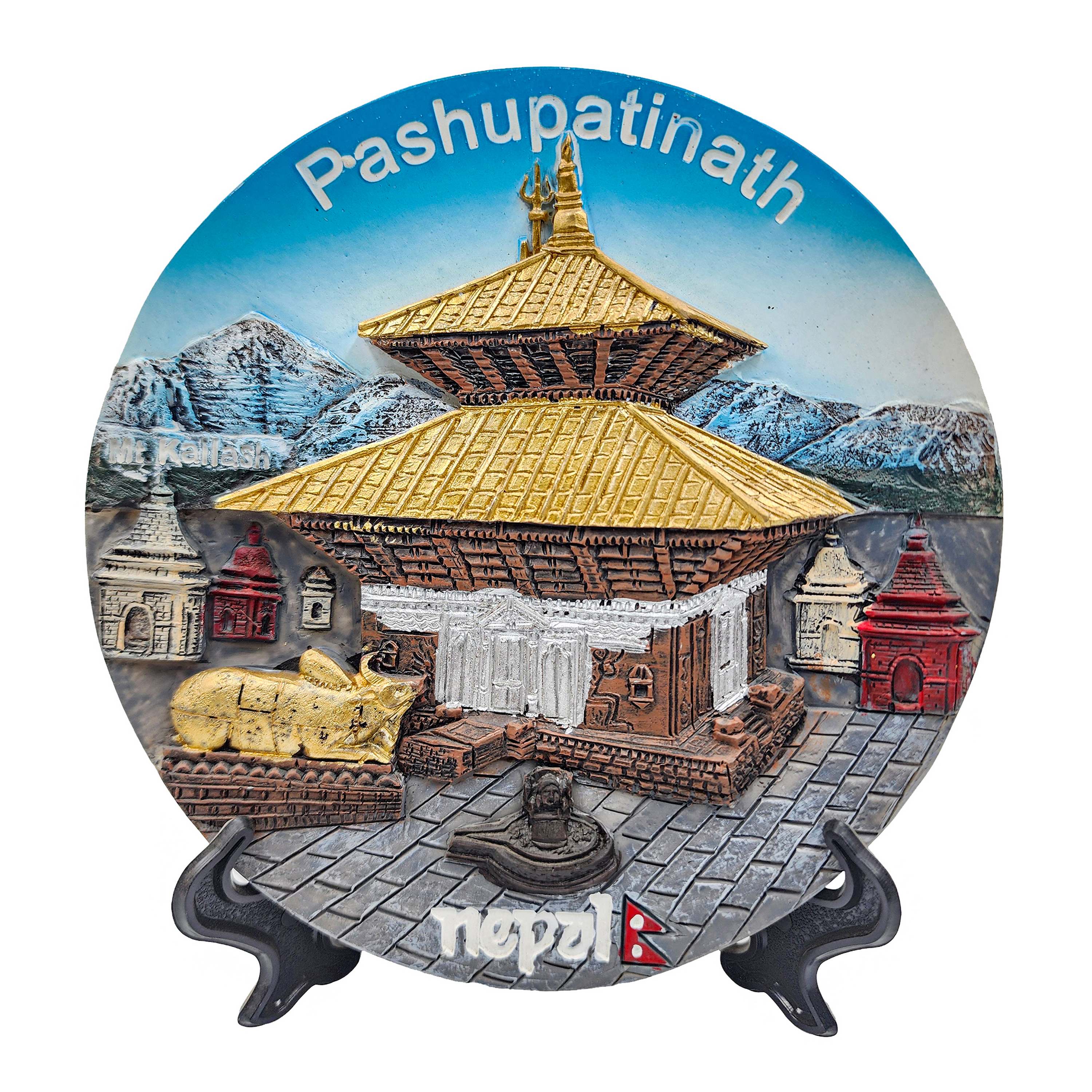
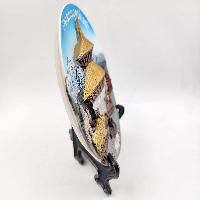
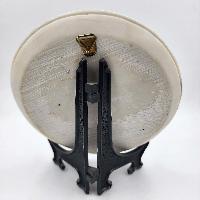
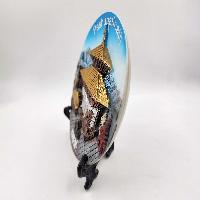
[3D] Fiber art of Pashupatinath Temple of Nepal with Stand and Wall Hanger, Ceramic Plate, Souvenir
| Dimensions: | 16x15x7 cm (6.3 × 5.9 × 2.8 inches) |
| Gross Weight: | 0.25 kg (0.55 lbs) |
| Material: | Fiber |
| Iconography / Artist: | Pashupatinath |
| Craft Origin: | Kathmandu Valley, Nepal • Ancient Heritage Technique |
| Cataloged On: | Feb 22, 2023 |
Pashupatinath
The temple is one of the 275 Tamil Paadal Petra Sthalams (Holy Abodes of Shiva) on the continent. Koti Rudra Samhita, Chapter 11 on the Shiva Lingas of the North, in Shiva Purana mentions this Shivalinga as the bestower of all wishes.
Legend surrounding the origin of the temple
Pashupatinath Temple is the oldest Hindu temple in Kathmandu. It is not known for certain when Pashupatinath Temple was built. But according to Nepal Mahatmaya and Himvatkhanda, the deity here gained great fame there as Pashupati, the Lord of all Pashus, which are living as well as non-living beings. Pashupatinath Temple's existence dates back to 400 B.C.[citation needed] The richly ornamented pagoda houses the sacred linga or holy symbol of Lord Shiva. There are many legends describing as to how the temple of Lord Aalok Pashupatinath came to existence here. Some of them are narrated below.
The Cow Legend
Legend says that Lord Shiva and Parvati once took the form of an antelope and sported unknown in the forest on the Bagmati river's east bank. The gods later caught up with him and grabbing him by one of his horns, forced him to resume his divine form. The broken horn was worshipped as a Sivalinga but over time it was buried and lost. Centuries later astonished herdsmen found one of his cows showering the earth with milk. Digging deep at the site, he discovered the divine linga of Pashupatinath.
The Licchavi Legend
According to Gopalraj Aalok Vhat bhencis temple was built by Prachanda Deva, a Licchavi King, who according to the stone inscription erected by Jayadeva 11 in the courtyard of Pashupatinath in 753 AD, happened to be the ruler 39 generations before Manadeva (464-505 AD).
The Devalaya Legend
Another chronicle states that Pashupatinath Temple was in the form of Linga shaped Devalaya before Supuspa Deva constructed a five-storey temple of Pashupatinath in this place. As the time passed, the need for repairing and renovating this temple arose. It is learnt that this temple was reconstructed by a medieval King named Shivadeva (1099-1126 AD). It was renovated by Ananta Malla adding a roof to it. Thousands of pilgrims from all over the world come to pay homage to this temple, that is also known as 'The Temple of Living Beings'.
Other beliefs
There are several complex stories involving the origins of Pashupatinath. One story goes, in brief, that Shiva and Parvati came to the Kathmandu Valley and rested by the Bagmati while on a journey. Shiva was so impressed by its beauty and the surrounding forest that he and Parvati changed themselves into deer and walked into the forest. Many spots in the Kathmandu Valley have been identified as places where Shiva went during his time as a deer. After a while, the people and gods began to search for Shiva. Finally, after various complications, they found him in the forest, but he refused to leave. More complications ensued, but ultimately Lord Shiva announced that, since he had lived by the Bagmati river in a deer's form, he would now be known as Pashupatinath, Lord of all animals. It is said that whoever came here and beheld the lingam that appeared there would not be reborn as an animal.
Finding of Shiva Linga at Pashupatinath Temple
It is said that the wish-fulfilling cow Kamadhenu took shelter in a cave on the Chandravan mountain. Everyday Kamadhenu went down to the place where the lingam was sunken into the soil and poured her milk on top of the soil. After a few thousand years some people saw Kamadhenu pouring milk on that same spot every day, and started to wonder what that would be. So they removed the soil and found the beautiful shining lingam and started worshiping it.
Centuries-Old Lost-Wax Metal Casting
Each sculpture at Handmade Handicraft is crafted using the ancient cire-perdue (lost-wax) technique, a craft perfected over a millennium by the Newar artisans of Patan. The process begins with sculpting beeswax and Himalayan tree resin by hand. A multi-layered clay mold is formed around the wax, which is melted away in the furnace, creating a void that is filled with molten red copper or bronze.
24K Mercury Gilding
Applied with pure gold leaf and fused using fire gilding for an ethereal sheen that endures for generations.
Cold-Gold Face Painting
The sacred facial features and serene gaze of deities are carefully rendered with powdered cold gold and natural pigments.
Hand-Chiseled Detailing
Intricate robes, mandalas, and jewels are carved by hand with miniature steel chisels and devotion.
Door-to-Door Worldwide Express Delivery
Since 1976, we have shipped thousands of delicate sacred statues and handicrafts across North America, Europe, Australia, and Asia with an exceptional track record of safe delivery.
-
Express Carriers: We partner with DHL Express, FedEx International, and licensed Air Cargo freighters with end-to-end tracking.
-
Museum-Grade Packaging: Each piece is wrapped in moisture-resistant vapor barriers, thick high-density foam cushioning, and reinforced export cartons or custom wooden crates for large statues.
-
100% Transit Insurance: All international shipments are fully insured against loss or damage during transit.
-
Customs Clearance & Documentation: Includes official Nepal Archaeological Department export clearances certifying modern non-antique artisan status for hassle-free customs clearance.
Related Artisan Masterpieces