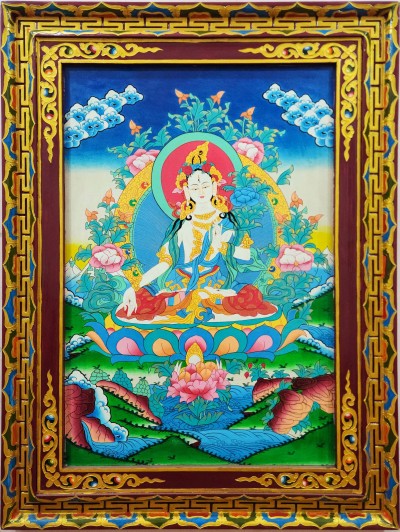
White Tara Thangka, [Black and Gold], Buddhist Traditional Hand Painting, Tibetan Style, Three Long Life Deities, [Fast Selling]
| Dimensions: | 104x75 cm (40.9 × 29.5 inches) |
| Gross Weight: | 0.5 kg (1.1 lbs) |
| Material: | Cotton Canvas & Natural Color |
| Iconography / Artist: | White Tara |
| Craft Origin: | Kathmandu Valley, Nepal • Ancient Heritage Technique |
| Cataloged On: | Jun 16, 2023 |
White Tara
Mantra of White Tara
Her left hand is gracefully lowered in an empty open palm boon granting gesture [Skt. Varada Mudra]. White Tara has a blooming pink lotus & an unopened bud on either side of her body. The lotus in the painting is stylised as a peony & a chrysanthemum to provide artistic contrast with her lotus throne. The open blossom represents the present and the bud represents the future situations & Buddhas yet to be born. The future also refers to beneficial changes circumstances that she will help bring about. Her right hand wisdom hand is in the gesture of giving refuge [Skt. Sharanagamana]. The word refuge refers to the teaching of compassionate understanding which she imparts. The third finger touches the thumb to create a circle representing the union of wisdom and compassion, and the three extended fingers symbolise the Three Jewels of Buddhism A. The Buddha State B. The Body of teachings [Skt. Sangha] C. The Principles of the Universal form [Skt. Dharma]. The same hand holds the stem of a blue lotus [Skt. Utpala] representing change. The lower part of the stem below the bend represents the root of the lotus in the mud. The allegory of the Lotus refers to the something that grows from the obscurity of the mud & which eventually bursts open in the light. The lotus journey is one of inner awakening & enlightenment analogous to the human spirit. Buddhism shows us how to grow towards the light with profound teachings which help us to navigate away from burdens and sufferings which we may have by being materially minded, bitter & confused.
There is a lotus on her diadem bearing the Wish Granting Gem [Skt. Chintamani] surrounded by an aureole of fire symbolising auspicious blessings. The extra eye on her forehead, on the palms of her hands & soles of her feet represent her ability to see and understand the sufferings of all beings & her omniscient compassion toward the suffering. Avalokiteshvara [Tib. Chengresi] her progenitor also has a white body & extra eyes. The eyes denote psychic & supernatural power. The rainbow coloured leggings represent a mastery of Boddhi Nature [Skt. Siddhi] & a manifestation of the Sambhogakaya. The dark blue layer of clothing signifies Mantrayana practice. She is upon a white moon disk & has an orange sun aureole to representing her emanation their melting point [Skt. Nada]. There is a branch of an Ashoka Tree in the foreground. The word Ashoka means 'without sorrow' in other words she has no regrets about her behaviour. The tree linked to the Vedic God of love & sexual union Kamadeva which blossoms when a virtuous lady touches it. The triangular diamond rock formation in the foreground represents the Source of Reality [Skt. Dharmadaya] out of which deities arise & which is generated from emptiness by the seed syllable E. In the Indian language is a Triangular shaped letter D & so expressed in the triangular rock formations.
Centuries-Old Lost-Wax Metal Casting
Each sculpture at Handmade Handicraft is crafted using the ancient cire-perdue (lost-wax) technique, a craft perfected over a millennium by the Newar artisans of Patan. The process begins with sculpting beeswax and Himalayan tree resin by hand. A multi-layered clay mold is formed around the wax, which is melted away in the furnace, creating a void that is filled with molten red copper or bronze.
24K Mercury Gilding
Applied with pure gold leaf and fused using fire gilding for an ethereal sheen that endures for generations.
Cold-Gold Face Painting
The sacred facial features and serene gaze of deities are carefully rendered with powdered cold gold and natural pigments.
Hand-Chiseled Detailing
Intricate robes, mandalas, and jewels are carved by hand with miniature steel chisels and devotion.
Door-to-Door Worldwide Express Delivery
Since 1976, we have shipped thousands of delicate sacred statues and handicrafts across North America, Europe, Australia, and Asia with an exceptional track record of safe delivery.
-
Express Carriers: We partner with DHL Express, FedEx International, and licensed Air Cargo freighters with end-to-end tracking.
-
Museum-Grade Packaging: Each piece is wrapped in moisture-resistant vapor barriers, thick high-density foam cushioning, and reinforced export cartons or custom wooden crates for large statues.
-
100% Transit Insurance: All international shipments are fully insured against loss or damage during transit.
-
Customs Clearance & Documentation: Includes official Nepal Archaeological Department export clearances certifying modern non-antique artisan status for hassle-free customs clearance.
Related Artisan Masterpieces