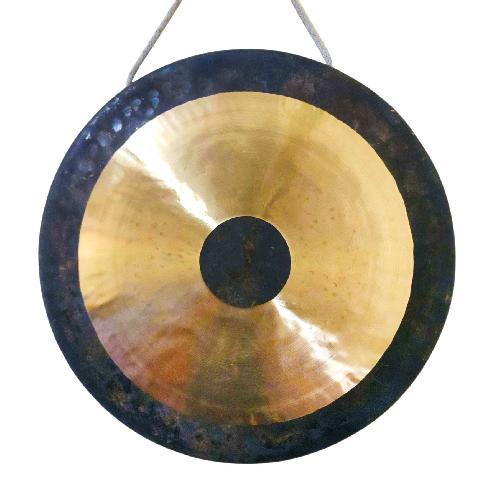
Handmade [Gong], Bronze Chau Gong, Tam-tam Gong, symphonic Gong with [Pancha Buddha] Etching
| Dimensions: | 23x23x2 cm (9.1 × 9.1 × 0.8 inches) |
| Gross Weight: | 0.81 kg (1.79 lbs) |
| Material: | Bronze |
| Iconography / Artist: | Chau Gong |
| Craft Origin: | Kathmandu Valley, Nepal • Ancient Heritage Technique |
| Cataloged On: | Aug 08, 2023 |
Chau Gong
The Chau Gong's history dates back to ancient China, with its earliest known existence found in a tomb from the early Western Han Dynasty, discovered at the Guixian site in the Guangxi Zhuang Autonomous Region of China. Throughout Chinese history, gongs, including the Chau Gong, were integral to cultural and spiritual practices, being used in intense and spiritual drumming during rituals and tribal meetings. Notably, Chau Gongs were employed to clear the way for important officials and processions, much like a modern-day police siren. In this context, the number of gong strokes was sometimes used to indicate the seniority of an official, helping to determine the proper etiquette when officials met unexpectedly.
Use:
The Chau Gong, or tam-tam, has made its way into symphony orchestras, becoming a fundamental part of the percussion section. Introduced to orchestral music by François-Joseph Gossec in 1790, it gained popularity and was adopted by renowned composers such as Hector Berlioz, Gioachino Rossini, Vincenzo Bellini, Richard Wagner, Peter Ilyich Tchaikovsky, Gustav Mahler, Dmitri Shostakovich, Sergei Rachmaninov, and Sergei Prokofiev, among others. This widespread adoption showcases the versatility and emotional range of the Chau Gong. Composers often use it to evoke scenes of mourning or to add dramatic intensity and horror to their compositions. In operas, the Chau Gong has been employed to heighten suspense and create powerful, unforgettable moments. Igor Stravinsky pushed the boundaries of Chau Gong playing techniques in his composition "The Rite Of Spring," introducing innovative techniques like quick crescendos, short, quickly damped notes, and using a triangle beater to scrape across the front of the instrument.
How to Play:
Playing the Chau Gong requires a skilled percussionist who understands its nuances and techniques. The player typically holds the gong vertically by a rope or cord attached to the rim. Striking the gong with a mallet or beater can produce a broad spectrum of sounds, from soft and subtle to thunderous and booming, depending on the striking force and location. By varying the striking point, angle, and force, the player can control the gong's resonance and create a range of expressive sounds. Additionally, certain techniques like scraping the surface with a beater or using quick, damped strokes can produce unique effects that add to the instrument's expressive capabilities. Mastering the Chau Gong requires a keen sense of timing, dynamics, and artistry to harness its full potential and bring out its mesmerizing qualities in various musical contexts.
Centuries-Old Lost-Wax Metal Casting
Each sculpture at Handmade Handicraft is crafted using the ancient cire-perdue (lost-wax) technique, a craft perfected over a millennium by the Newar artisans of Patan. The process begins with sculpting beeswax and Himalayan tree resin by hand. A multi-layered clay mold is formed around the wax, which is melted away in the furnace, creating a void that is filled with molten red copper or bronze.
24K Mercury Gilding
Applied with pure gold leaf and fused using fire gilding for an ethereal sheen that endures for generations.
Cold-Gold Face Painting
The sacred facial features and serene gaze of deities are carefully rendered with powdered cold gold and natural pigments.
Hand-Chiseled Detailing
Intricate robes, mandalas, and jewels are carved by hand with miniature steel chisels and devotion.
Door-to-Door Worldwide Express Delivery
Since 1976, we have shipped thousands of delicate sacred statues and handicrafts across North America, Europe, Australia, and Asia with an exceptional track record of safe delivery.
-
Express Carriers: We partner with DHL Express, FedEx International, and licensed Air Cargo freighters with end-to-end tracking.
-
Museum-Grade Packaging: Each piece is wrapped in moisture-resistant vapor barriers, thick high-density foam cushioning, and reinforced export cartons or custom wooden crates for large statues.
-
100% Transit Insurance: All international shipments are fully insured against loss or damage during transit.
-
Customs Clearance & Documentation: Includes official Nepal Archaeological Department export clearances certifying modern non-antique artisan status for hassle-free customs clearance.
Related Artisan Masterpieces

Handmade [Gong], Bronze Chau Gong, Tam-tam Gong, symphonic Gong with [Mandala] Etching

Handmade [Gong], Bronze Chau Gong, Tam-tam Gong, symphonic Gong with [Mandala] Etching