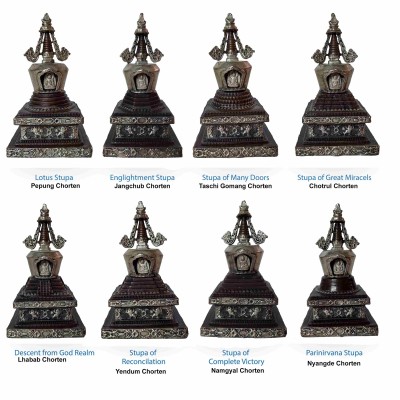
[Stupa], Buddhist statue, [Stone Setting]
| Dimensions: | 25x12x12 cm (9.8 × 4.7 × 4.7 inches) |
| Gross Weight: | 0.71 kg (1.57 lbs) |
| Material: | Mix Metal |
| Iconography / Artist: | Stupa |
| Craft Origin: | Kathmandu Valley, Nepal • Ancient Heritage Technique |
| Cataloged On: | Dec 14, 2023 |
Stupa
The shape of the stupa represents the Buddha, crowned, and sitting in meditation posture on a lion throne. His crown is the top of the spire; his head is the square at the spire's base; his body is the vase shape; his legs are the four steps of the lower terrace, and the base is his throne.
Lotus Blossom Stupa
Also known as Stupa of Heaped Lotuses or Birth of the Sugata Stupa, this stupa refers to the birth of the Buddha. "At birth Buddha took seven steps in each of the four directions" (East, South, West and North). In each direction lotuses sprang, symbolizing the Four Immeasurables: love, compassion, joy and equanimity. The four steps of the basis of this stupa is circular, and it is decorated with lotus-petal designs. Occasionally, seven heaped lotus steps are constructed. These refer to the seven first steps of the Buddha.
Enlightenment Stupa
Also known as the Stupa of the Conquest of Mara. This stupa symbolizes the 35-year-old Buddha's attainment of enlightenment under the bodhi tree in Bodh Gaya, where he conquered worldly temptations and attacks manifesting in the form of Mara.
Stupa of Many Doors
Also known as the Stupa of Many Gates. After reaching enlightenment, the Buddha taught his first students in a deer-park near Sarnath. The series of doors on each side of the steps represent the first teachings: the Four Noble Truths, the Six Perfections, the Noble Eightfold Path and the Twelve Links in the Chain of Dependent Origination.
Stupa of Descent from the God Realm
At 42 years old, Buddha spent a summer retreat in Tushita Heaven, where his mother had taken rebirth. In order to repay her kindness he taught the dharma to her reincarnation. Local inhabitants built a stupa like this in Sankasya in order to commemorate this event. This stupa is characterized by having a central projection at each side containing a triple ladder or steps.
Stupa of Great Miracles
Also known as Stupa of Conquest of the Tirthikas. This stupa refers to various miracles performed by the Buddha when he was 50 years old. Legend claims that he overpowered maras and heretics by engaging them in intellectual arguments and also by performing miracles. This stupa was raised by the Lichavi kingdom to commemorate the event.
Stupa of Reconciliation
This stupa commemorates the Buddha's resolution of a dispute among the sangha. A stupa in this design was built in the kingdom of Magadha, where the reconciliation occurred. It has four octagonal steps with equal sides.
Stupa of Complete Victory
This stupa commemorates Buddha's successful prolonging of his life by three months. It has only three steps, which are circular and unadorned.
Stupa of Nirvana
This stupa refers to the death of the Buddha, when he was 80 years old. It symbolizes the Buddha's complete absorption into the highest state of mind. It is bell-shaped and usually not ornamented.
The number of Tsa-Tsas are dependent on the size of both the treasury and Tsa-Tsa, since it should be completely filled. For example, the Kalachakra stupa in southern Spain has approximately 14 000 Tsa-Tsas within.
Jewellery and other "precious" objects are also placed in the treasury. It is not necessary that the jewellery be expensive, since it is the symbolic value that is important, not the market price. It is believed that the more objects placed into the stupa, the stronger the energy of the Stupa will be
Centuries-Old Lost-Wax Metal Casting
Each sculpture at Handmade Handicraft is crafted using the ancient cire-perdue (lost-wax) technique, a craft perfected over a millennium by the Newar artisans of Patan. The process begins with sculpting beeswax and Himalayan tree resin by hand. A multi-layered clay mold is formed around the wax, which is melted away in the furnace, creating a void that is filled with molten red copper or bronze.
24K Mercury Gilding
Applied with pure gold leaf and fused using fire gilding for an ethereal sheen that endures for generations.
Cold-Gold Face Painting
The sacred facial features and serene gaze of deities are carefully rendered with powdered cold gold and natural pigments.
Hand-Chiseled Detailing
Intricate robes, mandalas, and jewels are carved by hand with miniature steel chisels and devotion.
Door-to-Door Worldwide Express Delivery
Since 1976, we have shipped thousands of delicate sacred statues and handicrafts across North America, Europe, Australia, and Asia with an exceptional track record of safe delivery.
-
Express Carriers: We partner with DHL Express, FedEx International, and licensed Air Cargo freighters with end-to-end tracking.
-
Museum-Grade Packaging: Each piece is wrapped in moisture-resistant vapor barriers, thick high-density foam cushioning, and reinforced export cartons or custom wooden crates for large statues.
-
100% Transit Insurance: All international shipments are fully insured against loss or damage during transit.
-
Customs Clearance & Documentation: Includes official Nepal Archaeological Department export clearances certifying modern non-antique artisan status for hassle-free customs clearance.
Related Artisan Masterpieces