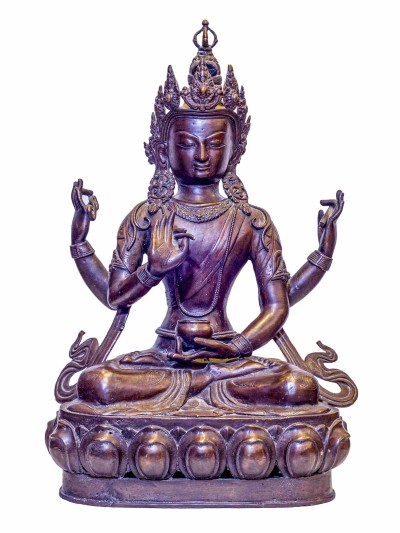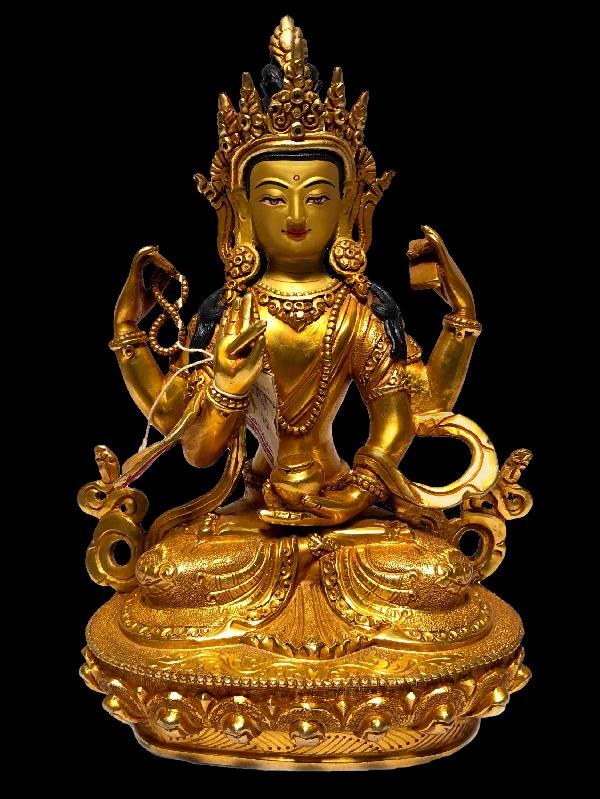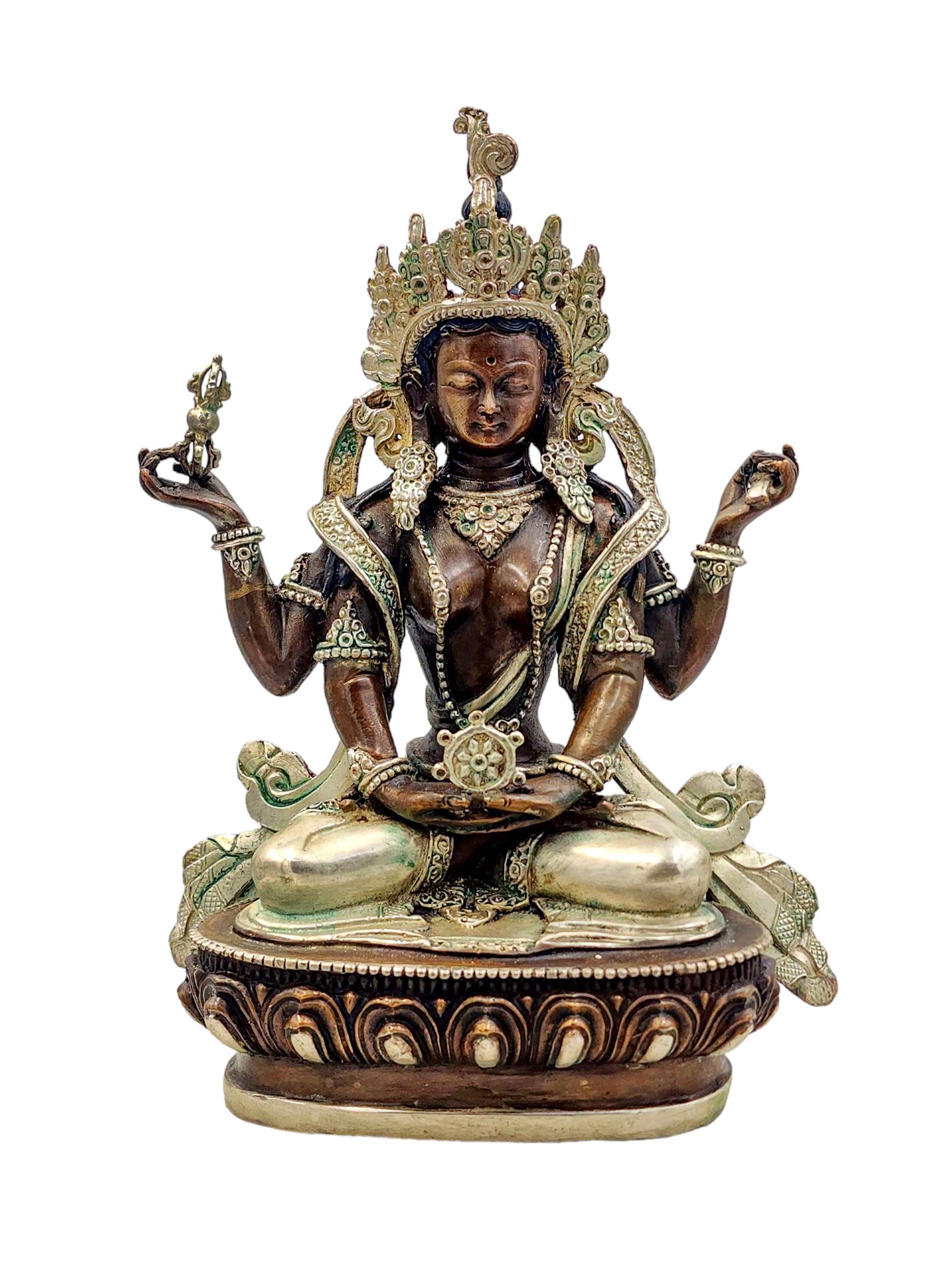
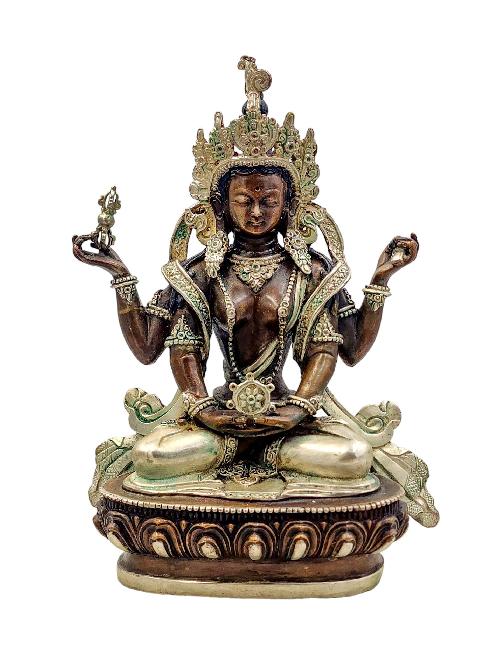
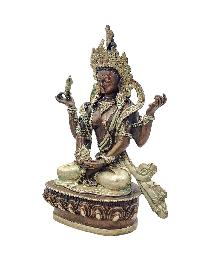
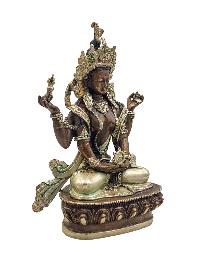
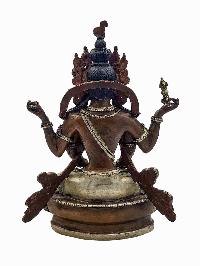
[Prajnaparamita], Buddhist Handmade Statue, [Silver and Chocolate Oxidized], [Painted Face], [High Quality]
| Dimensions: | 17x12x8 cm (6.7 × 4.7 × 3.1 inches) |
| Gross Weight: | 0.85 kg (1.87 lbs) |
| Material: | Copper |
| Iconography / Artist: | Prajnaparamita |
| Craft Origin: | Kathmandu Valley, Nepal • Ancient Heritage Technique |
| Cataloged On: | Jul 14, 2024 |
Prajnaparamita
Earliest Prajnaparamita Sutra is Astasahasrika Pajanaparmita Sutra, which was probably put in writing in the 1st century BCE. The first translation of the Astasahasrika Prajnaparamita also has a corresponding version in poetry format called the Ratnagu?asamcaya Gatha, which some believe to be slightly older because it is not written in Sanskrit. However, these findings rely on late-dating Indian texts, in which poetry and mantras are often kept in archive forms.
Mahayana Prajnaparamita teachings were first developed by the Caitika subsect of the Mahasamghikas. Astasahasrika Prajnaparamita Sutra originated amongst Mahasamghika schools and they had two copy of the Astasahasrika Prajnaparamita Sutra in Prakrit Script.
In 2012, A partially damaged, Kharosthi manuscript of the Astasahasrika Prajnaparamita was radiocarbon dated to 75 CE , making it one of the oldest Buddhist texts in existence.


For example,
The inferior was taught to the merchants, Trapusa and Bahalika because they were ordinary men,
The middle was taught to the group of people who were at the stage of becoming saints or are already saints;
The Superior [the eightfold Prajnaparamitas] were taught to bodhisattvas.
The eightfold Prajnaparamitas are the teachings of the Prajnaparamita which can be categorized as:
Trisatika Prajnaparamita Sutra :300 lines, alternatively known as the Vajracchedika Prajnaparamita Sutra (Diamond Sutra)
Pancasatika Prajnaparamita Sutra: 500 lines
Saptasatika Prajnaparamita Sutra :700 lines, the bodhisattva Manjusri's exposition of Prajnaparamita
Sardhadvisahasrika Prajnaparamita Sutra : 2500 lines, from the questions of Suvikrantavikramin Bodhisattva
Astasahasrika Prajnaparamita Sutra :8000 lines
Astadasasahasrika Prajnaparamita Sutra :18,000 lines
Pancavimsatisahasrika Prajnaparamita Sutra : 25,000 lines, alternatively known as the MahaPrajnaparamita Sutra
satasahasrika Prajnaparamita Sutra :100,000 lines, alternatively known as the MahaPrajnaparamita Sutra
Pancavimsatisahasrika Prajnaparamita Sutra :(25,000 lines)
satasahasrika Prajnaparamita Sutra : (100,000 lines) have a connection with the Dharmaguptaka sect, while the Astasahasrika Prajnaparamita Sutra (8000 lines) does not.
The titles of these eight Prajnaparamita texts are given according to their length. The texts may have other Sanskrit titles as well, or different variations which may be more descriptive.
There are also other Prajnaparamita sutras the Heart Sutra (Prajnaparamita H?daya), and Diamond Sutra which exists in a shorter and longer version. these two sutras are in a class by themselves and deservedly renowned throughout the world of Northern Buddhism.
Centuries-Old Lost-Wax Metal Casting
Each sculpture at Handmade Handicraft is crafted using the ancient cire-perdue (lost-wax) technique, a craft perfected over a millennium by the Newar artisans of Patan. The process begins with sculpting beeswax and Himalayan tree resin by hand. A multi-layered clay mold is formed around the wax, which is melted away in the furnace, creating a void that is filled with molten red copper or bronze.
24K Mercury Gilding
Applied with pure gold leaf and fused using fire gilding for an ethereal sheen that endures for generations.
Cold-Gold Face Painting
The sacred facial features and serene gaze of deities are carefully rendered with powdered cold gold and natural pigments.
Hand-Chiseled Detailing
Intricate robes, mandalas, and jewels are carved by hand with miniature steel chisels and devotion.
Door-to-Door Worldwide Express Delivery
Since 1976, we have shipped thousands of delicate sacred statues and handicrafts across North America, Europe, Australia, and Asia with an exceptional track record of safe delivery.
-
Express Carriers: We partner with DHL Express, FedEx International, and licensed Air Cargo freighters with end-to-end tracking.
-
Museum-Grade Packaging: Each piece is wrapped in moisture-resistant vapor barriers, thick high-density foam cushioning, and reinforced export cartons or custom wooden crates for large statues.
-
100% Transit Insurance: All international shipments are fully insured against loss or damage during transit.
-
Customs Clearance & Documentation: Includes official Nepal Archaeological Department export clearances certifying modern non-antique artisan status for hassle-free customs clearance.
Related Artisan Masterpieces