


[Bhairav], Handmade Wooden Mask, Wall hanging, [Painted], Poplar Wood, White Mahakala
| Dimensions: | 40x29x19 cm (15.7 × 11.4 × 7.5 inches) |
| Gross Weight: | 1.9 kg (4.19 lbs) |
| Material: | Wood |
| Iconography / Artist: | White Mahakala |
| Craft Origin: | Kathmandu Valley, Nepal • Ancient Heritage Technique |
| Cataloged On: | Sep 02, 2024 |
White Mahakala
White Mahakala is depicted with a serene expression, often seated on a lotus throne. He is adorned with white garments and holds a white parasol or umbrella, symbolizing protection from obstacles and negative influences. On his other hands, he may hold various symbolic objects such as a wish-fulfilling gem or a mongoose.
History:
White Mahakala originated in ancient Indian Buddhism and was subsequently incorporated into Tibetan Buddhist traditions. He is particularly associated with the Nyingma and Sakya schools of Tibetan Buddhism, where he is considered a guardian and protector of the teachings.
Temples and Monasteries:
While specific temples solely dedicated to White Mahakala might not be widely known, various Buddhist monasteries and temples in Nepal and other regions have dedicated spaces or shrines for this deity. These sacred places serve as centers for practitioners to gather, engage in rituals, and pay homage to White Mahakala. Examples of such temples and monasteries include Boudhanath Stupa, Swayambhunath Stupa, Kopan Monastery, and Shechen Monastery in Nepal. These revered sites attract pilgrims and devotees seeking blessings, guidance, and a deeper connection with White Mahakala. Within the serene and prayerful ambiance of these temples and monasteries, individuals can immerse themselves in the practice and devotion associated with White Mahakala.
Benefits of practicing White Mahakala:
Practicing White Mahakala is believed to bring blessings of compassion, wisdom, and protection from obstacles. Devotees seek his assistance in overcoming difficulties, increasing positive energy, and cultivating spiritual growth.
How to practice:
Practices related to White Mahakala typically involve visualization, mantra recitation, and meditation. Devotees may also engage in acts of generosity, ethical conduct, and the cultivation of loving-kindness and compassion towards all beings.
Mantras of White Mahakala:
The primary mantra associated with White Mahakala is "OM TARE TUTTARE TURE MAMA AYU PUNYE JNANA PUSHTIM KURU SVAHA." Chanting this mantra is believed to invoke the blessings and protection of White Mahakala. Additional mantras and prayers specific to particular lineages or practices may also be used.
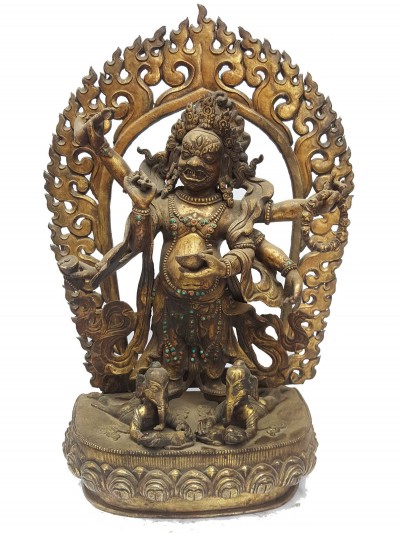
 The Chintamani Jewel in White Mahakala's Hand | This is the wealth aspect of Mahakala which specifically supports the comfort and economic well-being of tantric practitioners. The following description is according to his sadhana: "His body is white. His face is wrathful and he has three eyes. He has six arms. His main right hand holds a wish- fulfilling jewel (chintamani) mounted on a jewel-tipped handle, in front of his chest." |
 White Mahakala's Bowl of Jewels | The White Mahakala is known as mGon po yid bzhin nor bu in Tibetan with the last four meaning 'Wish-Granting Gem,' and he is the special protector of Mongolian Buddhists. His iconography is rich in symbols delineating his 'wealth-deity' status. For example his skull bowl, rather than contain the mortal remains of his victims, is full of various jewels, |
 White Mahakala's Crown of Jewels | and his crown is made up of five jewels instead of the trademark five skulls. |
 The Elephant Goad | The other notable departure from the normal Mahakala iconography is the elephant goad held in the center left hand, the sharp point of which symbolizes penetrating awareness. |
 Two Elephants Under His Feet | Also, in contrast to other Mahakalas, he stands on two elephants rather than one. |
 White Mahakala in Tribhanga Central Tibet 7th century | The elephant skin stretched at the back refers to the deity having torn asunder the pachyderm of ignorance. Another interesting aspect of White Mahakala is that he is occasionally shown in the tribhanga posture. In this typical stance of the body, the head, torso, and legs slant in contrary directions. The legs and hips jutt to the right, the trunk to the left, and the neck and head then again gently to the right. It is a lyrical, dreamy, very graceful pose. The three curves formed by the body symbolize the three worlds, upper, lower and middle, better known in Sanskrit as triloka. This is also popularly known as the posture of three bends. White Mahakala is popular for both mundane as well as spiritual reasons, ranging from the basic desire for wealth and prosperity to the ultimate attainment of the precious jewel, which is none other than the Buddhist Dharma. |
Centuries-Old Lost-Wax Metal Casting
Each sculpture at Handmade Handicraft is crafted using the ancient cire-perdue (lost-wax) technique, a craft perfected over a millennium by the Newar artisans of Patan. The process begins with sculpting beeswax and Himalayan tree resin by hand. A multi-layered clay mold is formed around the wax, which is melted away in the furnace, creating a void that is filled with molten red copper or bronze.
24K Mercury Gilding
Applied with pure gold leaf and fused using fire gilding for an ethereal sheen that endures for generations.
Cold-Gold Face Painting
The sacred facial features and serene gaze of deities are carefully rendered with powdered cold gold and natural pigments.
Hand-Chiseled Detailing
Intricate robes, mandalas, and jewels are carved by hand with miniature steel chisels and devotion.
Door-to-Door Worldwide Express Delivery
Since 1976, we have shipped thousands of delicate sacred statues and handicrafts across North America, Europe, Australia, and Asia with an exceptional track record of safe delivery.
-
Express Carriers: We partner with DHL Express, FedEx International, and licensed Air Cargo freighters with end-to-end tracking.
-
Museum-Grade Packaging: Each piece is wrapped in moisture-resistant vapor barriers, thick high-density foam cushioning, and reinforced export cartons or custom wooden crates for large statues.
-
100% Transit Insurance: All international shipments are fully insured against loss or damage during transit.
-
Customs Clearance & Documentation: Includes official Nepal Archaeological Department export clearances certifying modern non-antique artisan status for hassle-free customs clearance.
Related Artisan Masterpieces


[Bhairav], Handmade Wooden Mask, Wall hanging, [Painted], Poplar Wood,White Mahakala
