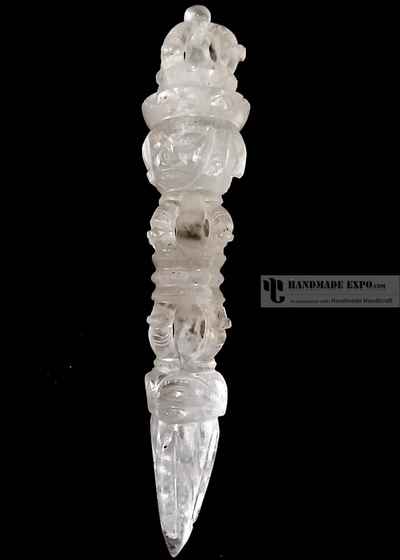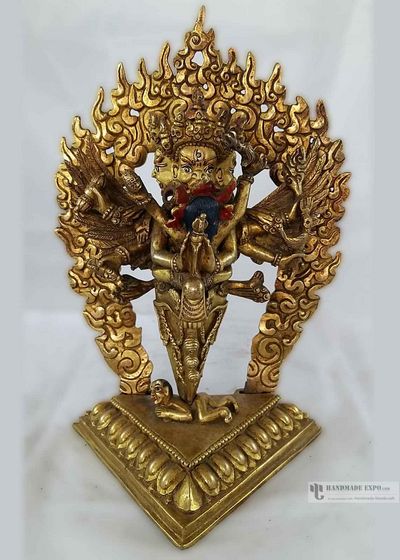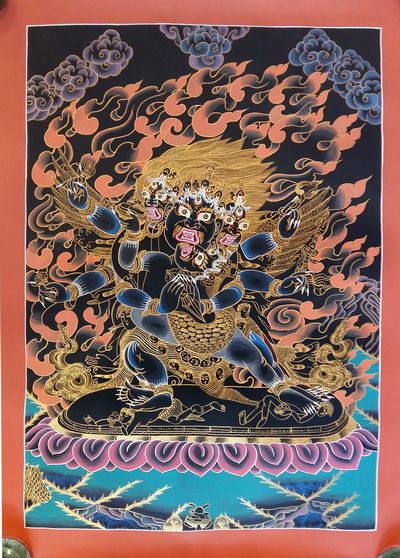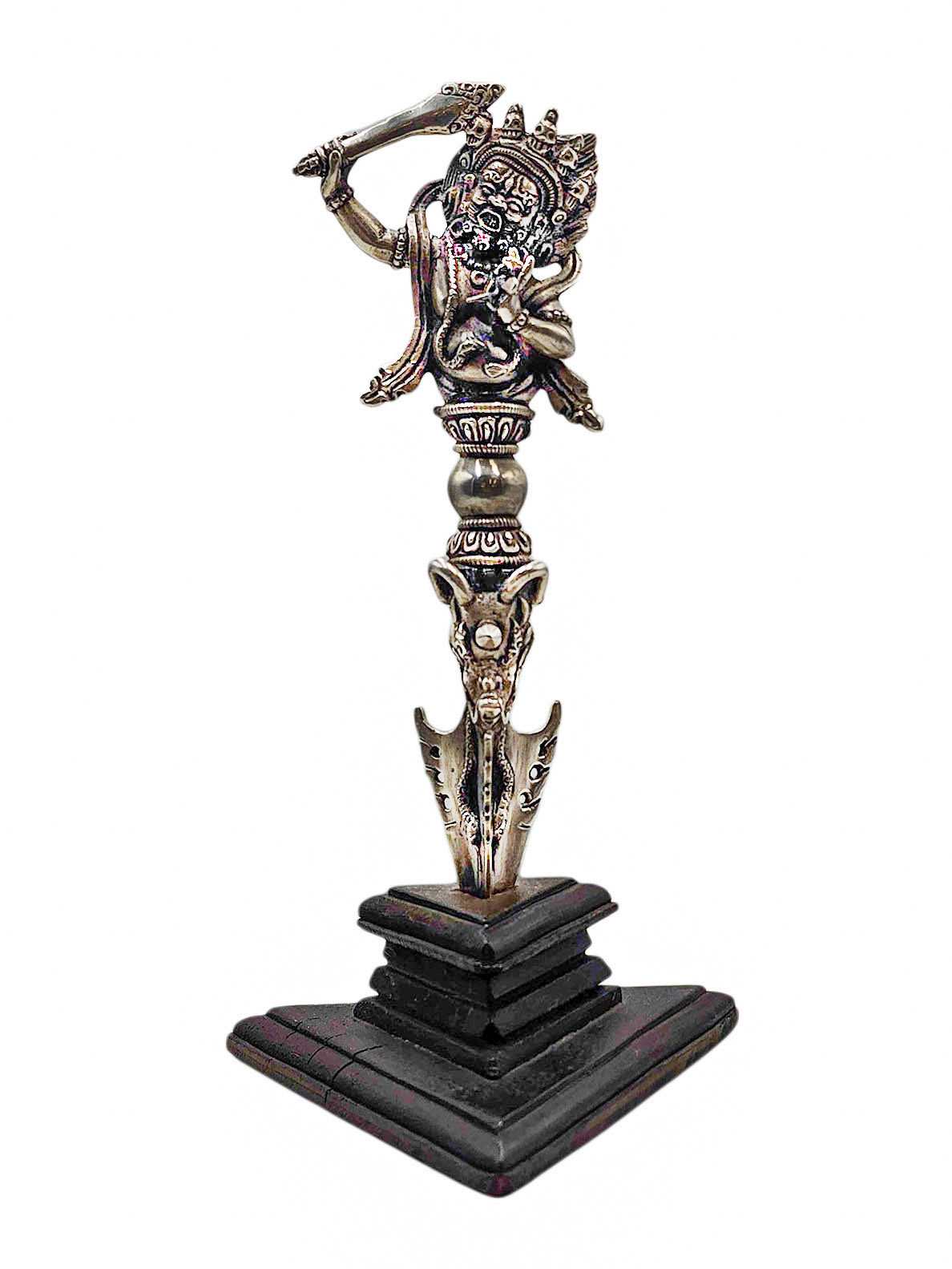
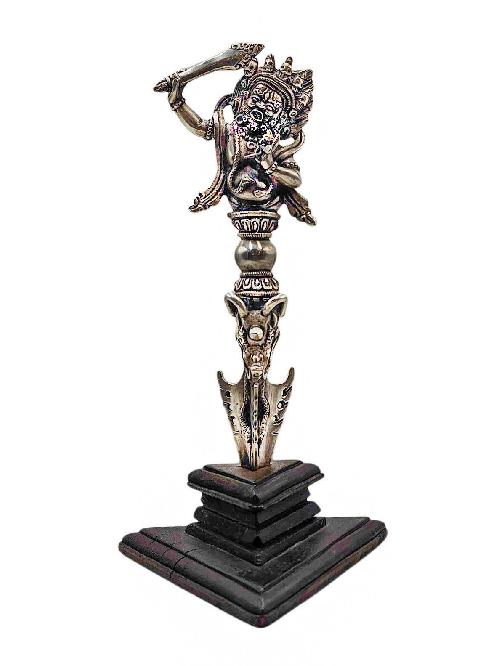
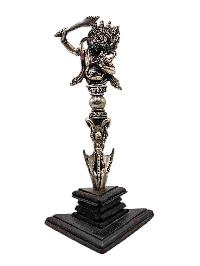
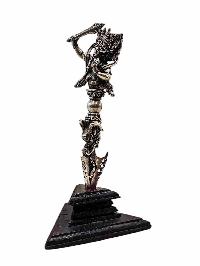
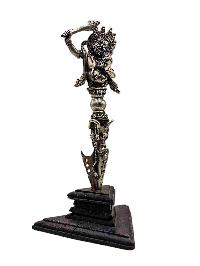
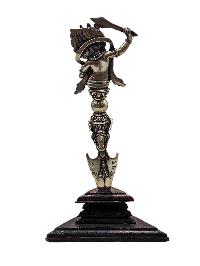
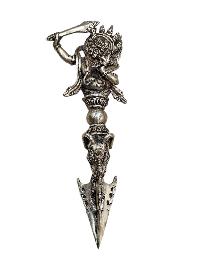
Tibetan Phurba, [Silver] and [High quality]
| Dimensions: | 16x8x8 cm (6.3 × 3.1 × 3.1 inches) |
| Gross Weight: | 0.18 kg (0.4 lbs) |
| Material: | Copper and Silver |
| Iconography / Artist: | Phurba |
| Craft Origin: | Kathmandu Valley, Nepal • Ancient Heritage Technique |
| Cataloged On: | Jan 22, 2025 |
Phurba
Mayer (1996) contests Boord's assertion, pointing out that eminent Sanskritists such as Sakya Pandita employed Vajrakīlaya Further, he argues:
it is possible, on the other hand, that the name Vajrakīlaya as favoured by the Tibetans could in fact have been the form that was actually used in the original Indic sources, and that there is no need to hypothesize a correct form Vajrakīla". "Vajrakīlaya" could have come from the second person singular active, causative imperative, of the verb Kīl. Indigenous grammar (Pāṇini Dhātupāṭha I.557) gives to Kīl the meaning of bandha, i.e. "to bind", while Monier-Williams (285) gives the meanings "to bind, fasten, stake, pin". Hence the form kīlaya could mean "you cause to bind/transfix!", or "bind/transfix!". This, taken from mantras urging "bind/transfix", or "may you cause to bind/transfix", might have come to be treated as a noun; and the noun might then have become deified; hence Kīlaya might have started out as a deified imperative, in some ways comparable to the famous example of the deified vocative in the name Hevajra, and a not unheard of phenomenon in Sanskrit tantric literature. This suggestion is supported by Alexis Sanderson, a specialist in Sanskrit tantric manuscripts whom I consulted on this problem.[3]
Like the majority of traditional Tibetan metal instruments, the kīla is often made from brass and iron (terrestrial and/or meteoric iron. 'Thokcha' (Tibetan: ཐོག་ལྕགས, Wylie: thog lcags) means "sky-iron" in Tibetan and denote tektites and meteorites which are often high in iron content. Meteoric iron was highly prized throughout the Himalaya where it was included in sophisticated polymetallic alloys such as Panchaloha for ritual implements. The pommel of the kīla often bears three faces of Vajrakīla, one joyful, one peaceful, one wrathful, but may bear the umbrella of the ashtamangala or mushroom cap, ishtadevata (like Hayagriva), snow lion, or stupa, among other possibilities. The handle is often of a vajra, weaving or knotwork design. The handle generally has a triune form as is common to the pommel and blade. The blade is usually composed of three triangular facets or faces, meeting at the tip. These represent, respectively, the blade's power to transform the negative energies known as the "three poisons" or "root poisons" (Sanskrit: mula klesha) of attachment/craving/desire, delusion/ignorance/misconception, and aversion/fear/hate.
Centuries-Old Lost-Wax Metal Casting
Each sculpture at Handmade Handicraft is crafted using the ancient cire-perdue (lost-wax) technique, a craft perfected over a millennium by the Newar artisans of Patan. The process begins with sculpting beeswax and Himalayan tree resin by hand. A multi-layered clay mold is formed around the wax, which is melted away in the furnace, creating a void that is filled with molten red copper or bronze.
24K Mercury Gilding
Applied with pure gold leaf and fused using fire gilding for an ethereal sheen that endures for generations.
Cold-Gold Face Painting
The sacred facial features and serene gaze of deities are carefully rendered with powdered cold gold and natural pigments.
Hand-Chiseled Detailing
Intricate robes, mandalas, and jewels are carved by hand with miniature steel chisels and devotion.
Door-to-Door Worldwide Express Delivery
Since 1976, we have shipped thousands of delicate sacred statues and handicrafts across North America, Europe, Australia, and Asia with an exceptional track record of safe delivery.
-
Express Carriers: We partner with DHL Express, FedEx International, and licensed Air Cargo freighters with end-to-end tracking.
-
Museum-Grade Packaging: Each piece is wrapped in moisture-resistant vapor barriers, thick high-density foam cushioning, and reinforced export cartons or custom wooden crates for large statues.
-
100% Transit Insurance: All international shipments are fully insured against loss or damage during transit.
-
Customs Clearance & Documentation: Includes official Nepal Archaeological Department export clearances certifying modern non-antique artisan status for hassle-free customs clearance.
Related Artisan Masterpieces