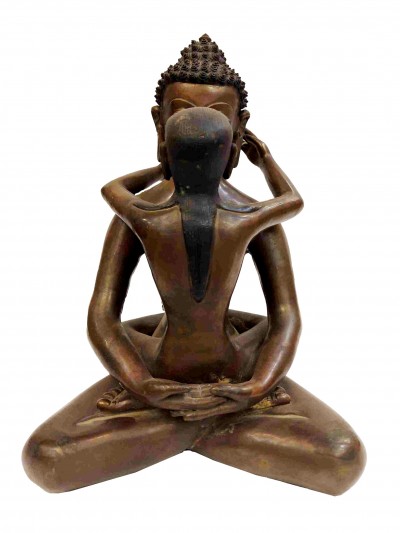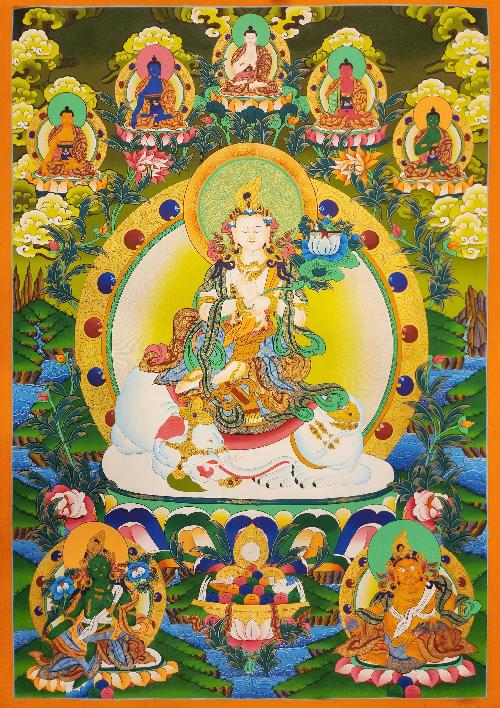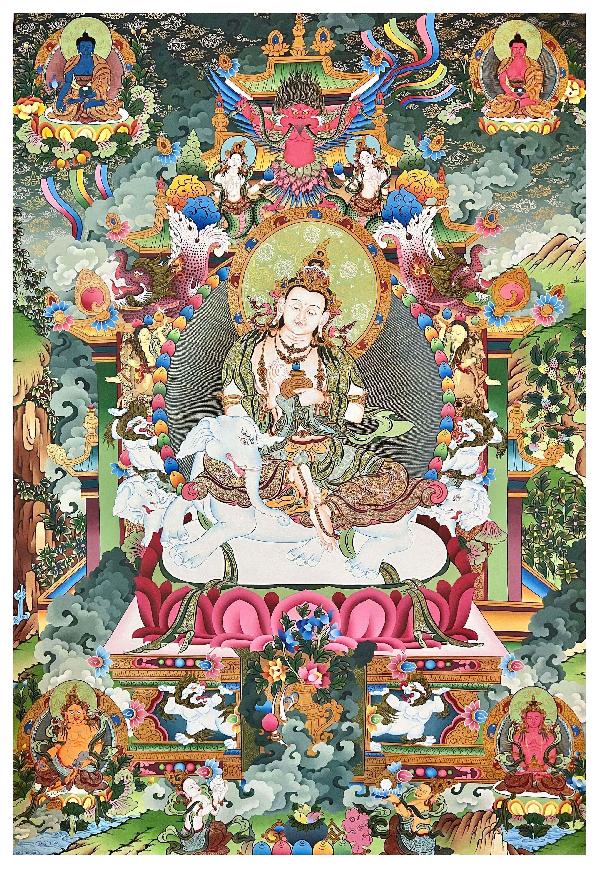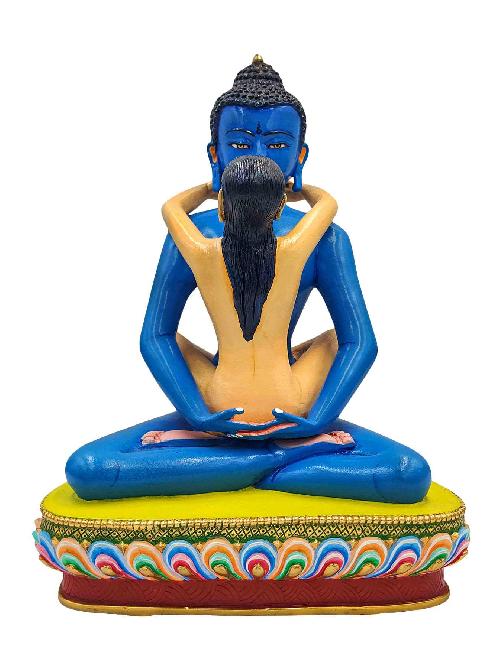


[Samantabhadra], Buddhist Handmade Statue, [Natural color finishing] and [High quality]
| Dimensions: | 22x17x16 cm (8.7 × 6.7 × 6.3 inches) |
| Gross Weight: | 2.55 kg (5.62 lbs) |
| Material: | Copper |
| Iconography / Artist: | Samantabhadra |
| Craft Origin: | Kathmandu Valley, Nepal • Ancient Heritage Technique |
| Cataloged On: | Jan 23, 2025 |
Samantabhadra
Mantra of Samathabhadra
The central concepts regarding the image
1. The original self which is perceived a pure awoken consciousness [Skt. bodhi]. The Awoken self [viz. spiritual nature] which realises the delusion of the material world which is the common perception of reality & in doing so is liberated.
1b.Understanding of the sun & moon, which themselves represent time {place} & the human condition respectively.
2a. The eternal Present moment which from the Awoken Mind of bodhi realises the union of the past, present & future.
3. The origin of all form out of which all form is derived & within to which all form dissolves into Nothingness. The nature of truth of reality, explored by the Buddhist Early Schools. These two leading schools are Sunyavada [aka. Madyamanka] & Yogacara. The realisation of the this truth of reality generates the Boddhi-sattva [the enlightened being of 'pure consciousness'.
4. According to Vajrayana Buddhism all Deities & Dakinis arose out of Samantabhadra. This idea is especially connected ot the Dhyana Buddha Familiies of Amitabha, Akshobhya, Amoghasiddhi, Ratnasambhava & Vairochana 5. Bodhissatva & figure of the Lotus Sutra [Skt. Avatamsaka Sutra] made the 10 vows to guide a bodhisattva.
Take the example of a carefree, spontaneous & happy child compared to a stressed, tired & unhappy adult. But this state of pure consciousness does not mean we have to become children again. This is merely a good example of how change can not always be for the better. The Sambhogaya state which Samantabhadra is depicted is attained though understanding & by realising the delusion of the material world. The blissful union is one of transcendent understanding & liberated awareness rather than the spontaneous naivety of a child. B. 1b. The union of the sun & moon, which themselves represent time {place} & the human condition respectively. It is beyond the common perception of the cyclical sun & moon that a person can enter the Dharmakaya & 4th Vajrakaya realms.
2. Samantabhadra symbolises the union of two. In Hinduism this union is perceived as a union of the atman [the self] with the Brahman [infinite universe]. But in Buddhism the Brahman is perceived as merely another aspect of form, & so in being a described form a veil hindering the realisation of pure consciousness. In Buddhism this union usually refers to two leading ideas which are A. The eternal Present Moment which from the origin, the Awoken Mind of bodhi realises the union of the past, present & future within the ever flowering moment of conscious reality. The blue figure of the past embraces the white figure representing the future within the eternal present. In this way Samantabhadra presents timeless awareness who was existing befoe the very notion of time itself.
Although the school of Yogācāra evolved in the 4th CE much later than the original idea of Samantabhadra, the figure of Samantabhadra is just as useful for meditating on the Principle. The discourse is founded on the existential truth of the human condition: there is nothing that humans experience that is not mediated by mind. Yogācāra thinkers did not focus on consciousness to assert it as ultimately real (Yogācāra claims consciousness is only conventionally real since it arises from moment to moment due to fluctuating causes and conditions), but rather because it is the cause of the karmic problem they are seeking to eliminate. This is to say understand original nothingness it is worthwhile reflecting on momentariness & the transitionb of one moment to the other. In Buddhism, consciousness-only or mind-only [Skt. vijñapti-mātratā, citta-mātra] is a theory according to which unenlightened conscious experience is nothing but false discriminations or imaginations. Also known as "Yogācāra-Svatantrika-Mādhyamaka" by the Tibetan tradition. In his view the Mādhyamika [aka. Sunyavada position is ultimately true and at the same time the mind-only view is a useful way to relate to conventionalities and progress students more skillfully toward the ultimate.
3. The image of Samantabhadra embodies the idea origin of phenomena which is perceived as nothingness. Phenomenal Thought-Form, including the painting of Samantabhadra itself, is believed to be derived from an original simple form. This original form is itself a illusion & ultimately nothingness. That all objects are dependent on causes & conditions which caused the object to be form which were themselves in turn dependent on others causes & conditions & so on & the ultimate emptiness of the constantly changing nature of all things. Since everything is nothingness there is a lack of autonomous existence [Skt. Nihsvabhava]. This is related principle of dependent origination of phenomena [Skt. Pratityasamutpada]. [Skt.] By the 11th CE Tibetan Buddhists in such as Patsap Drak categorised this idea into Prasangika & Svatantrika. Out of which all form is derived & within to which all form dissolves into Nothingness. This is realisation of the Sunyavada [Madyamanka] & Yogacara Schools, & is more completely explained in the Nagarjuna Tablet.
4. Samantabhadra is more commonly associated with emanation of Deific thought-form, i.e. all the Vajrayana Buddhist Deities & Dakinis which arise out of the original inception of Samantabhadra. This idea is particularly connected to Nepalese & Tibetan Buddhism & the concept of Dhyana 'Transcendent' Buddha Families of Amitabha, Akshobhya, Amoghasiddhi, Ratnasambhava & Vairochana. However, the Kagyu & Gelug schools use Vajradhara to represent the Original Buddha.
5. Samantabhadra is a key figure in the Flower Garland Sutra, particularly the last chapter, the Gandhavyuha Sutra. The Gandavyuha Sutra details the journey of the youth Sudhana, who undertakes a pilgrimage at the behest of the bodhisattva Manjushree. Sudhana will converse with 52 masters in his quest for enlightenment. The antepenultimate master of Sudhana's pilgrimage is Maitreya. It is here that Sudhana encounters The Tower of Maitreya, which along with Indra's net is one of the most startling metaphors for the infinite to emerge in the history of literature across cultures. In the middle of the great tower... he saw the billion-world universe... and everywhere there was Sudhana at his feet... Thus Sudhana saw Maitreya's practices of... transcendence over countless eons [Skt. kalpa], from each of the squares of the check board wall... In the same way Sudhana... saw the whole supernal manifestation, was perfectly aware it, understood it, contemplated it, used it as a means, beheld it, and saw himself there. In the climax of the Gandhavyuha Sutra, the student Sudhana meets the Bodhisattva Samantabhadra, who teaches him that wisdom only exists for the sake of putting it into practice; that it is only good insofar as it benefits all living beings.
Centuries-Old Lost-Wax Metal Casting
Each sculpture at Handmade Handicraft is crafted using the ancient cire-perdue (lost-wax) technique, a craft perfected over a millennium by the Newar artisans of Patan. The process begins with sculpting beeswax and Himalayan tree resin by hand. A multi-layered clay mold is formed around the wax, which is melted away in the furnace, creating a void that is filled with molten red copper or bronze.
24K Mercury Gilding
Applied with pure gold leaf and fused using fire gilding for an ethereal sheen that endures for generations.
Cold-Gold Face Painting
The sacred facial features and serene gaze of deities are carefully rendered with powdered cold gold and natural pigments.
Hand-Chiseled Detailing
Intricate robes, mandalas, and jewels are carved by hand with miniature steel chisels and devotion.
Door-to-Door Worldwide Express Delivery
Since 1976, we have shipped thousands of delicate sacred statues and handicrafts across North America, Europe, Australia, and Asia with an exceptional track record of safe delivery.
-
Express Carriers: We partner with DHL Express, FedEx International, and licensed Air Cargo freighters with end-to-end tracking.
-
Museum-Grade Packaging: Each piece is wrapped in moisture-resistant vapor barriers, thick high-density foam cushioning, and reinforced export cartons or custom wooden crates for large statues.
-
100% Transit Insurance: All international shipments are fully insured against loss or damage during transit.
-
Customs Clearance & Documentation: Includes official Nepal Archaeological Department export clearances certifying modern non-antique artisan status for hassle-free customs clearance.
Related Artisan Masterpieces