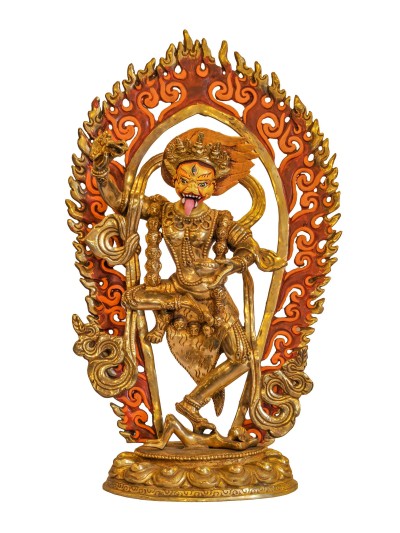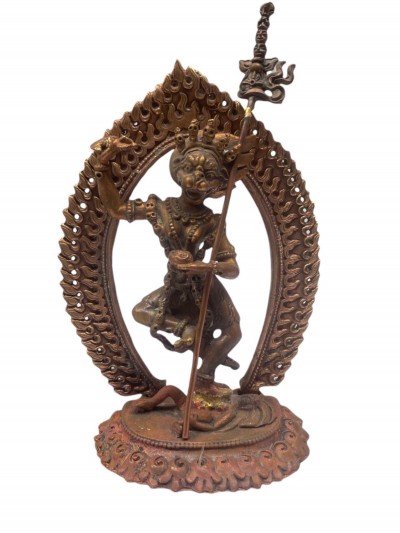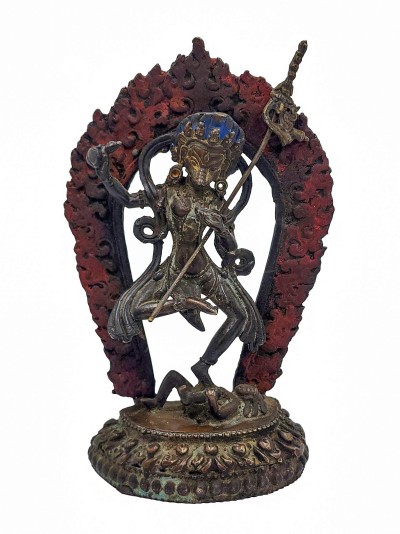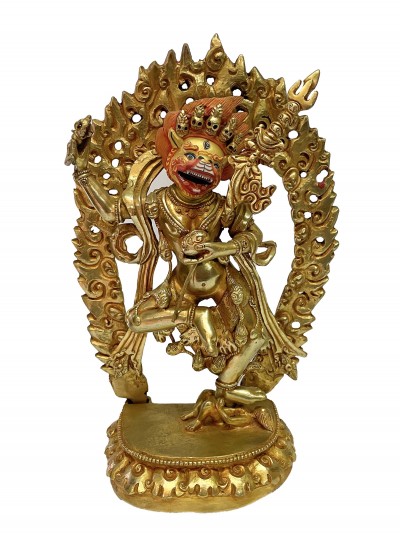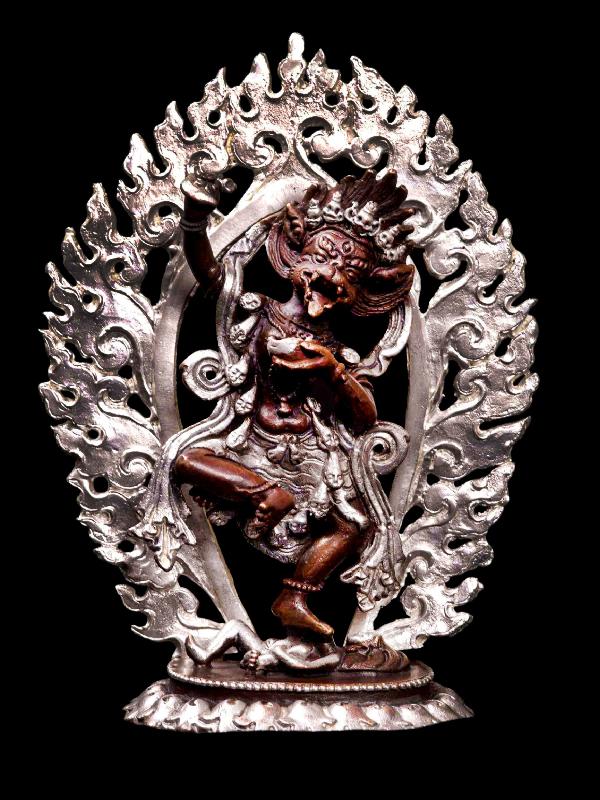


[Simhamukha Yogini], [HQ], Buddhist Miniature Statue, [Silver and Chocolate Oxidized]
| Dimensions: | 15x12x5 cm (5.9 × 4.7 × 2 inches) |
| Gross Weight: | 0.4 kg (0.88 lbs) |
| Material: | Copper |
| Iconography / Artist: | Simhamukha Yogini |
| Craft Origin: | Kathmandu Valley, Nepal • Ancient Heritage Technique |
| Cataloged On: | Jan 26, 2026 |
Simhamukha Yogini
Simhamukha is iconographically represented as a wrathful deity who is usually depicted as a dark blue, or maroon, coloured lion-faced female and is associated with the direction East. As Simhavaktra, an alternate form of Simhamukha, she is also an attendant of the Dharmapala Palden Lhamo, in which case she is depicted as carrying both a kapala, or skullcup, and a kartika, or ritual knife.
According to Sengdongma (lion-faced dakini) is a wrathful manifestation of Padmasambhava [Guru Rinpoche] who eliminates obstacles, whereas Sinhavaktra is a dark blue Lion-head Dakini who dispels obstacles to enlightenment. She holds a broad-bladed knife and skull cup.
Simhamukha usually indicates Rahu (eclipse). One of the nine planets, Rahu stands for a devourer. There is a Puranic story. During the fight between gods and demons for nectar or Amrita, the demon Rahu tried to get a sip of drink of immortality, stealthily. But he was caught in the nick of time by the Surya (the Sun God) and Chandra (the Moon God) and Lord Vishnu was informed instantly. He cut off Rahu's head. But the head became immortal, having tasted a drop of nectar. Rahu now tried to swallow Sun and Moon when they passed near him. During eclipses (grahana), this scene is repeated according to believers.
Rahu is the son of Simhika or the lioness, who symbolizes destruction. The incarnation of Narasimha has this concept behind it. The earliest carving of Kirtimuka or Simhamukha is seen in the stupa at Amaravati (2nd century C.E.). Dancers of Cambodia use Kirtimuka as a headdress. Artifacts and any worship-worthy idols or mandaps carry this symbol.
==Tibet == Within the Nyingma School, of the two divisions of Kama (Oral Teachings) and Terma (Revealed Treasures), Simhamukha belongs to the Terma. From the three general divisions of Terma: Root, Branch and Essence, Simhamukha belongs to the Dakini Cycle within the Root Terma class. Only in the Nyingma tradition she is regarded as the secret form of Guru Rinpoche Padmasambhava. Otherwise, in the Sarma Traditions coming from India, the deity Simhamukha is found in the Chakrasamvara Cycle of Tantras. Although both forms are similar in name and appearance, they are unrelated.
The dakini Simhamukha is a tutelary deity arising out of the Chakrasamvara cycle of Tantras and belongs to the Anuttarayoga 'wisdom' classification. The Sarma tradition Simhamukha is unrelated to the deity of the same name and appearance in the Nyingma 'terma' (treasure) traditions. In that tradition, of the many forms of Padmasambhava, Simhamukha is a secret form of Guru Rinpoche.
Gelugpa lineage: Vajradhara, Dakini Simhamukha, Vajrasana, Bari Lotsawa Rinchen Drag, Sachen Kunga Nyingpo (1092-1158) and the five Holy Superiors of Sakya, Rongpa Dorje Gyaltsen, Sanggye Yeshe, Yak De Panchen, Gyalwa Tsongkapa (1357-1419), etc.
There is reference to this protector's emanations in the Shurangama Mantra found in the Tibetan Chandragomin's Shurangama Mantra Sadhana translated from the original Buddhist Hybrid Sanskrit into Tibetan (Tibetan canon Tengyur Karchag Phangthangma Toh 3096, Toh 593/2/1), and also Padmankusha's Text Toh 3106, and the Vajrasana's Text Toh 3110 - Sarvatathāgataoṣṇīṣaśitātapatrā-nāmāparājitā-mahāpratyangirā-mahāvidyārājñī-nāma-dhāraṇī; Tibetan name is ['phags pa] De bshin gshegs pa'i gtsug tor nas byung ba'i gdugs dkar po can gshan gyi mi thub pa phir bzlog pa chen mo mchog tu grub pa shes bya ba'i gzungs.
Item Specific Details & Notes
Centuries-Old Lost-Wax Metal Casting
Each sculpture at Handmade Handicraft is crafted using the ancient cire-perdue (lost-wax) technique, a craft perfected over a millennium by the Newar artisans of Patan. The process begins with sculpting beeswax and Himalayan tree resin by hand. A multi-layered clay mold is formed around the wax, which is melted away in the furnace, creating a void that is filled with molten red copper or bronze.
24K Mercury Gilding
Applied with pure gold leaf and fused using fire gilding for an ethereal sheen that endures for generations.
Cold-Gold Face Painting
The sacred facial features and serene gaze of deities are carefully rendered with powdered cold gold and natural pigments.
Hand-Chiseled Detailing
Intricate robes, mandalas, and jewels are carved by hand with miniature steel chisels and devotion.
Door-to-Door Worldwide Express Delivery
Since 1976, we have shipped thousands of delicate sacred statues and handicrafts across North America, Europe, Australia, and Asia with an exceptional track record of safe delivery.
-
Express Carriers: We partner with DHL Express, FedEx International, and licensed Air Cargo freighters with end-to-end tracking.
-
Museum-Grade Packaging: Each piece is wrapped in moisture-resistant vapor barriers, thick high-density foam cushioning, and reinforced export cartons or custom wooden crates for large statues.
-
100% Transit Insurance: All international shipments are fully insured against loss or damage during transit.
-
Customs Clearance & Documentation: Includes official Nepal Archaeological Department export clearances certifying modern non-antique artisan status for hassle-free customs clearance.
Related Artisan Masterpieces