


| Dimensions: | 11x16x16 cm (4.3 × 6.3 × 6.3 inches) |
| Gross Weight: | 0.55 kg (1.21 lbs) |
| Craft Origin: | Kathmandu Valley, Nepal • Ancient Heritage Technique |
| Cataloged On: | Oct 09, 2026 |
Citipati
Durga
Ganesh
Youtube Mantra Link
Although he is known for many other attributes, Ganesha's elephant head makes him particularly easy to identify. Ganesha is widely revered as the Remover of Obstacles and more generally as Lord of Beginnings and Lord of Obstacles, patron of arts and sciences, and the deva of intellect and wisdom. He is honored at the beginning of rituals and ceremonies and invoked as Patron of Letters during writing sessions. Several texts relate mythological anecdotes associated with his birth and exploits and explain his distinct iconography.
Ganesha has the head of an elephant and a big belly. This statue has four arms, which is common in depictions of Ganesha. He holds his own broken tusk in his lower-right hand and holds a delicacy, which he samples with his trunk, in his lower-left hand. The motif of Ganesha turning his trunk sharply to his left to taste a sweet in his lower-left hand is a particularly archaic feature. A more primitive statue in one of the Ellora Caves with this general form has been dated to the 7th century.[38] Details of the other hands are difficult to make out on the statue shown. In the standard configuration, Ganesha typically holds an axe or a goad in one upper arm and a noose in the other upper arm.
Ganesha is Vighneshvara or Vighnaraja, the Lord of Obstacles, both of a material and spiritual order. He is popularly worshipped as a remover of obstacles, though traditionally he also places obstacles in the path of those who need to be checked. Paul Courtright says that "his task in the divine scheme of things, his dharma, is to place and remove obstacles. It is his particular territory, the reason for his creation."
Krishan notes that some of Ganesha's names reflect shadings of multiple roles that have evolved over time. Dhavalikar ascribes the quick ascension of Ganesha in the Hindu pantheon, and the emergence of the Ganapatyas, to this shift in emphasis from vighnakart? (obstacle-creator) to vighnahart? (obstacle-averter). However, both functions continue to be vital to his character, as Robert Brown explains, "even after the Pur??ic Ga?e?a is well-defined, in art Ga?e?a remained predominantly important for his dual role as creator and remover of obstacles, thus having both a negative and a positive aspect
Buddhi (Knowledge)
Ganesha is considered to be the Lord of letters and learning. In Sanskrit, the word buddhi is a feminine noun that is variously translated as intelligence, wisdom, or intellect. The concept of buddhi is closely associated with the personality of Ganesha, especially in the Puranic period, when many stories stress his cleverness and love of intelligence. One of Ganesha's names in the Ganesha Purana and the Ganesha Sahasranama is Buddhipriya. This name also appears in a list of 21 names at the end of the Ganesha Sahasranama that Ganesha says are especially important. The word Priya can mean "fond of", and in a marital context it can mean "lover" or "husband", so the name may mean either "Fond of Intelligence" or "Buddhi's Husband"
Frist Chakra
According to Kundalini yoga, Ganesha resides in the first chakra, called Muladhara (m?l?dh?ra). Mula means "original, main " adhara means "base, foundation". The Muladhara chakra is the principle on which the manifestation or outward expansion of primordial Divine Force rests.[95] This association is also attested to in the Ganapati Atharvashirsa. You continually dwell in the sacral plexus at the base of the spine. Thus, Ganesha has a permanent abode in every being at the Muladhara. Ganesha holds, supports and guides all other chakras, thereby "governing the forces that propel the wheel of life"
Aparimita
Mantra of Amitayus
Om A Ma Ra Ni Dzi Wan Ti Ye Soha
ओं अमरणि जीवन्तये स्वाहा
Akash Bhairav
The head of the Aakash Bhairav was dug up several hundred years ago in Kathmandu. The head now resides in a Hindu temple in Kathmandu not far from Durbar Square and is taken out of the temple once a year and is blessed by the Kumari - the living goddess who lives in the nearby Kumari Chowk. He is also known as King Yalamber of Kirat, Aju dya for Newars, and Barbarik, grandson of Bhimsen, In the common Kathmandu myth he is the god who will always fight for the weak or the losing side. Hence he is one of the beloved gods of the people of Kathmandu and is considered as the ancestor god of the people of Kathmandu.
AGNI
ANKUSH
Akshamala
Bana
Bina
Chakra
Chandra
Kapala
Pa
Chhatra
Chamaru
Dipa
Dhanusa
Dhwoja
Gada
Kangling
Kalas
Mayurpiccha
Pustak
Surya
Trishul
Utpala
Mukha
Purna Kalash
The Kalasha is included in the Ashtamangala lists of both the Svetambara and Digambara sects of Jainism. Two eyes are depicted around the Kalasha, symbolising right faith and right knowledge. It is used for religious and social ceremonies. It is used in temples when certain images are being worshipped. When one enters a new home it is customary to carry the kalasha on the head reciting mantras. This ceremony is performed to welcome grace and happiness into the new home. They first appear in stone in the Kushan Empire period (65-224 AD). It is a symbol of auspiciousness.
Ganesh Skunda
Ghau
Bhuma
Singa Asan
Kurmasana
Sayana Asana
Nrityamurti Asana
Dhayan Asan
Lalit Asana
Paryanka Asana
Rajalila Asana
Samapada Asana
Alidh Asana
Abhaya Mudra
This mudra, which initially appears to be a natural gesture, was probably used from prehistoric times as a sign of good intentions - the hand raised and unarmed proposes friendship, or at least peace; since antiquity, it was a plain way of showing that you meant no harm since you did not carry any weapon.
Buddhist tradition has an interesting legend behind this mudra:
Devadatta, a cousin of the Buddha, through jealousy caused a schism to be caused among the disciples of Buddha. As Devadatta's pride increased, he attempted to murder the Buddha. One of his schemes involved loosing a rampaging elephant into the Buddha's path. But as the elephant approached him, Buddha displayed the Abhaya mudra, which immediately calmed the animal. Accordingly, it indicates not only the appeasement of the senses, but also the absence of fear.
In Gandhara art, this mudra was sometimes used to indicate the action of preaching. This is also the case in China where it is very commonly found in images of the Buddha, mainly in the Wei and Sui eras (fourth to seventh centuries).
The Abhaya mudra is displayed by the fifth Dhyani Buddha, Amoghasiddhi. He is also the Lord of Karma in the Buddhist pantheon. Amoghasiddhi helps in overcoming the delusion of jealousy. By meditating on him, the delusion of jealousy is transformed into the wisdom of accomplishment. This transformation is hence the primary function of the Abhaya mudra.
But it is not just the divine Buddha who is credited with making mudras. Every position assumed and every gesture performed by our mortal body may be said to imprint its seal on the Ether, and sent forth a continuous stream of vibrations that impress the atmosphere. But to be really effective there must be a deliberate and intended arrangement of the body or parts of the body. Such an arrangement is nothing but the yoga of mudra. It is interpreted as being able to bring the physiological system in harmony with the cosmic forces and so form a magical microcosm through which the macrocosm can be represented, channeled, and utilized. The mudra in all its variations is, therefore, a traditional body pattern; an archetypal posture of performed occult significance.
We perform mudras in every action, every moment of the day. Each action is a symbol of our underlying mental and physical condition and results because of the various energy patterns forming within our being. These patterns determine our personality character and mannerism and expressions. Thus our every moment is an expression of our inner-nature. Consciously performing mudras allow us to become more aware of inner energy and to control it so that we make the most of each moment. The effect is total, at once subtle but powerful. In this way, we learn to integrate our dissipated thoughts and actions, so that life becomes a graceful flow of energy and understanding. Our whole being can then become a mudra, a gesture of life within, reflecting into our external life.
Bhumisparsa Mudra
This gesture is Characteristic of Dhyani Buddha Akshobhya as well as Shakyamuni.
Dharmchakra Mudra
This mudra symbolizes one of the most important moments in the life of Buddha, the occasion when he preached to his companions the first sermon after his Enlightenment in the Deer Park at Sarnath. It thus denotes the setting into motion of the Wheel of the teaching of the Dharma.
The three remaining fingers of the two hands remain extended. These fingers are themselves rich in symbolic s
ignificance:
The three extended fingers of the right hand represent the three vehicles of the Buddha's teachings, namely:
The middle finger represents the 'hearers' of the teachings
The ring finger represents the 'solitary realizers'
The Little finger represents the Mahayana or 'Great Vehicle'.
The three extended fingers of the left hand symbolize the Three Jewels of Buddhism, namely, the Buddha, the Dharma, and the Sangha.
Significantly, in this mudra, the hands are held in front of the heart, symbolizing that these teachings are straight from the Buddha's heart.
This mudra is displayed by the first Dhyani Buddha Vairochana. Each of the five Dhyani Buddhas is associated with a specific human delusion, and it is believed that they help mortal beings in overcoming them. Thus, Vairochana is believed to transform the delusion of ignorance into the wisdom of reality. By displaying the Dharmachakra mudra, he thus helps adepts in bringing about this transition.
Dhyana Mudra
The Dhyana mudra is the mudra of meditation, of concentration on the Good law, and of the attainment of spiritual perfection. According to tradition, this mudra derives from the one assumed by the Buddha when meditating under the pipal tree before his Enlightenment. This gesture was also adopted since time immemorial, by yogis during their meditation and concentration exercises. It indicates the perfect balance of thought, rest of the senses, and tranquility.
This mudra is displayed by the fourth Dhyani Buddha Amitabha, also known as Amitayus. By meditating on him, the delusion of attachment becomes the wisdom of discernment. The Dhyana mudra helps mortals achieve this transformation.
Jnana Mudra
Namaskar Mudra
Tarjani Mudra
Vajrahunkar Mudra
Varda Mudra
Generosity
Morality
Patience
Effort
Meditative Concentration
This mudra is rarely used alone, but usually in combination with another made with the right hand, often the Abhaya mudra (described below). This combination of Abhaya and Varada mudras is called Segan Semui-in or Yogan Semui-in in Japan.
Vitarka Mudra
Vajrayogini
Mantra of Vajrajogni
ḍā ki ṇī ye va jra va
rṇa nī ye va jra vai ro
ca nī ye hūṃ hūṃ hūṃ pha
ṭ pha ṭ pha ṭ svā hā
According to scholar Miranda Shaw, Vajrayoginī is "inarguably the supreme deity of the Tantric pantheon. No male Buddha, including her divine consort, Heruka Chakrasaṃvara, approaches her in metaphysical or practical import."A number of lamas and other contemporary scholars do in fact argue otherwise, as Vajradhāra is widely considered the supreme deity of the Tantric pantheon, but the importance of Vajrayoginī is agreed upon.
Vajrayoginī is visualized as the translucent, deep red form of a 16 year old female with the third eye of wisdom set vertically on her forehead. Vajrayoginī is generally depicted with the traditional accoutrements of a ḍākiṇī including a cleaver (Tib. drigug, Skt. kartṛī) marked with a vajra in her right hand and a kapala (skull cup) in her left hand which is filled with blood that she partakes of with her upturned mouth. Her consort Chakrasaṃvara is often symbolically depicted as a khaṭvāṇga on Vajrayoginī's left shoulder, when she is in 'solitary hero' form. Vajrayoginī's khatvanga is marked with a vajra and from it hang a damaru drum, a bell, and a triple banner. Her extended right leg treads on the chest of red Kālarātri, while her bent left leg treads on the forehead of black Bhairava, bending his head backward and pressing it into his back at the level of his heart. Her head is adorned with a crown of five human skulls and she wears a necklace of fifty human skulls. She is depicted as standing in the center of a blazing fire of exalted wisdom.
Each aspect of Vajrayoginī's form and mandala is designed to convey a spiritual meaning. For example, her brilliant red-colored body symbolizes the blazing of her inner fire (Tib. tummo). Her single face symbolizes that she has realized that all phenomena are of one nature in emptiness. Her two arms symbolize her realization of the two truths. Her three eyes symbolize her ability to see everything in the past, present and future. She looks upward toward the Pure Dākiṇī Land (Skt. Kechara), demonstrating her attainment of outer and inner Pure Dākiṇī Land, and indicating that she leads her followers to these attainments. The curved drigug knife in her right hand shows her power to cut the continuum of the delusions and obstacles of her followers and of all living beings. Drinking the nectar of blood from the kapala in her left hand symbolizes her experience of the clear light of bliss.
In her form as Vajravārāhī, when she is known as 'the Vajra Sow' she is often pictured with a sow's head on the side of her own as an ornament and in one form has the head of a sow herself. Vajrayoginī is often associated with triumph over ignorance, the pig being associated with ignorance in Buddhism. This sow head relates to the origins of Vajravārāhī from the Hindu sow-faced goddess Vārāhī.
The severed-headed form of Vajrayoginī is similar to the Indian goddess Chinnamasta who is recognized by both Hindus and Buddhists
Wheel of Life
Second Layer Karma
The second layer of the wheel shows two-half circles:
One half-circle (usually light) shows contented people moving upwards to higher states, possibly to the higher realms.
The other half-circle (usually dark) shows people in a miserable state being led downwards to lower states, possibly to the lower realms.
These images represent karma, the law of cause and effect. The light half-circle indicates people experiencing the results of positive actions. The dark half-circle indicates people experiencing the results of negative actions.
God realm:the gods lead long and enjoyable lives full of pleasure and abundance, but they spend their lives pursuing meaningless distractions and never think to practice the dharma. When death comes to them, they are completely unprepared; without realizing it, they have completely exhausted their good karma (which was the cause for being reborn in the god realm) and they suffer through being reborn in the lower realms
Demi-god realm:the demi-gods have pleasure and abundance almost as much as the gods, but they spend their time fighting among themselves or making war on the gods. When they make war on the gods, they always lose, since the gods are much more powerful. The demi-gods suffer from constant fighting and jealousy, and from being killed and wounded in their wars with each other and with the gods.
Human realm: humans suffer from hunger, thirst, heat, cold, separation from friends, being attacked by enemies, not getting what they want, and getting what they don't want. They also suffer from the general sufferings of birth, old age, sickness and death. Yet the human realm is considered to be the most suitable realm for practicing the dharma, because humans are not completely distracted by pleasure (like the gods or demi-gods) or by pain and suffering (like the beings in the lower realms).
The three lower realms are:
Animal realm: wild animals suffer from being attacked and eaten by other animals; they generally lead lives of constant fear. Domestic animals suffer from being exploited by humans; for example, they are slaughtered for food, overworked, and so on.
Hungry ghost realm: hungry ghosts suffer from extreme hunger and thirst. They wander constantly in search of food and drink, only to be miserably frustrated any time them come close to actually getting what they want. For example, they see a stream of pure, clear water in the distance, but by the time the get there the stream has dried up. Hungry ghosts have huge bellies and long thin necks. On the rare occasions that they do manage to find something to eat or drink, the food or water burns their neck as it goes down to their belly, causing them intense agony.
Hell realm: hell beings endure unimaginable suffering for eons of time. There are actually eighteen different types of hells, each inflicting a different kind of torment. In the hot hells, beings suffer from unbearable heat and continual torments of various kinds. In the cold hells, beings suffer from unbearable cold and other torments.
Generally speaking, each realm is said to be the result of one of the six main negative emotions: pride, jealousy, desire, ignorance, greed, and anger. Dzongsar Khyentse states:
So we have six realms. Loosely, you can say when the perception comes more from aggression, you experience things in a hellish way. When your perception is filtered through attachment, grasping or miserliness, you experience the hungry ghost realm. When your perception is filtered through ignorance, then you experience the animal realm. When you have a lot of pride, you are reborn in the god realm. When you have jealousy, you are reborn in the asura (demi-god) realm. When you have a lot of passion, you are reborn in the human realm. Among the six realms, the human realm is considered to offer the best opportunity to practice the dharma. Dzongsar Khyentse states:
If we need to judge the value of these six realms, the Buddhists would say the best realm is the human realm. Why is this the best realm? Because you have a choice... The gods don't have a choice. Why? They're too happy. When you are too happy you have no choice. You become arrogant. The hell realm: no choice, too painful. The human realm: not too happy and also not too painful. When you are not so happy and not in so much pain, what does that mean? A step closer to the normality of mind, remember? When you are really, really excited and in ecstasy, there is no normality of mind. And when you are totally in pain, you don't experience normality of mind either. So someone in the human realm has the best chance of acquiring that normality of mind. And this is why in Buddhist prayers you will always read: ideally may we get out of this place, but if we can't do it within this life, may we be reborn in the human realm, not the others.
Sometimes, the wheel is represented as only having five realms because the God realm and the Demi-god realm are combined into a single realm.
In some representations of the wheel, there is a buddha or bodhisattva depicted within each realm, trying to help sentient beings find their way to nirvana.
Robert Beer
Buddha Life Story
Gautama Buddha, the historical Buddha, lived between 563 and 483 BC in the area known now as the Indo-Nepalese region. As a bodhisattva, he had passed through thousands of existences before coming to Earth for his ultimate transmigration.
This last lifetime he began as a son of the King of the realm Sakya, Sudhodana, who ruled at Kapilavastu, in Ancient India on the border of present-day Nepal, and was born in a village called Lumbini into the warrior tribe called the Sakyas (from where he derived the title Sakyamuni, meaning "Sage of the Sakyas").
Five days after his birth, the young prince received the name of Siddhartha. When his parents took him to the temple, the statues of the gods prostrated themselves before him, great were the rejoicings of the people over the birth of this illustrious prince. Also at this time a devout old man named Asita came down from the Himalayas to meet the newborn prince. An ascetic of high spiritual attainments, Asita was particularly pleased to hear this happy news. Having been a tutor to the King, he visited the palace to see the royal baby. The king, who felt honoured by his unexpected visit, carried the child up to him in order to make the child pay him due reverence. To the surprise of all, the child's legs turned and rested on the matted locks of the ascetic.
Instantly, the ascetic rose from his seat and recognizing in the young child the 80 signs that are pledges to a highly religious vocation, and foreseeing with his supernormal vision the child's future greatness, saluted him with clasped hands. The Royal father did likewise. The great ascetic smiled at first and then was sad. Questioned regarding his mingled feelings, he answered that he smiled because the prince would eventually become a Buddha, an Enlightened One, and he was sad because he would not be able to benefit from the superior wisdom of the Enlightened One owing to his prior death and rebirth in a Formless Plane.
After seven days Queen Maya died, and her place as mother was taken by her sister, whose devotion and love became legendary.
When the young prince was in his twelfth year, the king called the wise Brahmans in council. They revealed that Siddhartha would devote himself to asceticism if he cast his eyes on age, sickness, or death ~ and, if he were to meet a hermit.
Wanting his son to be a universal monarch instead, the king surrounded the palace with a triple enclosure and guard and proclaimed that the use of the words death and grief were forbidden. The most beautiful princess in the land, Yasodhara, was found for his bride, and after Siddhartha proved himself in many tournaments calling for strength and prowess, when he was 16, the two were wed.
Siddhartha was kept amused and entertained for some time by this privileged life behind the palace walls until one day his divine vocation awoke in him, and he decided to visit the nearby town. The king called for everything to be swept and decorated, and any ugly or sad sight to be removed. But these precautions were in vain for while Siddhartha was travelling through the streets, an old wrinkled man appeared before him. In astonishment the young prince learned that decrepitude is the fate of those who live life through. Still later he met an incurable invalid and then a funeral procession. Finally heaven placed in his path an ascetic, a beggar, who told Siddhartha that he had left the world to pass beyond suffering and joy, to attain peace at heart.
Confirmed in his meditation, all these experiences awakened in Siddhartha the idea of abandoning his present life and embracing asceticism. He opened his heart to his father and said, "Everything in the world is changing and transitory. Let me go off alone like the religious beggar."
Grief-stricken at the idea of losing his son, the king doubled the guard around the walls and increased the pleasures and distractions within. And at this point, Yasodhara bore him a son whom he called Rahula (meaning "chain" or "fetter"), a name that indicated Gautama's sense of dissatisfaction with his life of luxury, while the birth of his son evoked in him much tenderness. His apparent sense of dissatisfaction turned to disillusion when he saw three things from the window of his palace, each of which represented different forms human suffering: a decrepit old man, a diseased man, and a corpse.Yet even this could not stop the troubling thoughts in his heart or close his eyes to the realizations of the impermanence of all life, and of the vanity and instability of all objects of desire.
His mind made up, he awoke one night and, casting one last look at his wife and child, mounted his horse Kataka and rode off accompanied by his equerry Chandaka. At the city gates Siddhartha turned over his horse to Chandaka, then he cut off his hair, gave up his sumptuous robes, and entered a hermitage where the Brahmans accepted him as a disciple. Siddhartha had now and forever disappeared. He became the monk Gautama, or as he is still called, Sakyamuni, the ascetic of the Sakyas.
For many years Gautama studied the doctrines until, having felt the need to learn more elsewhere, he traveled and fasted. His two teachers had showed him how to reach very deep states of meditation (samadhi). This did not, however, lead to a sense of true knowledge or peace, and the practice of deep meditation was abandoned in favour of a life of extreme asceticism which he shared with five companions. But again, after five or six years of self-mortification, Siddhartha felt he had failed to achieve true insight and rejected such practices as dangerous and useless.
Resolved to continue his quest, Siddharta made his way to a deer park at Isipatana, near present day Benares. Here he sat beneath a tree meditating on death and rebirth. Discovering that excessive fasts destroy strength, he learned that as he had transcended earthly life, so must he next transcend asceticism. Alone and weak, he sat beneath the sacred Bodhi tree of wisdom, and swore to die before arising without the wisdom he sought.
Mara, the demon, fearful of Gautama's power, sent his three beautiful daughters to distract him. When that failed, Mara sent an army of devils to destroy him. Finally Mara attacked Gautama with a terrible weapon capable of cleaving a mountain. But all this was useless, and the motionless monk sat in meditation.
It was here that Siddharta attained a knowledge of the way things really are; it was through this knowledge that he acquired the title Buddha (meaning "awakened one"). This awakening was achieved during a night of meditation, which passed through various stages as the illumination that Gautama had sought slowly welled up in his heart. He knew the exact condition of all beings and the causes of their rebirths. He saw beings live, die and transmigrate. In meditating on human pain, he was enlightened about both its genesis and the means of destroying it.
In this first stage he saw each of his previous existences, and then understood the chain of cause and effect. In the second he surveyed the death and rebirth of all living beings and understood the law that governs the cycle of birth and death. In the third he identified the Four Noble Truths: the universality of suffering, the cause of suffering through selfish desire, the solution to suffering and the way to overcome suffering. This final point is called the Noble Eightfold Path, this being eight steps consisting of wisdom (right views, right intention) ethics (right speech, right action, right livelihood), mental discipline (right effort, right mindfulness, right concentration), which ultimately lead to liberation from the source of suffering.
When day came, Gautama had attained perfect illumination, and had become a Buddha. The rays emanating from his body shone to the boundaries of space. He stayed in meditation for seven more days, and then for four more weeks he stayed by the tree. Through his process of enlightenment he discovered that all sentient beings in this universal life possess buddhahold, and all are future potential buddhas.
From that time he had two alternate paths: he could enter Nirvana immediately, or else he could stay and spread enlightenment. After Brahma came in person to beg him to preach the law, Buddha yielded and stayed on the earth. For many years he traveled and taught his wisdom about the force of love and the destruction of all desire.
Although initially hesitant to share his insight on the grounds that humanity might not be ready for such a teaching, the Buddha decided to communicate his discovery to those willing to listen. His first converts were the five ascetics with whom he had lived when he himself followed the lifestyle of the ascetic. To these he preached his first sermon in the Deer Park at Benares, outlining to them the Four Noble Truths. Out of this small group the community of monks (or Sangha) grew to about 60 in size and came to include Buddha's cousin, Ananda, and his son, Rahula. Later the Buddha was persuaded by his stepmother and cousin to accept women into the sangha.
The remaining 45 years of the Buddha's life were spent journeying around the plain of the Ganges, teaching and receiving visitors.
"There are two extremes which are to be avoided: a life of pleasure ~ this is low and ignoble, unworthy and useless, and runs counter to the affairs of the spirit; and a life of fasting ~ this is sad, unworthy and useless. Perfection has kept its distance from these two extremes, and has found the middle way which leads to repose, knowledge, illumination, and Nirvana. So here is the sacred truth about pain: birth, old age, sickness, death, and separation from that which one loves, are pain. And this is the origin of pain: it is thirst for pleasure, thirst for existence, thirst for impermanence. And here is the truth about the suppression of pain: it is the extinction of that thirst by the destruction of desire.
"Charity, knowledge and virtue are possessions that cannot be lost. To do a little good is worth more than accomplishing works of a difficult nature. The perfect man is nothing unless he pours out kindness on his fellow creatures, unless he consoles the abandoned. My doctrine is a doctrine of mercy. The way of salvation is open to all. Destroy your passions as the elephant would trample down a reed hut. But I would have you know that it is a mistaken idea to believe that one can escape from one's passions by taking shelter in hermitages. The only remedy against evil is healthy reality."
And so Buddha travelled and preached. He performed many miracles, and converted his family and many followers. During his life the Buddha had taught that no one was to succeed him as leader of the Sangha. Instead, his followers were to take his teaching and rule as their sole guides. By the time he reached the age of 80, Sakyamuni began to feel old. He visited all of the monasteries he had founded and prepared to meet his end.
Before the Buddha's death, he became severely sick. He journeyed northwest to the banks of the river Hiranyavati, walking with his disciples, and ate the food offered by a blacksmith. His illness had progresses, and at the end, he came to the river and took a bath. Then he made a rope bed among eight sal trees, with each direction having two. He lay down on his side, right hand supporting his head, the other resting on his body. All later reclining Buddhas (called Buddha's Nirvana) are in the same posture.
The Buddha's disciples kept watch on him after they were told the Buddha was going to nirvana. At night, a scholar of Brahman went to see the Buddha, but was stopped by the Buddha's disciple Ananda. Hearing this, the Buddha called the scholar Subhadda to his bed and spoke him. Thus the scholar became the Buddha's last disciple. The final exhortation of the Buddha to his disciples was that they should not be sorry for losing their tutor. (See the last sermon of the Buddha for
Growing weaker, he spoke one last time: "Do not say we have no master now. The doctrine I have preached will be your master when I have disappeared. Listen, I beg you: ALL CREATIONS ARE IMPERMANENT; work diligently for your liberation."
Having pronounced these final words, Buddha went into the jhana stages, or meditative absorptions. Going from level to level, one after the other, ever deeper and deeper, he reached ecstacy. Then he came out of the meditative absorption for the last time and passed into nirvana, leaving nothing whatever behind that can cause rebirth again in this or any other world.and finally passed into Nirvana.
After his death, Buddha's remains were cremated, as became the Buddhist tradition. The passing away, or the final nirvana, of the Buddha occurred in 483 BC on a full moon day in the month of May, known in the Indian calendar as Wesak.
Kalachakra Mandala
Mantra of Kalachakra
Each mandala is a sacred mansion, the home of particular meditational deity, who represent and embodies enlightened qualities ranging from compassion to heightened consciousness and bliss. In the Tibetan Buddhist tradition, mandalas are created for rituals of initiation in which a highly qualified teacher grants permission to advanced disciples to engage in the tantric meditation practices. Both the deity, which resides at the centre of the mandala, and the mandala itself are recognised as pure expressions of the Buddha's fully enlightened mind. Symbolically the deity confers the initiations and the mandala is where the initiations takes place. Through the initiations ceremony the seed of enlightenment in each person's mind is nourished by the dynamic process of visualising and contemplating a mandala.
In essence the ceremony involves the transportation of disturbing emotions into beneficial intuition and wisdom. Normally such an initiation is given at the request of an individual or group of people. The altruistic motivation of the artist and sponsor is essential to the creation of mandala.
The Kalachakra Tantra is interpreted at three levels referred to as external, internal and alternative. The external concerns the laws of time and space of this physical world and accordingly deals with astronomy, astrology and mathematics. The internal concerns the elements and structure of the human body, including its energy system. The alternative is the doctrine, path and fruit of the actual meditational deity and its circular mandala abode.
The Kalachakra deity resides in the centre of the mandala. His palace consists of our mandala, one within another: the mandala of body, the mandala of speech, that of mind, and the very centre, wisdom and great bliss.
The palace is divided into four quadrants each with walls, gates, and a centre. The colours are specific representations of the elements and mental types. Black, in the east, is associated with the element of winds. The south is red, its elements is fire. The west is yellow, associated with the element of earth, and the north is white, represent water.
The square palace of the 722 deities is seated upon the first concentric circles, the first of which of which represents the earth. The other circles, represent water, fire, wind, space, and consciousness extend beyond the wall of the palace. The outer circles, a representation of the cosmos, is a source of Tibetan astrology. The ten wrathful deities who reside in one of the outer, concentric circles of the mandala serve as its protectors.
The Kalachakra sand mandala is dedicated to peace and physical balance, both for individual and for the world, thanks to the deities carefully among minute human, animal and floral forms, abstract pictographs, and the Sanskrit syllables that comprises the mandala's design.
Although depicted here on a flat surface, the mandala is actually three-dimensional, being a five-storeyed "divine mansion", at the centre of which stands the Kalachakra deity the manifest state of Enlightenment.
A person who simply sees this mandala many feel peace on many levels. According to the Dalai Lama, the Kalachakra deities create a favourable atmosphere, reducing tension and violence in the world. "It is a way of planting a seed, and the seed will have karmic effect. One doesn't need to be present at the Kalachakra ceremony in order to receive its benefits," he explains.
Mandala
Tibetan for mandala in Vajrayana Buddhism usually depicts a landscape of the "Buddha-land", or the enlightened vision of a Buddha, which inevitably represents the nature of experience and the intricacies of both the enlightened and confused mind, or "a microcosm representing various divine powers at work in the universe." Such mandalas consist of an outer circular mandala and an inner square (or sometimes circular) mandala with an ornately decorated mandala "palace" placed at the center. Any part of the inner mandala can be occupied by Buddhist glyphs and symbols, as well as by images of its associated deities, which "symbolise different stages in the process of the realisation of the truth."
Kvarne (1975: p. 164) in his extended discussion of sahaja, discusses the relationship of sadhana interiority and exteriority in relation to mandala thus:
"...external ritual and internal sadhana form an indistinguishable whole, and this unity finds its most pregnant expression in the form of the mandala, the sacred enclosure consisting of concentric squares and circles drawn on the ground and representing that adamant plane of being on which the aspirant to Buddha hood wishes to establish himself. The unfolding of the tantric ritual depends on the mandala; and where a material mandala is not employed, the adept proceeds to construct one mentally in the course of his meditation."
Mandalas are commonly used by tantric Buddhists as an aid to meditation. More specifically, a Buddhist mandala is envisaged as a "sacred space," a "Pure Buddha Realm," and also as an abode of fully realised beings or deities. While on the one hand, the mandala is regarded as a place separated and protected from the ever-changing and impure outer world of samsara, and is thus seen as a "Buddhafield" or a place of Nirvana and peace, the view of Vajrayana Buddhism sees the greatest protection from samsara being the power to see samsaric confusion as the "shadow" of purity (which then points towards it). By visualizing "pure lands," one learns to understand experience itself as pure, and as the abode of enlightenment. The protection that we need, in this view, is from our own minds, as much as from external sources of confusion. In many tantric mandalas, this aspect of separation and protection from the outer samsaric world is depicted by "the four outer circles: the purifying fire of wisdom, the vajra circle, the circle with the eight tombs, the lotus circle." The ring of vajras forms a connected fence-like arrangement running around the perimeter of the outer mandala circle.
The mandala is also "a support for the meditating person," something to be repeatedly contemplated to the point of saturation, such that the image of the mandala becomes fully internalised in even the minutest detail and can then be summoned and contemplated at will as a clear and vivid visualized image. With every mandala comes what Tucci calls "its associated liturgy...contained in texts known as tantras," instructing practitioners on how the mandala should be drawn, built and visualised, and indicating the mantras to be recited during its ritual use.
As a meditation on impermanence (a central teaching of Buddhism), after days or weeks of creating the intricate pattern of a sand mandala, the sand is brushed together and placed in a body of running water to spread the blessings of the mandala.
A mandala can also represent the entire universe, which is traditionally depicted with Mount Meru as the axis mundi in the center, surrounded by the continents. A "mandala offering" in Tibetan Buddhism is a symbolic offering of the entire universe. Every intricate detail of these mandalas is fixed in the tradition and has specific symbolic meanings, often on more than one level.
The mandala can be shown to represent in visual form the core essence of the Vajrayana teachings. In the mandala, the outer circle of fire usually symbolises wisdom. The ring of 8 charnel grounds represents the Buddhist exhortation to always be mindful of death, and the impermanence with which samsara is suffused: "such locations were utilized in order to confront and to realize the transient nature of life." Described elsewhere: "within a flaming rainbow nimbus and encircled by a black ring of dorjes, the major outer ring depicts the eight great charnel grounds, to emphasize the dangerous nature of human life." Inside these rings lie the walls of the mandala palace itself, specifically a place populated by deities and Buddhas.
One well-known type of mandala, in Japan is the mandala of the "Five Buddhas", archetypal Buddha forms embodying various aspects of enlightenment. Such Buddhas are depicted depending on the school of Buddhism, and even the specific purpose of the mandala. A common mandala of this type is that of the Five Wisdom Buddhas (a.k.a. Five Jinas), the Buddhas Vairocana, Aksobhya, Ratnasambhava, Amitabha and Amoghasiddhi. When paired with another mandala depicting the Five Wisdom Kings, this forms the Mandala of the Two Realms.
Hindisum
A yantra is a two- or three-dimensional geometric composition used in sadhanas, or meditative rituals. It is thought to be the abode of the deity. Each yantra is unique and calls the deity into the presence of the
practitioner through the elaborate symbolic geometric designs. According to one scholar, "Yantras function as revelatory symbols of cosmic truths and as instructional charts of the spiritual aspect of human experience"
Many situate yantras as central focus points for Hindu tantric practice.Yantras are not representations, but are lived, experiential, nondual realities. As Khanna describes:
Despite its cosmic meanings a yantra is a reality lived. Because of the relationship that exists in the Tantras between the outer world (the macrocosm) and man's inner world (the microcosm), every symbol in a yantra is ambivalently resonant in inner-outer synthesis, and is associated with the subtle body and aspects of human consciousness
Conch shell
Buddhist monk blowing conch shell at Mindrolling Monastery
In addition to Buddha's throat, the conch also appears as an auspicious mark on the soles, palms, limbs, breast or forehead of a divinely endowed being.
The fourfold caste division is also applied as follows:
The smooth white conch represents the Brahmin caste (priests)
The red conch, the kshatriyas (warriors)
The yellow conch, the vaishyas (merchants)
The grey conch, the shudras (labourers)
Additionally, there is a fundamental classification of conch shells occurring in nature: those that turn to the left and those which turn to the right. Shells which spiral to the right in a clockwise direction are a rarity and are considered especially sacred. The right-spiralling movement of such a conch is believed to echo the celestial motion of the sun, moon, planets and stars across the heavens. The hair whorls on Buddha's head spiral to the right, as do his fine body hairs, the long curl between his eyebrows (urna), and also the conch-like swirl of his navel.
Arjuna's (hero of the Mahabharata) mighty conch was known as Devadatta, whose triumphant blast brought terror to the enemy. As a proclaiming battle horn, the conch is akin to the bugle. It is an emblem of power, authority and sovereignty whose blast is believed to banish evil spirits, avert natural disasters, and scare away poisonous creatures.
Today, in its greatly tamed avatar, the conch is used in Tibetan Buddhism to call together religious assemblies. During the actual practise of rituals, it is used both as a musical instrument and as a container for holy water.
Ancient Indian belief classifies the conch into male and female varieties. The thicker-shelled bulbous one is thought to be the male (purusha), and the thin-shelled slender conch to be the female (shankhini).
Nataraj
Mantra for Natraj
Galeavalambya lambitam bhujangatungamalikam
Damad damad damaddama ninadavadamarvayam
Chakara chandtandavam tanotu nah shivah shivam II1II
1st Lasya -the Gentle form of Dance
Which is related with the creation of the world
2nd The most popular Tandab - More wrathful form of shiva
Here Shiva is depicted in this full wrath with his dread locked hair all open, with a fiery background. This poster depict the destructive nature of the Lord Shiva. This form is associated with destruction of the Weary (fatigue/boring) worldviews.
Parvati
She is also known by 108 names from the Durga Saptashati. These include Durga (invincible), Shakti (power), Ambika ('dear mother'), Gauri ('fair complexioned'), Bhairavi ('ferocious'), Kali ('dark'), Uma, Lalita, Mataji ('revered mother'), Sahana ('pure'), Maheshwari ('great goddess'). Bhavani, Shivaradni ('Queen of Shiva'), and many hundreds of others. The Lalita sahasranama contains an authoritative listing of 1,000 names of Parvati.
Source of Power
Parvati represent all form of power or energy. It is believed when shiva lost his first wife he went to a massive depression, in a nearly a Shava(Dead Body / Corpse) It is also believed that without her, Shiva remains as Shava or Corpse, for she is the ultimate source of power for all beings, gods and Devas. She brought back shiva from that Shava(Corpse)mode to Shiva.
That is why she is considered as goddess of power. Indeed, she is most powerful of all. When her anger reaches its peak, she can destroy the whole universe, gods and Trimurti in just seconds. Even Trinity i.e. Brahma, Vishnu and Shiva, never try to make her angry at any cost.
Rudraksha Prayer Beads
What is Rudraksha?
Rudraksha is said to be the tears of Lord Shiva (Rudra is Lord Shiva and Aksha is tears). Rudraksha a Vedic Beads of Power worn by the Gods, Yogis, and Rishis since times immemorial on their path to Enlightenment and Liberation. History is proof of successful people adorning these to gain power, health, protection, and self-empowerment. Rudraksha beads are very powerful beads that are used to cure many physical and emotional disorders. Rudraksha beads are found in different types from 1 Mukhi to 21 Mukhi Rudraksha.
It has been Proven that it is the fastest Healing methods available till date.
Rudraksha beads help to open Chakras and starts healing mind and body in an unbelievable time period of 48 hours.
Easy to use. Only need to be worn for a couple of hours a day and no strict regulations need to be followed.
Cost only fractional as compared to gemstones, but give effect in much profound manner and that too without any side effects.
In this New age when alternate therapies are fast gaining popularity, Rudraksha stands out as the most attractive and effective option irrespective of any caste , sex and religion .
It says that there used to be a demon called “TripuraSur” who gained so much power that all the gods felt intimidated by him. The demon misused his power on brutally torturing the innocents. All the gods were helpless and finally turned to lord Shiva to eliminate the evils of the demon. Shiva decided to use his very powerful and destructive weapon called Aaghor to kill the demon. But on realizing the devastating effects the weapon would bring about, Shiva became very emotional and tears naturally fell down from his eyes and thus landed on the earth. Mother earth enveloped the tear drops and gave birth to a Rudraksha tree. Another tale foretells that when Lord Shiva woke up from his deep meditation, tear drops welled down from his eyes on realizing the sufferings of living creatures. His Almighty’s teardrops on reaching the earth germinated into a seed. It is believed that the seed of Rudraksha contains the secrets of entire evolution of the cosmos within it.
Dreamcatcher
The Dreamcatcher has been a part of Native American culture for generations. One element of Native American Dreamcatcher relates to the tradition of the hoop. Some Native Americans of North America held the hoop in the highest esteem, because it symbolized strength and unity. Many symbols started around the hoop, and one of these symbols is the Dreamcatcher.
Buddha and Its Tachings
Thus we take refuge in the Buddha. Since Dharma is the unmistaken path reading to enlightenment, we take refuge in Dharma which eliminates all our causes of suffering. We take refuge in Sangha who supports and guides our dharma practice. All Buddha images are representatives of the Buddha, Scriptures are the representatives of Dharma, Bhikkhus and Bodhisattvas are the representatives of Sangha. Taking refuge in Buddha, Dharma and Sangha is termed as outer refuge. the objects of inner refuge are Gurus, Ishta Devas and Dakinis.
They will be described in a more elaborative way in subsequent chapters. And the secret refuge according to Vajrayana tradition is to realize Dharmakaya, Sambhogakaya and Nirmanakaya.
Akash Yogini
In the Newar Buddhist tradition the four aspects of Vajrayogini appear as the four ‘Heart Yoginis’ that form the inner circle of Great Bliss of the Chakrasamvara and Vajravarahi mandalas. These are:
(1) Vajrayogini as Naropa’s Dakini or Naro Khandroma, whose temple is located at Shanku.
(2) Vajravarahi as Indrabhuti’s Dakini, or Indra Yogini, whose temple is located at Guhyeshvari.
(3) The ‘Raised Foot’ form of Vajrayogini, whose temple is located at Pharphing.
(4) Vajrayogini as Akash Yogini or Vidyadhari, whose temple is located at Bijeshwori.
Vidyadhari Vajrayogini is beautiful, playful and lusty, and youthful like a sixteen-year-old. She is the colour of a red hibiscus flower, with three lotus-like eyes, and an expression that combines the sentiments of passion and slight wrath. She is shown leaping into space in the flying posture of a sky-going dakini, with her right leg bent back at the knee, and her right leg extended in ‘raised foot’ (Skt. urdhvapada) posture and held in the crook of her left arm, such that her thighs are fully splayed. Her nubile body is perfect in proportion, with a narrow waist, and firm round breast with aroused nipples.
Her long tresses of black hair flow freely behind her back, and her head is adorned with a golden crown of five jewel-topped and carved white skulls, with loops of bone beads hanging beneath below each little skull. She wears the golden ornaments of jeweled earrings, a heavy neck choker decorated with the serpent-devouring head of a garuda, wide Newar bracelets, armlets, anklets, and finger rings. A golden breast ornament loops around her chest, with small coins hanging from its upper thread, little round bells from its lower thread, with a small endless knot and reliquary box (Tib. gau) joining the threads together between her breasts. From her golden belt hang the sixty-four filigree beaded strands of her bone apron, the joined loops of which are embellished with pendant-emblems of auspicious symbols and swans, with the large pendant near her right knee displaying a small carved image of the goddess Vidyadhari herself. An embellished Newar medallion on a long silver chain swings out behind her neck, and around her shoulders she wears a long garland of dry white skulls that are described as being fifty in number.
Vidyadhari's face is inclined upward to her left as she drinks a stream of fresh blood from the tilted skull-cup she holds in her left hand. Her drinking of blood symbolizes that she is consumed with great bliss, and her inclined posture of flying towards the left represents the importance placed upon 'left-hand rituals' within the yogini or mother-tantra traditions. With her lowered right hand she circles a vajra-handled curved knife towards the ten directions, with her index finger raised in the threatening tarjani gesture, symbolizing that she terrorizes all obstructive demons. Across her left shoulder she carries the golden staff of her tantric-staff or khatvanga, which is equal in height to her own body and represents her male consort, Chakrasamvara. The top of her khatvanga is sealed with a golden crossed-vajra and a nectar vase, the impaled blue head of Bhairava, a freshly severed head, a dry white skull, and a crowning half-vajra. A billowing silk ribbon, and a damaru and bell hang from a chain near the top of the khatvanga's shaft.
Marutse
Mantra Mandala
The mantra can be found on the small hand wheels or a large wheel with millions of copies of mantra inside.
They are also cravings of the mantra outside the walls of Stupas. Sometimes there are found in the center of the Sand Mandalas.
Felt
Felt has many applications outside of the textile and clothing industries. It can be used for filtering, finishing, sealing and vibration control, as well as a variety of other functions. For many of these uses, graded wool felt is often preferred, although polyester synthetics also provide similar qualities, often at better prices. Certain synthetics also offer superior chemical properties, although wool felt is an ideal fabric when dealing with oil. Softer cotton felt is effective in various lining applications.
Loss Wax system
 Before Making statue :At work room making the wax models. |  Softening a piece of wax over a brazier. |  Relaxing after softening the wax The working environment with works in progress. |
 Working the face of an Ekajata wax model. |  Working the face of wax model.Using a modeling tool to form the face of Ekajata. |  Deatail of wax model |
 The design for Ekajata compared to the Tibetan book on which it was based.Statues Maker Are master in buddhism . |  Detail of A partially finished Candamaharoshana (Acala) wax figure made in the Tibetan style. |  A finished wax image of Mahakala. |
 Anthor Finished Wax Model of Shakyamuni Buddha |  One of the modelers working in the room shows the Pehar image on which he is working. |  The artist showed how the goat , which had been completed earlier, fits under the image. , |
 Tej Jyoti Shakya and his wife, Nani Maya Shakya Covering the wax model in a mixture of clay and dung |  Pressing the mixture of clay and dung around the wax image. |  The board with the clay and dung mixture ready for use. |
 Model Pieces drying after the initial (dipped) thin layer of fine clay. |  Clay-covered model pieces drying in the sun. |  Molds waiting to be put into the burnout furnace |
 The same molds, seen in the previous image, in the burnout furnace |  The double row of refractory bricks used to support the heated molds during casting. |  The melting furnace and a pile of coke used for melting the metals. Laying the bed of coke in the melting furnace. |
 The first ignition of the coke. |  Checking the coke bed. |  The electric blower used to force air into the melting furnace |
 Beginning to fill the crucibles with scrap copper. |  Preparing the bed of burning coke to receive the crucibles |  Sorting various metals used in the alloys. |
 Weighing precious metals that are used in the alloys |  Weighing copper from Singapore to achieve a correct alloy. |  Different sizes of crucibles and various types of metals to be cast in this melt. |
 Placing the crucibles in the bed of coke filled with metal are in place. |  After the crucibles are in place, more coke is piled around them. |  The crucibles are covered with scrap metal to hold in the heat. |
 The electric fan is then connected.Soon a very hot flame is produced. |  The entire furnace temperature goes up to about 1800 -1900 degrees. |  Setting up molds in between the refractory bricks to receive the molten metal. Handling the molds with asbestos gloves and bracing them with fragments of bricks. |
 Pouring the molten metal into the base of a mold |  Another view of the artists pouring the molten metal.Detailed view showing the molten metal being poured into the sprues. |  Preparing to lift and pour molten metal from one of the larger crucibles. |
 Cooling a mold containing the recently poured metal. |  Beginning to break away the clay mold from the metal casting. The mold breaks away revealing the metal image inside |  The first metal image from the day's work. |
 Examining the image for flaws |  Two auras (prabhamandalas), one that cast perfectly and one (in front) that only partially filled. |  Opening more molds |
 |  |  |
| Researchers mark specific metal images for future identification. | Cleaning the details of the image with a metal tool. | Sawing off the sprues from Aura image. The sprue metal will be reused in future castings. |
 |  |  |
| Two auras that worked perfectly. The one on the right has been cut off of the sprues, while the one on the left still has the sprues attached. | The finishing specialist begins the finishing process with a set of tools, including a small hammer. to give more detail | The entire surface of the image will be gently hammered to a final, almost polished finish. |
 |  |  |
| The finisher's tools and the work in progress | Finishing work on an image of the Buddha. | Hammering the chest of an image that is being held against the work block |
 |  |  |
| A Buddha image hammered and chased to the final, detailed finish. | Cleaning in a very mild acid bath. The image and prabhamandala are placed in a final acidic bath to make sure the surface is absolutely clean. | Drying the image with a blow torch. |
The method of metal casting in which molten metal is poured into a mold that has been created by means of a wax model. Once the mold is made, the wax model is melted and drained away. Bronze statues come to life differently than marble statues. Instead of carving a block or marble, the bronze artist uses the lost-wax technique to make a series of molds and then pours melted bronze into the final mold to create the sculpture. This method has been around since 4500 BCE.
There are a few important steps in the lost wax casting process:
Step 1: Sculpting ( It all starts in the studio with an idea, Then figuring out how to realize the vision in clay.)
Step 2: Mold Making.
Step 3: Wax Pouring.
Step 5: Wax Spring.
Step 6: Shell Dipping.
Step 7: Bronze Pouring.
Interestingly enough Loss wax process is also called Investment casting because after layers have been formed and dried, the wax is melted out of the ceramic tree by using steam (120°C) in an autoclave. This is why it is called "lost wax casting". The majority of the molten wax can then be regenerated and reusable.
Finishing : Bronze
Example of Bronze finishing
 |  |
 |  |
The art of giving the bronze color to red copper is truly exceptional and is practiced by skilled craftsmen. With each piece, you not only acquire a beautifully finished zzzz product but also pay homage to the artisans who are dedicated to preserving this rare and fading art form. The result is a unique and captivating aesthetic that adds a touch of sophistication and nostalgia to any setting.
While the production of bronze statues can be complex and challenging, particularly in the Nepali statue-making industry, the bronze color can still be achieved through alternative methods such as the Bronze finishing process. In Nepal, sand casting is commonly used for creating bronze statues, but the resulting quality may not always meet desired standards. The Lost Wax system, on the other hand, yields better quality but can be prone to damage during the intricate carving process, leading to a decline in its practice.
Despite the challenges faced in creating bronze statues, the Bronze finishing process offers a way for individuals who appreciate the appearance of bronze to still experience its allure. By applying this finishing technique to other materials, such as zzzz, individuals can enjoy the look and feel of a bronze statue while preserving the essence of this revered art form.
Finishing : Chocolate Oxidized
By imitating the natural aging process, the chocolate color antique patina lends an air of authenticity and vintage charm to the zzzz. This carefully crafted finish ensures that the patina remains intact for an extended period, offering longevity and resistance to wear. The result is a unique piece that captures the essence of a time-worn copper statue, evoking a sense of history and artistic heritage.
Finishing : Full Fire Gold Plated
Detailed Description of Mercury Gilding
The process of Fire Gold plating is both time-consuming and intricate, requiring skilled artisans to carefully apply the gold layer using specialized tools and techniques. Despite the labor-intensive nature of the process, the end result is a stunning work of art that is sure to impress anyone who sees it.
Source wikipedia
Fire-gilding or Wash-gilding is a process by which an amalgam of gold is applied to metallic surfaces, the mercury being subsequently volatilized, leaving a film of gold or an amalgam containing 13 to 16% mercury. In the preparation of the amalgam, the gold must first be reduced to thin plates or grains, which are heated red-hot, and thrown into previously heated mercury, until it begins to smoke. When the mixture is stirred with an iron rod, the gold is totally absorbed. The proportion of mercury to gold is generally six or eight to one. When the amalgam is cold, it is squeezed through chamois leather to separate the superfluous mercury; the gold, with about twice its weight of mercury, remains behind, forming a yellowish silvery mass with the consistency of butter.
When the metal to be gilded is wrought or chased, it ought to be covered with mercury before the amalgam is applied, that this may be more easily spread; but when the surface of the metal is plain, the amalgam may be applied to it directly. When no such preparation is applied, the surface to be gilded is simply bitten and cleaned with nitric acid. A deposit of mercury is obtained on a metallic surface using quicksilver water, a solution of mercury(II) nitrate, the nitric acid attacking the metal to which it is applied, and thus leaving a film of free metallic mercury.
The amalgam is equally spread over the prepared surface of the metal, the mercury is then sublimed by heat just sufficient for that purpose; for, if it is too great, part of the gold may be driven off, or it may run together and leave some of the surface of the metal bare. When the mercury has evaporated, which is known by the surface having entirely become of a dull yellow color, the metal must undergo other operations, by which the fine gold color is given to it. First, the gilded surface is rubbed with a scratch brush of brass wire, until its surface is smooth.
It is then covered with gilding wax and again exposed to fire until the wax is burnt off. Gilding wax is composed of beeswax mixed with some of the following substances: red ochre, verdigris, copper scales, alum, vitriol, and borax. By this operation, the color of the gilding is heightened, and the effect seems to be produced by a perfect dissipation of some mercury remaining after the former operation. The gilt surface is then covered over with potassium nitrate, alum, or other salts, ground together, and mixed into a paste with water or weak ammonia. The piece of metal thus covered is exposed to heat, and then quenched in water.
By this method, its color is further improved and brought nearer to that of gold, probably by removing any particles of copper that may have been on the gilt surface. This process, when skillfully carried out, produces gilding of great solidity and beauty, but owing to the exposure of the workmen to mercurial fumes, it is very unhealthy. There is also much loss of mercury to the atmosphere, which brings extremely serious environmental concerns as well.
This method of gilding metallic objects was formerly widespread but fell into disuse as the dangers of mercury toxicity became known. Since fire-gilding requires that the mercury be volatilized to drive off the mercury and leave the gold behind on the surface, it is extremely dangerous. Breathing the fumes generated by this process can quickly result in serious health problems, such as neurological damage and endocrine disorders since inhalation is a very efficient route for mercuric compounds to enter the body. This process has generally been supplanted by the electroplating of gold over a nickel substrate, which is more economical and less dangerous
Finishing : Full Electro Plated
The Full Electro Gold plated finishing offers several advantages, including affordability and high-quality results. In Nepal's handicraft industry, this method of gold plating is gaining popularity due to its ability to produce exquisite and long-lasting handicraft items. Skilled craftsmen employ their expertise to ensure that the gold plating is of the utmost quality, resulting in beautiful and durable zzzz products.
By choosing the Full Electro Gold plated finishing, you can enjoy the luxurious and captivating allure of gold, enhancing the aesthetic appeal of the zzzz product while ensuring its longevity and enduring beauty.
Finishing : Partly Gold Plated
Fire-gilding or Wash-gilding is a process by which an amalgam of gold is applied to metallic surfaces, the mercury being subsequently volatilized, leaving a film of gold or an amalgam containing 13 to 16% mercury. In the preparation of the amalgam, the gold must first be reduced to thin plates or grains, which are heated red-hot, and thrown into previously heated mercury, until it begins to smoke. When the mixture is stirred with an iron rod, the gold is totally absorbed. The proportion of mercury to gold is generally six or eight to one. When the amalgam is cold, it is squeezed through chamois leather to separate the superfluous mercury; the gold, with about twice its weight of mercury, remains behind, forming a yellowish silvery mass with the consistency of butter.
When the metal to be gilded is wrought or chased, it ought to be covered with mercury before the amalgam is applied, that this may be more easily spread; but when the surface of the metal is plain, the amalgam may be applied to it directly. When no such preparation is applied, the surface to be gilded is simply bitten and cleaned with nitric acid. A deposit of mercury is obtained on a metallic surface using quicksilver water, a solution of mercury(II) nitrate, the nitric acid attacking the metal to which it is applied, and thus leaving a film of free metallic mercury.
The amalgam is equally spread over the prepared surface of the metal, the mercury is then sublimed by heat just sufficient for that purpose; for, if it is too great, part of the gold may be driven off, or it may run together and leave some of the surface of the metal bare. When the mercury has evaporated, which is known by the surface having entirely become of a dull yellow color, the metal must undergo other operations, by which the fine gold color is given to it. First, the gilded surface is rubbed with a scratch brush of brass wire, until its surface is smooth.
It is then covered with gilding wax and again exposed to fire until the wax is burnt off. Gilding wax is composed of beeswax mixed with some of the following substances: red ochre, verdigris, copper scales, alum, vitriol, and borax. By this operation, the color of the gilding is heightened, and the effect seems to be produced by a perfect dissipation of some mercury remaining after the former operation. The gilt surface is then covered over with potassium nitrate, alum, or other salts, ground together, and mixed into a paste with water or weak ammonia. The piece of metal thus covered is exposed to heat, and then quenched in water.
By this method, its color is further improved and brought nearer to that of gold, probably by removing any particles of copper that may have been on the gilt surface. This process, when skillfully carried out, produces gilding of great solidity and beauty, but owing to the exposure of the workmen to mercurial fumes, it is very unhealthy. There is also much loss of mercury to the atmosphere, which brings extremely serious environmental concerns as well.
This method of gilding metallic objects was formerly widespread but fell into disuse as the dangers of mercury toxicity became known. Since fire-gilding requires that the mercury be volatilized to drive off the mercury and leave the gold behind on the surface, it is extremely dangerous. Breathing the fumes generated by this process can quickly result in serious health problems, such as neurological damage and endocrine disorders since inhalation is a very efficient route for mercuric compounds to enter the body. This process has generally been supplanted by the electroplating of gold over a nickel substrate, which is more economical and less dangerous.
Fire Gold Plating In Nepal
In the realm of Buddhist statues, this technique holds additional significance as it distinguishes the golden-plated body from the oxidized or maroon-painted clothing. This visual separation conveys the contrast between the divine purity of the body and the modest attire symbolizing the humble lifestyle of Buddhist monks. The partly fire gold gilding not only adds exquisite detail and elegance but also embodies the deep cultural and spiritual meaning associated with these treasured artifacts.
Fire-gilding or Wash-gilding is a process by which an amalgam of gold is applied to metallic surfaces, the mercury being subsequently volatilized, leaving a film of gold or an amalgam containing 13 to 16% mercury. In the preparation of the amalgam, the gold must first be reduced to thin plates or grains, which are heated red-hot, and thrown into previously heated mercury, until it begins to smoke. When the mixture is stirred with an iron rod, the gold is totally absorbed. The proportion of mercury to gold is generally six or eight to one. When the amalgam is cold, it is squeezed through chamois leather to separate the superfluous mercury; the gold, with about twice its weight of mercury, remains behind, forming a yellowish silvery mass with the consistency of butter.
When the metal to be gilded is wrought or chased, it ought to be covered with mercury before the amalgam is applied, that this may be more easily spread; but when the surface of the metal is plain, the amalgam may be applied to it directly. When no such preparation is applied, the surface to be gilded is simply bitten and cleaned with nitric acid. A deposit of mercury is obtained on a metallic surface using quicksilver water, a solution of mercury(II) nitrate, the nitric acid attacking the metal to which it is applied, and thus leaving a film of free metallic mercury.
The amalgam is equally spread over the prepared surface of the metal, the mercury is then sublimed by heat just sufficient for that purpose; for, if it is too great, part of the gold may be driven off, or it may run together and leave some of the surface of the metal bare. When the mercury has evaporated, which is known by the surface having entirely become of a dull yellow color, the metal must undergo other operations, by which the fine gold color is given to it. First, the gilded surface is rubbed with a scratch brush of brass wire, until its surface is smooth.
It is then covered with gilding wax and again exposed to fire until the wax is burnt off. Gilding wax is composed of beeswax mixed with some of the following substances: red ochre, verdigris, copper scales, alum, vitriol, and borax. By this operation, the color of the gilding is heightened, and the effect seems to be produced by a perfect dissipation of some mercury remaining after the former operation. The gilt surface is then covered over with potassium nitrate, alum, or other salts, ground together, and mixed into a paste with water or weak ammonia. The piece of metal thus covered is exposed to heat, and then quenched in water.
By this method, its color is further improved and brought nearer to that of gold, probably by removing any particles of copper that may have been on the gilt surface. This process, when skillfully carried out, produces gilding of great solidity and beauty, but owing to the exposure of the workmen to mercurial fumes, it is very unhealthy. There is also much loss of mercury to the atmosphere, which brings extremely serious environmental concerns as well.
This method of gilding metallic objects was formerly widespread but fell into disuse as the dangers of mercury toxicity became known. Since fire-gilding requires that the mercury be volatilized to drive off the mercury and leave the gold behind on the surface, it is extremely dangerous. Breathing the fumes generated by this process can quickly result in serious health problems, such as neurological damage and endocrine disorders since inhalation is a very efficient route for mercuric compounds to enter the body. This process has generally been supplanted by the electroplating of gold over a nickel substrate, which is more economical and less dangerous.
Fire Gold Plating In Nepal
Finishing : Partly Gold Plated Extra Gold
In the context of statues, this technique serves to separate the divine golden body from the painted attire, symbolizing the humble robes worn by Buddhist monks. This artful fusion of electro-gold plating and paintwork results in captivating masterpieces that not only embody the essence of the zzzz but also carry the rich cultural and spiritual significance associated with Buddhist traditions. With its mesmerizing beauty and profound symbolism, the Elector Partly Gold Plated finishing captures the admiration of art enthusiasts and evokes a deep connection to the spiritual heritage it represents.
Fire-gilding or Wash-gilding is a process by which an amalgam of gold is applied to metallic surfaces, the mercury being subsequently volatilized, leaving a film of gold or an amalgam containing 13 to 16% mercury. In the preparation of the amalgam, the gold must first be reduced to thin plates or grains, which are heated red-hot, and thrown into previously heated mercury, until it begins to smoke. When the mixture is stirred with an iron rod, the gold is totally absorbed. The proportion of mercury to gold is generally six or eight to one. When the amalgam is cold, it is squeezed through chamois leather to separate the superfluous mercury; the gold, with about twice its weight of mercury, remains behind, forming a yellowish silvery mass with the consistency of butter.
When the metal to be gilded is wrought or chased, it ought to be covered with mercury before the amalgam is applied, that this may be more easily spread; but when the surface of the metal is plain, the amalgam may be applied to it directly. When no such preparation is applied, the surface to be gilded is simply bitten and cleaned with nitric acid. A deposit of mercury is obtained on a metallic surface by means of quicksilver water, a solution of mercury(II) nitrate, the nitric acid attacking the metal to which it is applied, thus leaving a film of free metallic mercury.
The amalgam being equally spread over the prepared surface of the metal, the mercury is then sublimed by a heat just sufficient for that purpose; for, if it is too great, part of the gold may be driven off, or it may run together and leave some of the surface of the metal bare. When the mercury has evaporated, which is known by the surface having entirely become of a dull yellow color, the metal must undergo other operations, by which the fine gold color is given to it. First, the gilded surface is rubbed with a scratch brush of brass wire, until its surface is smooth.
It is then covered with gilding wax, and again exposed to fire until the wax is burnt off. Gilding wax is composed of beeswax mixed with some of the following substances: red ochre, verdigris, copper scales, alum, vitriol, and borax. By this operation the color of the gilding is heightened, and the effect seems to be produced by a perfect dissipation of some mercury remaining after the former operation. The gilt surface is then covered over with potassium nitrate, alum or other salts, ground together, and mixed into a paste with water or weak ammonia. The piece of metal thus covered is exposed to heat, and then quenched in water.
By this method, its color is further improved and brought nearer to that of gold, probably by removing any particles of copper that may have been on the gilt surface. This process, when skillfully carried out, produces gilding of great solidity and beauty, but owing to the exposure of the workmen to mercurial fumes, it is very unhealthy. There is also much loss of mercury to the atmosphere, which brings extremely serious environmental concerns as well.
This method of gilding metallic objects was formerly widespread but fell into disuse as the dangers of mercury toxicity became known. Since fire-gilding requires that the mercury be volatilized to drive off the mercury and leave the gold behind on the surface, it is extremely dangerous. Breathing the fumes generated by this process can quickly result in serious health problems, such as neurological damage and endocrine disorders since inhalation is a very efficient route for mercuric compounds to enter the body. This process has generally been supplanted by the electroplating of gold over a nickel substrate, which is more economical and less dangerous.
Fire Gold Plating In Nepal
Finishing : Full Gold Plated antique
Detailed Description of Mercury Gilding - Source wikipedia
Fire-gilding or Wash-gilding is a process by which an amalgam of gold is applied to metallic surfaces, the mercury being subsequently volatilized, leaving a film of gold or an amalgam containing 13 to 16% mercury. In the preparation of the amalgam, the gold must first be reduced to thin plates or grains, which are heated red-hot, and thrown into previously heated mercury, until it begins to smoke. When the mixture is stirred with an iron rod, the gold is totally absorbed. The proportion of mercury to gold is generally six or eight to one. When the amalgam is cold, it is squeezed through chamois leather to separate the superfluous mercury; the gold, with about twice its weight of mercury, remains behind, forming a yellowish silvery mass with the consistency of butter.
When the metal to be gilded is wrought or chased, it ought to be covered with mercury before the amalgam is applied, that this may be more easily spread; but when the surface of the metal is plain, the amalgam may be applied to it directly. When no such preparation is applied, the surface to be gilded is simply bitten and cleaned with nitric acid. A deposit of mercury is obtained on a metallic surface by means of quicksilver water, a solution of mercury(II) nitrate, the nitric acid attacking the metal to which it is applied, and thus leaving a film of free metallic mercury.
The amalgam being equally spread over the prepared surface of the metal, the mercury is then sublimed by a heat just sufficient for that purpose; for, if it is too great, part of the gold may be driven off, or it may run together and leave some of the surface of the metal bare. When the mercury has evaporated, which is known by the surface having entirely become of a dull yellow color, the metal must undergo other operations, by which the fine gold color is given to it. First, the gilded surface is rubbed with a scratch brush of brass wire, until its surface is smooth.
It is then covered with gilding wax, and again exposed to fire until the wax is burnt off. Gilding wax is composed of beeswax mixed with some of the following substances: red ochre, verdigris, copper scales, alum, vitriol, and borax. By this operation the color of the gilding is heightened, and the effect seems to be produced by a perfect dissipation of some mercury remaining after the former operation. The gilt surface is then covered over with potassium nitrate, alum or other salts, ground together, and mixed into a paste with water or weak ammonia. The piece of metal thus covered is exposed to heat, and then quenched in water.
By this method, its color is further improved and brought nearer to that of gold, probably by removing any particles of copper that may have been on the gilt surface. This process, when skillfully carried out, produces gilding of great solidity and beauty, but owing to the exposure of the workmen to mercurial fumes, it is very unhealthy. There is also much loss of mercury to the atmosphere, which brings extremely serious environmental concerns as well.
This method of gilding metallic objects was formerly widespread, but fell into disuse as the dangers of mercury toxicity became known. Since fire-gilding requires that the mercury be volatilized to drive off the mercury and leave the gold behind on the surface, it is extremely dangerous. Breathing the fumes generated by this process can quickly result in serious health problems, such as neurological damage and endocrine disorders, since inhalation is a very efficient route for mercuric compounds to enter the body. This process has generally been supplanted by the electroplating of gold over a nickel substrate, which is more economical and less dangerous.
Fire Gold Plating In Nepal
Face Painted
Moreover, the painted face serves as a symbolic and sacred ritual in Buddhism, preparing the statue for consecration and practice. The act of painting the face with gold in Buddhism holds deep meaning. It represents the intention to bring life and expression to the statue, imbuing it with a sense of vitality and presence. The application of gold on the face showcases the devotion and craftsmanship of the artisans, ensuring that every detail is carefully attended to honor the sacred essence of the zzzz.
As the face is painted it is highly recommended that the face of the statue is to be greatly taken care of as it requires a very professional and skilled face artist to repair the face of dirt and damages. Commonly to protect it from damage, the statue with painted face is placed under a glass box and it is always covered with a cotton face mask if it has to be moved
Finishing : Full Electro Plated antique
By selecting the zzzz with the Full Electro Gold plated and Antique finishing, you can enjoy the luxurious appeal of gold while also adding a touch of antiquity. The protective varnish further ensures that the gold plating remains pristine, allowing you to appreciate the beauty and durability of the zzzz for years to come.
Finishing: Silver and Chocolate Oxidized
The partly silver plating and dark oxidation finishing is a testament to the craftsmanship and artistic vision of the creators. It showcases their ability to harmonize different elements, resulting in a distinctive and captivating aesthetic for the zzzz.
Finishing : Natural Finishing
Finishing: Black Oxidized
Crafted with utmost precision and skill, the full dark chocolate color oxidation finish showcases the artistry and craftsmanship involved in creating the zzzz. It is a testament to the dedication and expertise of the artisans who masterfully transform the surface of the statue, resulting in a truly mesmerizing work of art.
Finishing: Double color Oxidized
The double-color oxidation finish is a testament to the skill and artistry of the craftsmen involved. It showcases their ability to manipulate the oxidation process to create a unique and visually captivating result, giving the zzzz a distinct and memorable appearance.
Finishing:Thangka Color Finishing
By employing this traditional coloring method, the zzzz is not only aesthetically pleasing but also maintains its cultural authenticity, paying homage to the rich traditions and practices associated with Buddhist art.
Finishing: Silver Plated
By choosing the zzzz with a silver plated finish, you can enjoy the timeless beauty and allure of silver, creating an exquisite and eye-catching piece that is sure to captivate.
The silver plating process steps are relatively straightforward, although they differ depending on what type you're doing — barrel or rack plating. The basic strategy, however, goes like this:
Inspection: Before electroplating, you should always check the part for imperfections — like cold shuts or sharp edges — and amend these issues before starting the process. Otherwise, the quality of the substrate will decrease, and this may cause problems for your customers.
Pre-treatment: Complete any necessary treatments before plating onto your metal part. You should also do an under-plating of copper, nickel or both metals. Additionally, you can add a silver strike or an anti-tarnish coating if there's a particular effect you want to achieve. If you plate a layer of nickel or copper with a 0.0005-inch thickness, the silver should also be 0.0005 inches for a total of 0.0010 inches.
Electroplating: Silver plating involves submerging the substrate into a bath of silver ions. After passing an electric current through the solution, the ions deposit onto the part's surface, coating it in your chosen metal — in this case, silver.
Finishing: Antique
The artist's dedication to creating an aged aesthetic goes beyond mere appearance. It is a deliberate and intentional effort to give the zzzz a unique identity, imbued with the charm and beauty of time. With every carefully applied treatment and artistic touch, the zzzz becomes a work of art that not only stands as a testament to the artisan's skill but also carries a sense of history and narrative, making it truly exceptional.
Finishing : Clay
With the Stone color finishing, you can have the best of both worlds—aesthetic appeal reminiscent of a stone statue and the durability and detailed carving possibilities of copper. This combination creates a unique and captivating zzzz product that is sure to enhance any space with its charm and craftsmanship.
Gampopa
Gampopa's position in the transmission lineage of the Mahamudra teaching is as follows:
Tilopa (988-1069), the Indian yogi who experienced the original transmission of the Mahamudra
Naropa (1016-1100), who perfected the methods of accelerated enlightenment described in his Six Yogas of Naropa.
Marpa (1012-1097), the first Tibetan in the lineage, who translated the Vajrayana and Mahamudra texts into Old Tibetan
Milarepa (1052-1135), poet and master who overcame Marpa's reluctance to teach but nonetheless attained enlightenment in a single lifetime
Gampopa, Milarepa's most important student, who integrated Atiśa's Kadam teachings and Tilopa's Mahamudra teaching to establish the Kagyü lineage
This lineage sequence, taken together, is called the "Five Founding Masters" by the Kagyu school.
After his studies with Milarepa, Gampopa founded Dakhla Gampo Monastery (Dwags lha sgam po) in 1121 CE. He had many great students who were accomplished tantric practitioners, both monks and laymen. Gampopa's teaching joined the Lamrim teachings of the Kadampa school with the Mahamudra and tantric teachings of the Kagyu school. According to Tony Duff, he taught Mahamudra in two approaches, "one is a gradual approach called the Four Yogas of Mahamudra, the other is a sudden approach called Essence Mahamudra.
"It is necessary for: dharma to turn to dharma; dharma to turn into the path; the path to dispel confusion; and confusion to turn into wisdom"
The Four Dharmas in Brief further states about each of the four Dharmas:
(1) Dharma to turn to dharma means to meditate on impermanence, the fact that all things will be left behind at death and that only Dharma is of use, all must be renounced except Dharma.
(2) Dharma turns into the path is explained as:
if there is the rational mind of loving kindness and compassion that cherishes other more than oneself-the fictional enlightenment mind-and then on top of that the understanding that all phenomena, outer and inner, appearing as the coming together of interdependency are illusory, then the primal dharma turns into the path.
(3) The Path is to be used to dispel confusion means that "confusion has to be dispelled from top to bottom", Gampopa explains this as follows:
First, meditation on impermanence dispels the confusion of clinging to this life, then meditation on karma and effect dispels the confusion of bad views, then meditation on the disadvantages of cyclic existence dispels the confusion of attachment to cyclic existence, then meditation on loving kindness and compassion dispels the confusion of the Lesser Vehicle, then meditation on appearances being dream-like, illusory, dispels the confusion of grasping at conceived-of things...
(4) Confusion turns into wisdom:
If, the force of meditation done on all phenomena being free from birth and cessation in suprefact (paramartha satya) causes whatever appears, whatever is known, to be resolved as its own entity, then confusion has dawned as wisdom.
Ceramic Molding
Sand casting
Mold-making -The first step in the sand casting process is to create the mold for the casting. In an expendable mold process, this step must be performed for each casting. A sand mold is formed by packing sand into each half of the mold. The sand is packed around the pattern, which is a replica of the external shape of the casting. When the pattern is removed, the cavity that will form the casting remains. Any internal features of the casting that cannot be formed by the pattern are formed by separate cores which are made of sand prior to the formation of the mold. Further details on mold-making will be described in the next section. The mold-making time includes positioning the pattern, packing the sand, and removing the pattern. The mold-making time is affected by the size of the part, the number of cores, and the type of sand mold. If the mold type requires heating or baking time, the mold-making time is substantially increased. Also, lubrication is often applied to the surfaces of the mold cavity in order to facilitate removal of the casting. The use of a lubricant also improves the flow the metal and can improve the surface finish of the casting. The lubricant that is used is chosen based upon the sand and molten metal temperature.
Clamping - Once the mold has been made, it must be prepared for the molten metal to be poured. The surface of the mold cavity is first lubricated to facilitate the removal of the casting. Then, the cores are positioned and the mold halves are closed and securely clamped together. It is essential that the mold halves remain securely closed to prevent the loss of any material.
Pouring - The molten metal is maintained at a set temperature in a furnace. After the mold has been clamped, the molten metal can be ladled from its holding container in the furnace and poured into the mold. The pouring can be performed manually or by an automated machine. Enough molten metal must be poured to fill the entire cavity and all channels in the mold. The filling time is very short in order to prevent early solidification of any one part of the metal.
Cooling - The molten metal that is poured into the mold will begin to cool and solidify once it enters the cavity. When the entire cavity is filled and the molten metal solidifies, the final shape of the casting is formed. The mold can not be opened until the cooling time has elapsed. The desired cooling time can be estimated based upon the wall thickness of the casting and the temperature of the metal. Most of the possible defects that can occur are a result of the solidification process. If some of the molten metal cools too quickly, the part may exhibit shrinkage, cracks, or incomplete sections. Preventative measures can be taken in designing both the part and the mold and will be explored in later sections.
Removal - After the predetermined solidification time has passed, the sand mold can simply be broken, and the casting removed. This step, sometimes called shakeout, is typically performed by a vibrating machine that shakes the sand and casting out of the flask. Once removed, the casting will likely have some sand and oxide layers adhered to the surface. Shot blasting is sometimes used to remove any remaining sand, especially from internal surfaces, and reduce the surface roughness.
Trimming - During cooling, the material from the channels in the mold solidifies attached to the part. This excess material must be trimmed from the casting either manually via cutting or sawing, or using a trimming press. The time required to trim the excess material can be estimated from the size of the casting's envelope. A larger casting will require a longer trimming time. The scrap material that results from this trimming is either discarded or reused in the sand casting process. However, the scrap material may need to be reconditioned to the proper chemical composition before it can be combined with non-recycled metal and reused.
Sand casting offers several advantages, including its versatility in producing complex shapes, cost-effectiveness for both small and large-scale productions, and the ability to use a wide range of metals. However, it does require skilled craftsmanship and careful attention to ensure the quality and accuracy of the final sculpture. By utilizing the sand casting system, the zzzz embodies the craftsmanship and artistry of the process, resulting in a captivating and unique metal artwork.
Finishing : Stone Setting
The intricate placement of these semi-precious stones showcases the meticulous craftsmanship and attention to detail that goes into the creation of the zzzz. It is a testament to the skill and artistic vision of the artisans who delicately adorn the statue, resulting in a truly remarkable and captivating piece of art.
Handmade Singing Bowls
The finished bowl is then polished to a high shine and may be adorned with intricate designs and symbols that are significant in Buddhist or Hindu tradition.
In addition, the vibrations produced by the singing bowl are said to have therapeutic benefits, promoting physical and emotional healing by reducing tension, improving circulation, and promoting relaxation. Overall, the use of handmade bronze singing bowls can be an effective and enjoyable way to enhance spiritual and emotional well-being.
2. Silver (Moon)
3. Copper (Venus)
4. Iron (Mars)
5. Tin (Jupiter)
6. Mercury/Quicksilver (Mercury)
7. Lead (Saturn)
all of which feature heavily in alchemical symbolism
SB - Accessories
 One Cushion Fitting the Size |  One Mallet Fitting the Size |  One DrumStick Fitting the Size |
Sb_casting
Singing bowl Etching
 |  |  |  |
 |  |  |  |
 |  |
Chakra Set Singing Bowl
Root Chakra (Muladhara): Represents stability, grounding, and a sense of security.
Sacral Chakra (Swadhisthana): Relates to emotions, creativity, and sexuality.
Solar Plexus Chakra (Manipura): Associated with personal power, confidence, and self-esteem.
Heart Chakra (Anahata): Pertains to love, compassion, and emotional balance.
Throat Chakra (Vishuddha): Concerned with communication, self-expression, and truth.
Third Eye Chakra (Ajna): Relates to intuition, perception, and higher consciousness.
Crown Chakra (Sahasrara): Represents spiritual connection, enlightenment, and universal consciousness.
Each singing bowl in the 7 chakra bronze singing bowl set is typically tuned to resonate with the specific frequency and vibration associated with a particular chakra. By playing the bowls or placing them on the body during sound therapy sessions or meditation practices, it is believed that the vibrations and tones produced by the bowls can help balance, align, and harmonize the corresponding chakras, promoting overall well-being and spiritual growth.
Full Moon Bowl
???? Balance the use of both hemisphere of the brain.
???? Reduces tension, stress and involved emotions.
???? Promotes energy balance in the body.
???? Enhance creativity and focus.
SB_Antique
2. The old bowls were all handmade by expert craftsmen and are distinctively different from the new bowls. Some newer bowls are still handmade by artisans in the Himalayas using the old ways and materials, but others are machine-manufactured and/or made of brass instead of bell metal bronze.
3. The antique bowls have a better tone. Some people believe this is due to the aging process, which mellows the tone.
Mustang Singing Bowl
Secret Accomplishment Hayagriva
 |
| Secret Accomplishment Hayagriva |
4th Zhabdrung Rinpoche
• Chinese Name: (Xiabuzaang Renboqie)
• Tibetan Name: (Zhabdrung Rinpoche)
• Bhutanese Name: (Zhabdrung Rinpoche)
• Nepali Name: (Jhabdrung Rinpoche)
As a result of the enormous infighting among the succession of Desis, its role became redundant when the Bhutanese Monarchy came into power in 1907. However, the role of the Je Khenpo remains, and he is seen as the head of the Drukpa Kagyu school of Buddhism in Bhutan.
After the passing away of Zhabdrung Ngawang Namgyal, three incarnations were identified, one for his body, one for his speech and one for his mind. However, only the mind reincarnation was recognized to be his successor, and called the Zhabdrung.
Jigme Norbu, the Fourth Mind Incarnation of the Zhabdrung, was born into the respected family line of the renowned Bhutanese Nyingma terton, Pemalingpa (1450-1521), whose Nyingma teachings had became part of the Drukpa lineage. His list of teachers included several important Je Khenpos, including Sherab Gyaltsen (25th Je Khenpo), Padma Zangpo (27th/29th Je Khenpo), Jampel Gyatso (30th Je Khenpo), and Yonten Gyaltsen (31st Je Khenpo).
After Jigme Norbu was recognized as the mind reincarnation of the Zhabdrung, he was enthroned as the Desi in 1851 under the recommendation of the Central Monk Body. However, Jigme Norbu did not want to be ordained and decided to take a consort to practice advanced Mahamudra.
He also had a daughter. This was not well looked upon by Bhutanese society. That, combined with a suspicion that he was involved in a political coup, were the reasons behind his resignation in 1852. Soon after, he left his monastic seat, Talo Sanga Choling, which is located at Talo valley, and journeyed to Tibet.
Later, Jigme Norbu returned to Gorina, the monastery which was founded by his teacher, Sherab Gyeltsen, and passed into clear light at the age of 31.
Jigme Norbu's compositions were published as one volume (1071 pages) by the National Library of Bhutan in 1984. It is entitled, "The Collected Works of the Fourth Zhabdrung Tulku of Bhutan, Jigme Norbu (1831-1861)". Among the many great writings by Jigme Norbu is a ritual to various protectors. The introduction emphasized Guru Rinpoche Padma Thotrend as "Powerful Lotus of the Garland of Skulls". He is regarded as a valid object of refuge for us and all of his followers, particularly the terton Pemalingpa and their protectors.
The ritual explains how to set up tormas, and explanations on different sections, such as the invocation and prostration. Protectors mentioned in this ritual include Mahakala, Tsering Chenga, Shinkongma, Rahula, Pam Busum, Tsiu Marpo, Palden Lhamo, Chatri Tsengod, Dorje Shugden, and Jagpa Melen.
There are many similarities in Jigme Norbu's writings to the 17th century Drukpa master, Drubwang Dreuley. Dreuley is the only other recorded Drukpa Master in Bhutan to have propitiated Dorje Shugden. Within the text authored by Jigme Norbu, as in the ritual by Dreuley, Dorje Shugden is specifically invoked from Lanka and Lhasa and at the end of the ritual, there is a praise to all protectors.
The volume also included a ritual specifically devoted to Dorje Shugden which seems to have drawn from the ritual written by the previous Drukpa master Dreuley. For example, the verses at the beginning that describe Dorje Shugden match those in the ritual composed by Dreuley.
Throughout the ritual, there are verses that seem to match verbatim, verses that match but with slight amendments, as well as completely new verses. The amendments included the many places where Dorje Shugden resides, such as Sakya Monastery, Doldum Bu Chokor, and Trode Khangsar in Lhasa. These places are all mentioned in the verses just before the invocation prayers. In Dreuley's ritual, we find the same invocation praises, with only marginal variations.
We find identical verses of praise in both rituals. However, in Jigme Norbu's first line of praise, which was modified from Dreuley's ritual, Dorje Shugden is asserted to be the great protector who is the collection of all Buddha's power, thus referencing Shugden's own indisputably enlightened nature. There are also references and praises across the text to Guru Rinpoche, a rare connection that is not commonly associated with Dorje Shugden practice. For example, in the confession verses, it reads:
Ordered to protect the essential doctrine
By Padma Wang and Jamyang father and sons
Heruka and Vajrakapalamalin [Guru Rinpoche],
Dorje Shugden and retinue consider me.
While later verses in the enthronement parts of the ritual read:
Fully empowered and vajra-sealed
By deathless Vidyadhara Vajrakapalamalin [Garland of Skulls Guru Rinpoche],
To protect the general and specific doctrine,
I enthrone you as the Great King of Dharma Protectors.
We must take note especially of the clear references made within Jigme Norbu's writings of Dorje Shugden's Buddha nature and his intricate connection to Guru Rinpoche. In view of the uniqueness of this ritual, which has praises to Guru Rinpoche throughout, we could wonder if Dorje Shugden is a very special protector to this Great Master alone in Bhutan, or to all its previous great masters as well
5th Karmapa Lama
After a long journey beginning in 1403, he arrived in Nanjing, the then capital on April 10, 1407 on an elephant, at the imperial palace, where tens of thousands of monks greeted him. He convinced the emperor that there were different Buddhist branches for different people and that does not mean that one branch is better than the other.
The Karmapa was very well received during his visit to the capital and a number of miraculous occurrences are reported. He also performed ceremonies for the emperor's family. The emperor presented him with 700 measures of silver objects and bestowed the title of 'Precious Religious King, Great Loving One of the West, Mighty Buddha of Peace'. He also gave him a material representation of the famous and ethereal 'Vajra Crown' which was said to be invisible to all except those of most pure spirit. It was woven in black brocade and studded with jewels.
Aside from religious matters, Emperor Cheng Zu wished to establish an alliance with the Karmapa similar to the one the Yuan (1277-1367 CE) emperors had established with the Sakyapa. The Ming emperor apparently offered to send regular armies to unify Tibet under the Karmapa but Deshin Shekpa declined this rather un-Buddhist offer.
Deshin left Nanjing on 17 May 1408 CE. In 1410 he returned to Tsurphu where he had his monastery rebuilt which had been severely damaged by an earthquake.
Tsongkhapa
In his two main treatises, the Lamrim Chenmo (Wylie: lam rim chen mo) and Ngakrim Chenmo (Wylie: sngags rim chen mo), Tsongkhapa meticulously sets forth this graduated way and how one establishes oneself in the paths of sutra and tantra.
With a Mongolian father and a Tibetan mother, Tsongkhapa was born into a nomadic family in the walled city of Tsongkhapa in Amdo, Tibet (present-day Haidong and Xining, Qinghai) in 1357. It is said that the Buddha Sakyamuni spoke of his coming as an emanation of the Bodhisattva Manjusri in the short verse from the Root Tantra of Manjushri (Wylie: 'jam dpal rtsa rgyud):
After I pass away
And my pure doctrine is absent,
You will appear as an ordinary being,
Performing the deeds of a Buddha
And establishing the Joyful Land, the great Protector,
In the Land of the Snows.
According to hagiographic accounts, Tsongkhapa's birth was prophesied by the 12th abbot of the Snar thang monastery and was recognized as such at a young age, taking the lay vows at the age of three before Rolpe Dorje, 4th Karmapa Lama, and was named Künga Nyingpo (Wylie: kun dga' snying po). At the age of seven, he was ordained as a ?r?ma?era by Döndrup Rinchen (Wylie: don grub rin chen, 1309–1385), the first abbott of Jakhyung Monastery (Wylie: bya khyung brag), and was given the ordination name Losang Drakpa (Wylie: blo bzang grags pa).
<strong>Monastic career</strong>
It was at this early age that he was able to receive the empowerments of Heruka, Hevajra, and Yamantaka, three of the most prominent wrathful deities of Tibetan Buddhism, as well as being able to recite a great many Sutras, not the least of which was Mañju?r?n?masamg?ti. He would go on to be a great student of the Vinaya, the doctrine of behavior, and even later of the Six Yogas of Naropa, the Kalachakra tantra, and the practice of Mahamudra. At the age of 24, he received full ordination as a monk of the Sakya school.
From Zhönnu Lodrö (Wylie: gzhon nu blo gros) and Rendawa (Wylie: red mda' pa), he received the lineage of the Pramanavarttika transmitted by Sakya Pandita. He mastered all the courses of study at Drigung kagyud Monastery in Ü-Tsang.
As an emanation of Manjusri, Tsongkhapa is said to have been of "one mind" with Ati?a, received the Kadam lineages and studied the major Sarma tantras under Sakya and Kagyu masters. He also studied with a Nyingma teacher, the siddha Lek gyi Dorjé (Wylie: legs gyi rdo rje) and the abbot of Shalu Monastery, Chö kyi Pel (Wylie: zhwa lus pa chos kyi dpal), and his main Dzogchen master was Drupchen Lekyi Dorje (Wylie: grub chen las kyi rdo je), also known as Namkha Gyaltsen (Wylie: nam mkha' rgyal mtshan, 1326–1401).
In addition to his studies, he engaged in extensive meditation retreats. He is reputed to have performed millions of prostrations, mandala offerings, and other forms of purification practice. Tsongkhapa often had visions of i??adevat?s, especially of Manjusri, with whom he would communicate directly to clarify difficult points of the scriptures.
<strong>Monastic career</strong>
It was at this early age that he was able to receive the empowerments of Heruka, Hevajra, and Yamantaka, three of the most prominent wrathful deities of Tibetan Buddhism, as well as being able to recite a great many Sutras, not the least of which was Mañju?r?n?masamg?ti. He would go on to be a great student of the vinaya, the doctrine of behaviour, and even later of the Six Yogas of Naropa, the Kalachakra tantra, and the practice of Mahamudra. At the age of 24, he received full ordination as a monk of the Sakya school.
From Zhönnu Lodrö (Wylie: gzhon nu blo gros) and Rendawa (Wylie: red mda' pa), he received the lineage of the Pramanavarttika transmitted by Sakya Pandita. He mastered all the courses of study at Drigung kagyud Monastery in Ü-Tsang.
As an emanation of Manjusri, Tsongkhapa is said have been of "one mind" with Ati?a, received the Kadam lineages and studied the major Sarma tantras under Sakya and Kagyu masters. He also studied with a Nyingma teacher, the siddha Lek gyi Dorjé (Wylie: legs gyi rdo rje) and the abbot of Shalu Monastery, Chö kyi Pel (Wylie: zhwa lus pa chos kyi dpal), and his main Dzogchen master was Drupchen Lekyi Dorje (Wylie: grub chen las kyi rdo je), also known as Namkha Gyaltsen (Wylie: nam mkha' rgyal mtshan, 1326–1401).
In addition to his studies, he engaged in extensive meditation retreats. He is reputed to have performed millions of prostrations, mandala offerings and other forms of purification practice. Tsongkhapa often had visions of i??adevat?s, especially of Manjusri, with whom he would communicate directly to clarify difficult points of the scriptures.
<strong>Death</strong>
Tsongkhapa died in 1419 at the age of sixty-two. After his death several biographies were written by Lamas of different traditions. Wangchuk Dorje, 9th Karmapa Lama, praised Tsongkhapa as one "who swept away wrong views with the correct and perfect ones." Mikyö Dorje, 8th Karmapa Lama, wrote in his poem In Praise of the Incomparable Tsong Khapa:
When the teachings of the Sakya, Kagyue, Kadam
And Nyingma sects in Tibet were declining,
You, O Tsong Khapa, revived Buddha's Doctrine,
Hence I sing this praise to you of Ganden Mountain.
Siku Design
Endless knot
In Jainism it is one of the eight auspicious items, an asthamangala, however found only in the Svetambara sect. It is often found marking the chests of the 24 Saints, the tirthankaras. It is more commonly referred to as the Shrivatsa.
Namaste
In Hinduism, it means "I bow to the divine in you". Namaste may also be spoken without the gesture or the namaste gesture performed wordlessly.
tk-Thangka
Thangkas come in various sizes, ranging from small pieces resembling Western half-length portraits to grand-scale creations spanning several meters in each dimension. While the larger thangkas are intended for temporary display during religious festivals, the majority of these artworks are designed for personal meditation or as educational aids for monastic students. The compositions of thangkas are meticulously crafted, featuring intricate details and often incorporating numerous small figures. A central deity or focal point is typically surrounded by a symmetrical arrangement of other divine beings, symbols, or narrative elements that convey profound spiritual teachings.
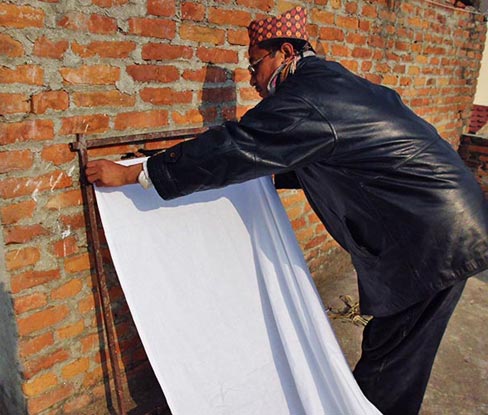
First, the canvas on which the painting is to be executed is laid on a wooden frame to determine the required dimensions. This canvas is an extremely finely woven cotton material, referred to in the Holy Scriptures as "Çura Canvas".
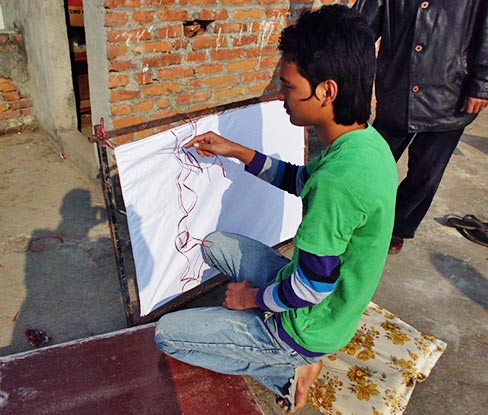
Then the canvas is cut, hemmed and, with the use of sturdy strings, very tightly mounted in the wooden frame. Painting is carried out with the frame in an upright position, without any further rigid support or backing.
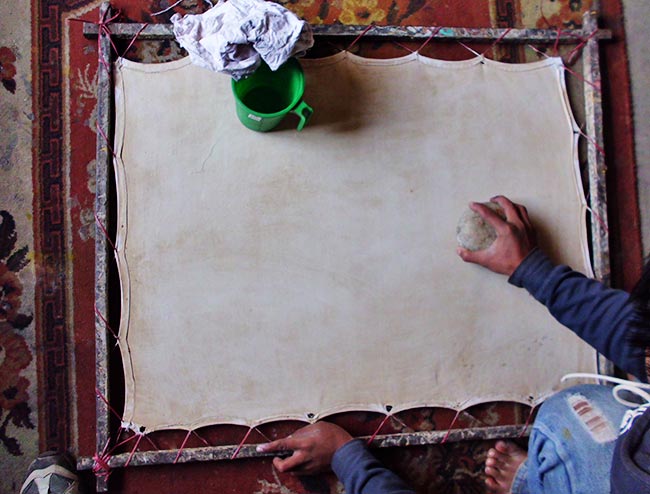
In this studio, our primary artist, who works virtually exclusively for us, applies the undercoat consisting of a mixture of chalk and glue to the canvas by hand. Other Thangka workshops have turned to mainly using industrially pre-primed canvas.
This photo shows how the canvas, after receiving its base coat followed by a second coating of bone glue, is polished and smoothed by hand with a stone to attain a perfectly smooth, featureless painting surface. Through this process the canvas becomes quite rigid, thereby providing perfect conditions to evoke very finest artistic detail and over-all superior painting quality.
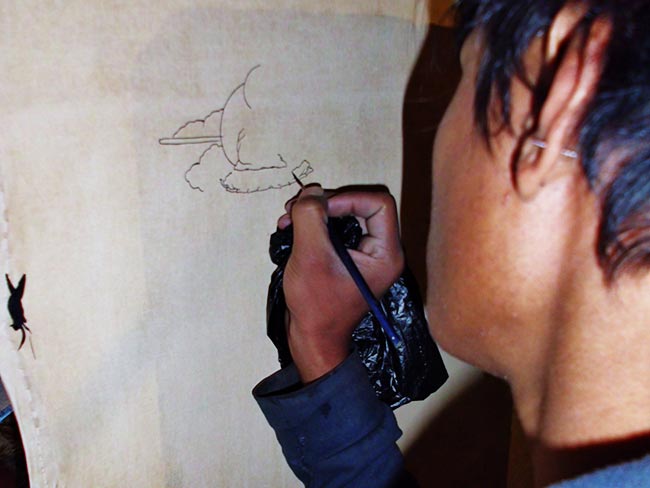
Using a different Thangka, we see how, after mounting, the complete basic pattern of the respective theme is applied to the canvas.
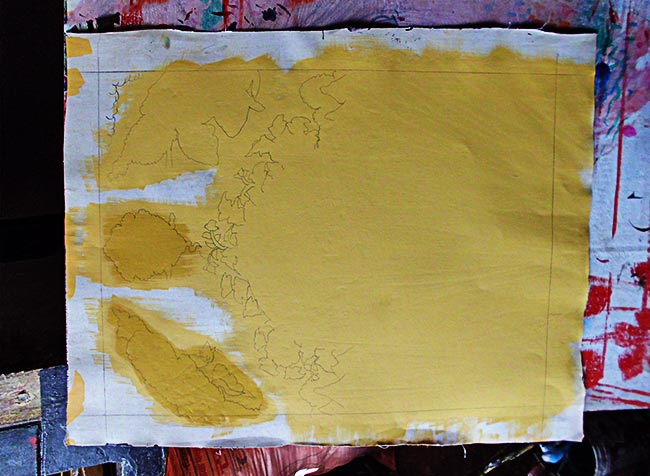
The following picture shows the steps in creating a gold-based Thangka, such as our No PH 9, the "Holy Mount Kailash". To achieve more intensive colour, yet another prime coat, in ochre, is applied, followed by a coat of pure gold. The so-called Thangka painting gold is traditionally produced by members of the Newar people in Nepal. 24-karat gold is ground to finest powder and mixed with bone glue and water in proportions suitable for direct use in painting. Thus, the Thangka gold is not gold leaf at all! Silver can be processed and used in the same way: Mount Kailash and the surrounding peaks in our completed Thangka were not painted with white paint, rather with precious silver.
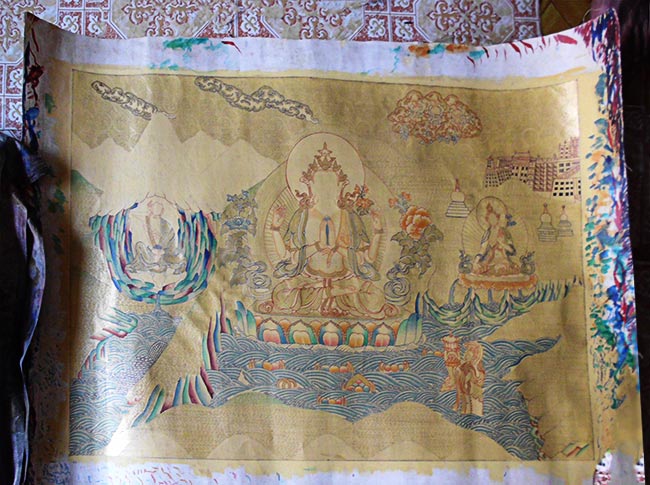
Here, the nearly completed piece has been removed from the wooden frame. Now only the very finest finishing touches remain to be added, such as compacting the gold and giving Mount Kailash its silver mantle.
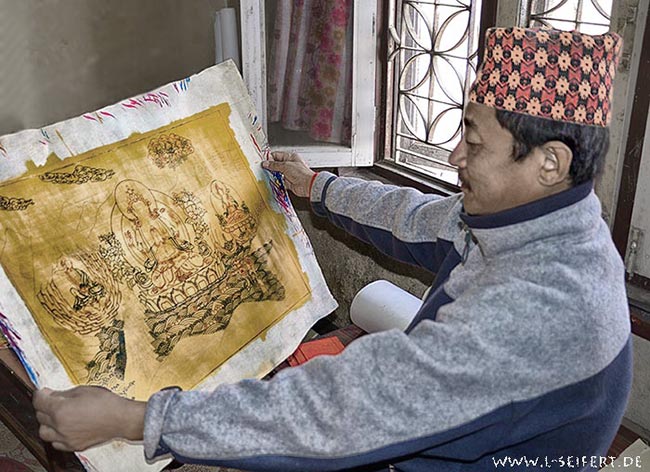
K. Lama regarded his already half-finished thangka proudly
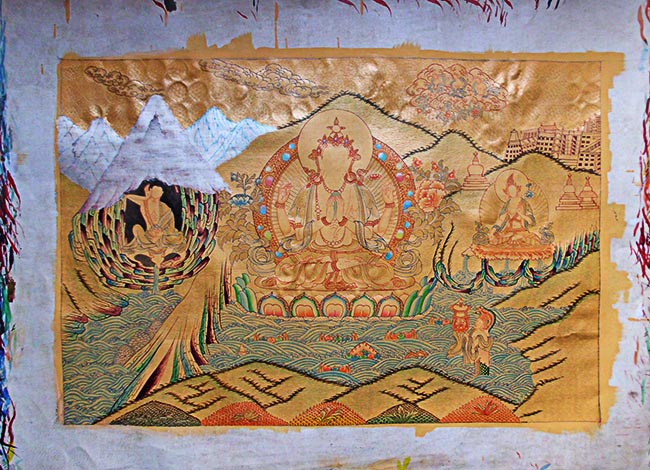
The Mount Kailash Thangka, including the black margin (which can also facilitate the fastening of a traditional brocade frame), is now complete. Only the background gold must be compacted in the places where it is later intended to exhibit a sheen.
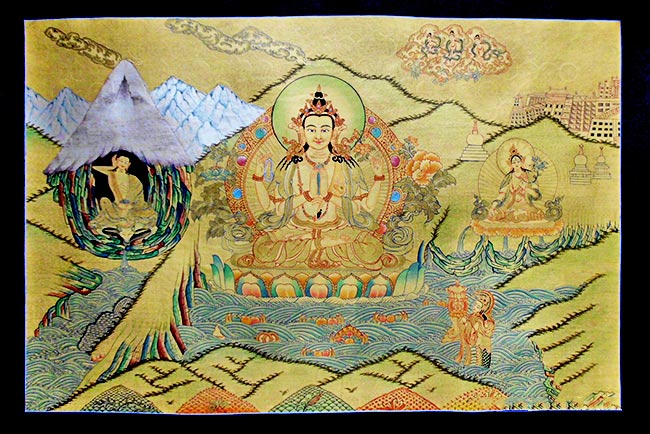
Here we see an old ballpoint pen casing into which a specially cut agate has been fitted. The back of this semi-precious stone is slightly concave and can be used to compact gold over extensive areas of the Thangka, while the blunt point is used to lineally compact gold, thus creating a shiny effect.
In this way, through partial compaction of the gold or refraining from compaction, nearly three-dimensional effects can be achieved. The glorious sheen of gold artistically treated in this way richly rewards the beholder or meditator with a Thangka possessed of an extraordinarily aesthetic aura.
Thangka Making Video
tk- Newari
While most paubhas portray Buddhist subjects, there are also a few that incorporate Hindu themes. The creation of these paintings is seen as a means of earning religious merit for both the artist and the patron. Newar Buddhists often commission skilled artists, primarily from the Chitrakar caste (known as Pun in Nepal Bhasa), to paint paubhas that are displayed during festivals and special occasions.
The Newar people's mastery of paubha painting highlights their rich artistic heritage and their devotion to Buddhism. These intricate and spiritually meaningful artworks continue to be cherished and admired both within Nepal and internationally. They stand as a testament to the profound artistic traditions of the Newar community and their cultural contributions to the wider Himalayan region.
The paint is made from minerals and plants. Gold and silver paint are also used on paubhas. The eyes of the deity are painted when the rest of the painting has been completed, and is known as "mikh? ch?yekegu" (opening the eyes). Brocade is sewn to the edge of the paubha to make a frame for display.
From a composition perspective, the surface of Paubha is usually occupied of a large figure in the center that is placed inside a shrine and surrounded by registers of smaller figures on the sides; the background is usually filled in with natural elements such as rocks rendered in abstract patterns. The color is often deep and subdued with subtle shadings of the figures and exquisite renderings of details that are the hallmarks of early Nepalese paubhas
tk-Real Gold
Gong
How to Play Gong
Gong Accessories
SB-G: Burmese Gong
Over the past fifteen years or so, Burmese gongs have become much more widely available in the West. This is partly due to the withdrawal of the tuned gongs made by Paiste and the affordability of the Burmese gong. Having said that, the prices are now rising and they are becoming quite expensive.
One thing to bear in mind when playing these gongs is that they need to be played with padded beaters and played quietly. They are cast gongs and can crack if played with a hard beater or struck with any force. The sound of the gong is a lovely low 'dong' with little overtones and no splash. The decay is fairly short lived and lasts the same length of time whether struck forte or piano.
The 'Kyeezee' is a triangular-shaped piece of bronze or brass, often decorated and carved and quite thick in cross-section. It is suspended on a cord at its mid point. When it is struck, it has a piercing bell-like tone and spinning the Kyeezee gives a warbling effect. They are often used in meditation.
Navagraha
The Navagraha are:
Surya (Ravi), the Sun
Chandra (Soma), the Moon
Mangala (Mangal), Mars
Budha (Budh), Mercury
Dev Guru (Brihaspati), Jupiter
Shukra, Venus
Shani, Saturn
Rahu, Solar Eclipse
Ketu, Lunar Eclipse
Chakra: Third eye
 | Name : Ajana Name English: Third Eye Chakra Sanskrit Name :आज्ञा Traslation :Command Location : Between Eyebrows Color : Indigo [Blue] Sound : B Node |
Chakra : Crown
 | Name : Sahasrara Name English: Crown Sanskrit Name :सहस्रार Traslation :Crown Location : Crown Color : violet Sound : A node |
Pashmina
Pashmina washing
To wash by hand, use cold water. You may add a little soft detergent, such as baby shampoo or Woolite, but please be certain the detergent is completely dissolved first. Then, wash very gently by hand while being very careful with the hand-tied tassels if you are washing a pashmina accessory.
After washing, please do not wring dry. Instead, lie it as flat as possible. Once dry, you may warm iron but it is best to put a piece of paper or cloth between the iron and the fabric.
That's it. Proper pashmina and cashmere care is actually easy. Now it is time to enjoy!
Lokta Paper
chakra Man
The concept is found in the early traditions of Hinduism. Beliefs differ between the Indian religions, with many Buddhist texts consistently mentioning five chakras, while Hindu sources offer six or even seven. Early Sanskrit texts speak of them both as meditative visualizations combining flowers and mantras and as physical entities in the body. Some modern interpreters speak of them as complexes of electromagnetic variety, the precise degree and variety of which directly arise from a synthetic average of all positive and negative so-called "fields", thus eventuating the complex Nadi. Within kundalini yoga, the techniques of breath exercises, visualizations, mudras, bandhas, kriyas, and mantras are focused on manipulating the flow of subtle energy through chakras.
The hymn 10.136 of the Rigveda mentions a renunciate yogi with a female named kunamnama. Literally, it means "she who is bent, coiled", representing both a minor goddess and one of many embedded enigmas and esoteric riddles within the Rigveda. Some scholars, such as David Gordon White and Georg Feuerstein, interpret this might be related to kundalini shakti, and an overt overture to the terms of esotericism that would later emerge in Post-Aryan Bramhanism. the Upanishad.
Breath channels (nāḍi) are mentioned in the classical Upanishads of Hinduism from the 1st millennium BCE, but not psychic-energy chakra theories. The latter, states David Gordon White, were introduced about 8th-century CE in Buddhist texts as hierarchies of inner energy centers, such as in the Hevajra Tantra and Caryāgiti. These are called by various terms such as cakka, padma (lotus) or pitha (mound). These medieval Buddhist texts mention only four chakras, while later Hindu texts such as the Kubjikāmata and Kaulajñānanirnaya expanded the list to many more.
In contrast to White, according to Georg Feuerstein, early Upanishads of Hinduism do mention cakra in the sense of "psychospiritual vortices", along with other terms found in tantra: prana or vayu (life energy) along with nadi (energy carrying arteries). According to Gavin Flood, the ancient texts do not present chakra and kundalini-style yoga theories although these words appear in the earliest Vedic literature in many contexts. The chakra in the sense of four or more vital energy centers appear in the medieval era Hindu and Buddhist texts.

The Four Harmonious Friends
In this spirit, Mandala shares these stories excerpted from A Practical Guide of Skillful Means, the training manual used at the seminar:
Having made this determination the four animals set out to make offerings and pay homage. The younger showed respect for the older by carrying the older on his back. Standing on each others’ backs in this way, the pheasant, rabbit, monkey and elephant reached the first limb of the nyän dro da (banyan tree).
The pheasant taught the others how to follow the moral conduct of not taking lives, not taking what was not given, not speaking deceptive words, not committing sexual misconduct, and not taking intoxicants. Then each animal led similar types of animals to themselves on the path of morality. Happiness and comfort increased greatly in the world.
At that time, the king, his ministers, and the general population had the proud belief that the good times were due to their own merit. In order to determine who was responsible for the peaceful times they gathered together and asked a hermit to tell them the cause of their happiness. Through his clairvoyance the hermit explained that the countries’ wealth was not due to the power of any of the people but to the merits of the four animals in the forest who were keeping the five precepts of moral conduct and leading the other animals on that path. He advised them that they, too, should behave like these animals.
Following this advice most of the people in that region began to keep the five precepts, and as a result, after they died, they were reborn in the deva realm.
It is said in the Vinaya teaching Dülwa rlung and the discourse Do de nä kyang rlung that the pheasant was an incarnation of the qualified destroyer gone beyond Shakyamuni Buddha and the others were disciples – the rabbit was Nyi gyä (Shariputra), the monkey was Päl na kyä (Maudgalyana) and the elephant was Kungawa (Ananda).
It is also said that wherever a picture of the four brothers is displayed, the 10 virtues will increase and the minds of all will become harmonious. There will be respect for elders and auspicious events will occur.
Then, the rabbit came. The rabbit would eat what was on the ground and would lift the bird up on his back so that the bird could reach the growing tree. In this way, they both had enough to eat. However, as the tree continued to grow, it started to become too high for the bird, even on the back of the rabbit.
Then, the monkey came. The monkey could climb up into the tree and drop the fruit from the tree onto the ground for the rabbit and the bird. However, it was difficult to get to the fruit at the very top of the tree.
Then, the elephant came. With the elephant, if all the animals helped each other, they could reach the fruit at the top of the tree; and, in this way, there was plenty for all of them to eat.
The reason the four animals worked so harmoniously together and the reason they were successful is that none of them was primarily concerned with getting enough food for themselves. Each of them was concerned with trying to help the others to get what they needed. Rather than being dominated by selfish concern, they were dominated by cherishing others.
Also, the reason they were successful is that they were willing to ask for help and to receive help. In this way, the bird is considered the hero of the story. The bird was the most fragile and needed the most help.
Because the bird was willing to ask for help and because the others were happy to help the bird, everything worked out very nicely.
In Tibet, in letters of advice to families who were going through some difficult times with each other, the Four Friends were often used as an example of how the family needs to stay together and help each other. Each member is very different and brings different strengths and different weaknesses, but if they work together, they can accomplish things they could never accomplish without working together.
This story is a story of interdependence. It is a story explaining how there is no place for self-cherishing, but rather we need each other and we need to help each other. The worst thing is self-cherishing. This is a story about working harmoniously.
(At our centers, we have pheasants, rabbits, monkeys, and elephants – very different kinds of people with different talents and different needs. If we only focus on the shortcomings, we might not recognize how they are able to contribute to the greater good of the center. But if we are creative, we can find a way for everybody to contribute, and in the end, everybody can partake of the fruits of bodhichitta!)
The way to Heaven
Levels One and Two, the meditator starts by using the powers of listening and pondering the meaning of the Dharma and this fires-up the motivation and zeal to stay with the concentration on the breath, the object of meditative concentration.
Level Three and Four , the power of continuous non-discursive recollection of the understanding of the dharma gained by studying and the deeply pondering of it, brings about a capacity for periodic engagement of concentration.
Level Five and Six , through the power of Watchfulness or Alertness, although our engagement is still periodic, wavering is diminishing. This power indicates that the meditator firmly and clearly comprehends what is occurring and what he or she is doing.
Level Seven and Eight, the power of Diligence or Effort, the mind is Concentrated and pliant of both body and mind, and the meditator's engagement in concentration is uninterrupted.
Level Nine, with the power of complete adaptation/habituation full Calm-Abiding is attained, the mind is naturally settled.
Seven Chakra
The concept is found in the early traditions of Hinduism. Beliefs differ between the Indian religions, with many Buddhist texts consistently mentioning five chakras, while Hindu sources offer six or even seven. Early Sanskrit texts speak of them both as meditative visualizations combining flowers and mantras and as physical entities in the body. Some modern interpreters speak of them as complexes of electromagnetic variety, the precise degree and variety of which directly arise from a synthetic average of all positive and negative so-called "fields", thus eventuating the complex Nadi. Within kundalini yoga, the techniques of breath exercises, visualizations, mudras, bandhas, kriyas, and mantras are focused on manipulating the flow of subtle energy through chakras.
|
|
|
|
|
|


Seven Chakra Incense
2. वँ Second Chakra: Sacral or Navel Chakra- Situated at the lower abdomen and approx. two inches from the belly bottom. Its color is orange.
The Svadhisthana chakra is our creativity and sexual center. It is located in the pubic bone, below the navel, and is responsible for our creative expression.
3. र Third Chakra: Solar Plexus- Situated at the base of Rib Cage. Yellow is the shade of the Solar Plexus Chakra. The Manipura chakra means lustrous gem and it's the area from the navel to the breastbone. The third chakra is our source of personal power.
4. य Fourth Chakra: The Heart- Situated at the center of the chest around the area of Heart. Green is the shade of the heart chakra.
The Anahata is located at the heart, center in the middle of the seven, and unites the lower chakras of matter and the upper chakras of spirit. The fourth chakra is also spiritual but serves as a bridge between our body, mind emotions, and spirit. The heart chakra is our source of love and connection. When we work through our physical chakras or the first three, we can open the spiritual chakras more fully.
5. ह Fifth Chakra: The Throat- Situated at the base of the neck in the throat. Lighter blue is the color of the throat chakra, and the note for it is G and G#. The Vishuddha chakra is the fifth chakra, located in the area of the throat. This is our source of verbal expression and the ability to speak our highest truth. The fifth chakra includes the neck, thyroid, and parathyroid glands, jaw, mouth, and tongue.
6.ऊँ Sixth Chakra: The Third Eye- Situated in the middle of the forehead linking the eyebrows. The darker blue is their color. The Ajna chakra is located between the eyebrows. It is also referred to as the "third eye" chakra. Ajna is our center of intuition. We all have a sense of intuition but we may not listen to it or heed its warnings. Focus on opening the sixth chakra will help you hone this ability.
7.Seventh Chakra- The Crown-Situated at the top of the head or crown area. Violet is the shade of the crown chakra. The Sahasrara "chakra of the thousand petal lotus" chakra is located at the crown of the head. This is the chakra of enlightenment and spiritual connection to our highest selves, others, and ultimately, to the divine.
Chakra means wheel in Sanskrit. These are receptors of the universal energy or Prana each one is associated with parts of the physical body. We recommend you this incense to burn during YOGA and MEDITATION for self-realization with Himalayan herbs.
Packed in a beautiful recyclable paper box with butter paper inner cover.
We have varieties of this incense which will help you balance your chakras.
2. Chakra Incense-Root (for Innocense) NAGCHAMPA
3. Chakra Incense-Crown (for Integration) FRANKINCENSE
4. Chakra Incense- Third Eye (for forgiveness) ROSE
5. Chakra Incense-Solar Plexus(for Peace) LEMONGRASS
6. Chakra Incense-Heart(for Love and Compassion) JASMINE
7. Chakra Incense-Throat(for Collectivity) PATCHOULI
Offering Bowls
Tibetan Water Offering Bowls: How to Use Them
The main point of any offerings is a pure motivation to cultivate generosity and to reduce our selfishness, stinginess, and greed.
We seek to give with an open, pure heart, with no attachment to what we are giving, and with no motivation of receiving something in return.
We seek to give with an open, pure heart, with no attachment to what we are giving, and with no motivation of receiving something in return.
Paradoxically, as His Holiness the Dalai Lama often teaches, cultivating generosity and devoting ourselves to the welfare of others increases our own happiness in many ways, as we release the painful, stiff worry that accompanies greed and self-centeredness.
He encourages us to become selfishly altruistic, to become happy people by concerning ourselves primarily with the well being of others.
One reason that we offer water is that water in Tibet has traditionally been considered plentiful and free, and therefore painless to give. The idea is that all of our offerings should be given as freely as we would give water.
Another way to view the water offerings is as representing the seven aspects of prayer:
prostrating
offerings to the Buddhas
confessing our wrongs
rejoicing in the good qualities of oneself and others
requesting the Buddhas to remain in this world
beseeching the Buddhas to teach others
dedicating the merit of ourselves and others which has been accumulated throughout time, in order that all sentient beings may enjoy happiness and virtue
Start with seven clean bowls — called ting in Tibetan — and a pitcher of fresh water. Tibetans usually use silver, brass or copper bowls, which range from very plain to carved and intricately decorated treasures.
One by one, pour a little water in each bowl before you place it on the shrine, lining the bowls up from left to right as you face the shrine. The reason to start with a little water in each bowl is that it is inauspicious to have a bowl sitting empty on the shrine.
Tibetan Buddhist masters explain that each bowl should be the distance of one barley seed from the next one.
Starting from left to right, fill each bowl with water, almost to the top. Again, the common thought is that you leave the space of one barley seed from the rim of the bowl.
While setting up your offering bowls, it is common for Tibetans to recite one of the more common mantras, like:
— Om mani padme hung (Avalokiteshvara’s mantra)
— Om muni muni maha munaye soha (Buddha Shakyamuni’s mantra)
— Om tare tuttare ture soha (Tara’s mantra)
Others may recite what is called the gyamdro prayer. The prayer can be whatever you choose. What is most important is that you pray with a sincere wish to cultivate generosity and an open heart.
In the same spirit, you might visualize that you are offering endless quantities of everything beautiful and precious, plus all the good qualities in our hearts and minds, to a vast assembly of Buddhas.
You can put a butter lamp between the third and fourth bowls, or between the fourth and fifth bowls, symbolizing the light of wisdom, dispelling the darkness of ignorance.
Once the bowls are filled, it is common to bless the offerings with kusha grass (also called elephant grass) or any kind of clean straw or stick that you may have access to. To do this, you dip your grasses into one of the bowls and sprinkle the shrine with water, reciting the purifying mantra “om a hum.” (From Khandro.net)
Finally, you can dedicate the merit you have gained by the offerings to the elimination of suffering and its causes for all sentient beings.
Bhumba
Torma
The Tibetan term comes from the root gtor-ba which means to "cast away, break up, or scatter". This implies both a sense of offering and of letting go or non-attachment.
Deity tormas
Deity tormas (Wylie: rten gtor) are kept on the shrine, and represent a particular tantric deity. These tormas vary in complexity from a very simple cone painted white for peaceful deities like Tara and Avalokiteshvara, to very complex designs for semi-wrathful deities like Vajrayogini and Chakrasamvara.
Food tormas
Food tormas (Wylie: skang gtor) are used in feast practices and are consumed partially by practitioners during the feast, with leftovers (Wylie: dme gtor) offered to lower beings after being blessed. In some traditions, food tormas are now made with more contemporary ingredients whereas others stay faithful to the barley flour tradition.
Offering tormas
Offering tormas may be made for and offered to deities (Wylie: sgrub gtor / mchod gtor), to Dharma Protectors, to obstructing spirits, or to other lower beings. Torma for obstructing spirits are called gektor (Wylie: gegs gtor).
Medicinal torma
A torma may be used in Tibetan medicine to extract an illness from a patient as a cure. The torma is then cast away.
Captured torma
A captured torma (Wylie: gta' gtor) may be used to speed completion of activities, by planning to offer the torma at the completion of the activity thereby encouraging successful activity.
Inner, secret and very secret torma
Practicing meditation with deity visualization is considered a form of torma offering, though no physical cake is created and then offered. Similarly, offering one's internal emotional and mental experiences and experience of suchness are non-physical forms of torma offerings.
Ratna Mandala
How To Make Mandala offering
How to Practice Mandal offering
The Tibetan term for mandala is khyil-khor, which means "taking the essence." The essence you take is the whole path from guru devotion to enlightenment. That's what you get from doing this practice, plus the result: the unification of dharmakaya and rupakaya. Therefore by doing this practice you receive inconceivable temporal and ultimate happiness.
 |  |  |
This practice pacifies all hindrances to your temporal and ultimate happiness. These depend on merit and merit depends on offerings. The most meritorious object to offer is the mandala. Therefore if you wish to achieve temporal and ultimate happiness, the best thing you can do is to offer many mandalas.
Lama Tsongkhapa offered a million eight hundred thousand mandalas and achieved all the realizations of the stages and paths. If you wish to gain realizations you should offer mandalas to your guru every day as his jewel-like body can bestow the sphere of great bliss in an instant. All realizations depend on your guru. Offering mandalas to him/her is like offering gifts to a king before requesting a favor of him. Achieving enlightenment in one lifetime depends on your relationship with your guru.
Lama Tsongkhapa was instructed by Manjushri to leave the monastery and go to a hermitage where he was to concentrate on bodhicitta, seeing his guru as Buddha, meditate on the path, purify and accumulate merit. Without working on all of these, even if you practice for a hundred years you won't gain realizations. However, if you do, you will receive realizations within three years or even in a few months. The mere wish to make progress doesn't make it happen. It's necessary to create the causes, one of which is accumulating merit.
Even if you're a beggar, by making mandala offerings you will receive all the necessities for your practice in this and future lives. By visualizing and then offering whatever you need in the space above the mandala, you create the cause to receive it. Visualizing anything golden and offering it to the buddhas frees you from disease, and offering the moon creates the cause for you to be reborn as a god or a holy being. Offering jewels, gold and enjoyments create the cause to be reborn in the caste of kings.
If you don't have good materials you can even use a stone for the mandala base (but first you should ask permission of the spirit landlord, otherwise it's like stealing). Lama Tsongkhapa's forearm was blue and bloody with scabs and calluses from making mandala offerings on a stone during his eight-year retreat. This doesn't mean that lamas don't have money to buy gold and silver bases. Lama Tsongkhapa did this to emphasize the importance of pure morality. If you are abiding in pure moral conduct you aren't allowed to touch precious metals with attachment. However, the more valuable the material you offer, the more merit you receive. The best is a gold or silver base, then copper or brass. The finest things to offer are piles of gold, silver, or jewels; the cnext best is seashells; rice or other grains are acceptable. As mandala offerings are of great consequence, you should offer the finest materials you can afford. If you have enough money to provide yourself with the comforts of life but you use inferior materials for offering, the only result of your offering will be a decrease of merit.
By visualizing the offerings as more precious and extensive, you create vast merits. For example, imagine that you're offering an Mt. Meru of silver, lapis lazuli, ruby, and gold, even if there are no such materials on your base, you receive the merit of actually offering them. So in just a few seconds, it's possible to create the merit of having offered the entire universe. When you offer water bowls it's good to visualize the water as nectar. The water appears as nectar to the devas, so of course, it appears as nectar to the buddhas—this is explained in Maha-Uttara Yoga Tantra. It generates infinite bliss in the holy mind. So if you offer only water, you get the merit of offering water, but if it's offered as nectar you gain much more merit because of the superior quality of that offering.
Herbal Incense
Histroy of Incense
Hundreds of years ago, the aromatic resins of myrrh and frankincense were considered far more valuable than gold or silver, and they were precious currency, even gifted to the newborn baby Jesus. In ancient Egyptian culture, frankincense was regarded as a perfume, a bug repellent, a remedy to heal wounds, and most importantly, a spiritual offering for the gods.
For thousands of years, Zen Buddhists and monks, alongside Hindus and other religions across Asia regarded incense burning an essential ritual for meditation, spiritual ascension, and healing. When ancient Roman and Greek civilizations discovered the Silk trade route, they began importing incense to burn during their religious ceremonies, cremation events, and worship rituals.
Native Americans also celebrated the benefits of burning herbs and incense, particularly sage, to cleanse their souls free of impurities, along with driving away impurities from their house and worship places. Burning incense with essential oils has been an ancient therapeutic ritual that has been revived by Buddhists, yogis, and other spiritual traditions around the world in modern times.
Boost Focus an Concentration
Most people believe that burning incense is a yogic ritual, but the truth is that it promotes mindfulness and concentration, so you can burn it whenever you feel the need to be fully aware. For instance, while you are work, studying, doing yoga, or anything else, incense can help you concentrate.
Buddhist monks realized this advantage of burning incense thousands of years ago, and they used it to purify their atmosphere, clear up their thoughts, and concentrate on meditation. Their traditions reveal that jewelry designers, artisans, and other handcrafters would also burn incense to boost their focus.
STIMULATE YOUR CREATIVE JUICES
The pleasant fragrance of incense stimulates the mind and gets your creative juices flowing so you can feel inspired to imagine and identify the beauty around you. Incense boosts creativity and its botanical aroma calms the mind & invites peace so the imagination can run wild and free without any anxieties stressing out your brain.
PROMOTES POSITIVITY ENERGY
For centuries, spiritual gurus and religious teachers have advocated the use of incense to purify the environment, the mind, and the soul. Modern science reveals that the smoke of incense is filled with potent fungicidal, insecticidal, and antibacterial powers, which keeps your environment free of pollutants.
Combining incense with essential oils is a great remedy to eliminate negativities, feel more positive, motivate yourself, and drive out all impurities from your soul and surroundings. Remember, a clean and pure environment is the most beneficial strategy to keep the mind energetic and the body healthy.
HELP WITH DEPRESSION & ANXIETY
Some research suggests that burning incense, particularly frankincense, which is obtained from the Boswellia plant, stimulates the less understood ionic pathways within the brain, which aid in reducing symptoms of depression and anxiety. Ancient therapeutic and healing rituals have advised the use of incense to drive away feelings of despair, depressive thoughts, negative emotions, and anxieties that gnaw at the brain’s peace.
It will allow you to feel light-hearted and positive by driving out the negative thoughts and replacing them with calmness and a mindful attitude to give your absolute best to yourself.
ELIMINATE STRESS
Whether you are performing yoga or doing meditation, anxious and stressful thoughts are the greatest challenge in your quest to find peace and serenity. Burning incense has always been a ritual for meditation and yoga, and this is primarily because of its ability to stimulate the brain with a sense of calm.
The aroma of incense smoke is capable of reducing heart rates, and soothing the nerve pathways within the brain to make you feel completely relaxed and at peace. It is a great idea to burn incense while taking a luxurious hot bath or a massage so your muscles can relax and get rid of all that tension.
FEEL HAPPY & MINDFULLY AWARE
Our ability to smell opens up a pathway that directly leads to the brain, and when the aroma released by incense smoke reaches the brain, it stimulates the Limbic system. This fragrance stimulates the production of various essential brain chemicals that are associated with the feelings of calmness, happiness, and bliss.
When you burn incense, its aroma aids in opening up the nasal passages, a great remedy for flu, allowing you to feel relaxed and happy by naturally reducing your blood pressure. It promotes a strong sense of mindfulness that allows you to be more aware of yourself and appreciative of everything around you.
SLEEP NATURALLY & BLISSFULLY
People who struggle with symptoms of insomnia or struggle falling asleep can benefit from the therapeutic calmness of burning incense. It is incredibly beneficial for inducing drowsiness, and it is widely considered an ancient treatment for dealing with insomnia and sleep disorders.
Incense contains a powerful variety of plants, and various different parts of herbs that boost potent chemicals, nutrients, and naturally-occurring compounds to stimulate the mind and trigger the production of therapeutic brain chemicals and happy hormones.
Incense is the perfect remedy to clear your mind and begin your meditative practice and yoga session with a clear and focused mind. Allow it to make you feel more mindful and connected with your spiritual self, even when you’re baking some cookies, doing your work or sitting down for dinner with your family. It is an essential ancient remedy to purify your environment, your house, your thoughts, and your soul.
1. STIMULATE YOUR CREATIVE JUICES
2. PROMOTES POSITIVE ENERGY
3. HELP WITH DEPRESSION & ANXIETY
4. ELIMINATE STRESS
5. FEEL HAPPY & MINDFULLY AWARE
6. SLEEP NATURALLY & BLISSFULLY
cheppu
It is additionally informed that Cheppu vanished from the world as he would not like to see the kaliyuga, the incredible yuga, when the evil would totally victorious over the great and the world would be obliterated by Vishnu in his manifestation as kalki, the destroyer. Knowing his fortitude, honesty and entitled with every one of the better stamps Manjushree needed than see him and mentioned him to show his full structure. He showed up gradually in the midst of the cloud. Manjushree, as a veteran craftsman, quickly drew his structure by his foot subtly without the information on Cheppu. At the point when Manjushree could complete to draw his head just he came to know Manjushree's misdirection and promptly vanished. Because of his valiance, honesty and every unrivaled imprint, he was given the spot at the highest point of the fundamental passage of the sanctums for the assurance from every one of the risks. Nagas(serpents) are the food of Cheppu.
Along the narratives of Manjushree, comes an intriguing and interesting story joined to Cheppu – The Mythical Creature:
Quite a while past, the Kathmandu Valley was just an enormous lake occupied by the endless number of sea-going creatures. Most of them were the Nagas (snakes). Along these lines, this valley was otherwise called Naga Daha, which means the "Home of the Serpents'.
One day Manjushree Bodhisattva (a Buddhist god from China) stayed with this valley. He loved the valley. He loved the valley such a lot of that he needed to make a delightful town out of it . With this aim he promptly slice through the southern slope of the valley with one stroke of this his incredible sword (Chandrahara) and depleted off the water. This constrained every one of the occupants of the lake to leave, as they couldn't do anything against the omnipotent Manjushree. Be that as it may, an animal called Cheppu waited. When by his yogic force Manjushree detected that there was somebody actually covered up some place under the remainder of the lake, he instructed the last to leave the water in a flash. He was frightened when he saw that he was unable to conflict with the force of Manjushree. In this way, he said he would leave the lake if Manjushree would vow not to take a gander at his shocking element when he moved out of the lake. As indicated by the guarantee, Manjushree shut his eyes and Cheppu arranged to emerge from the water. As the dread stricken animal pushed half of his terrible body over the surface, Manjushree couldn't resist the opportunity to open eyes covertly, wondering for no specific reason. At the point when Cheppu saw Manjushree open his eyes, he got so vexed that he immediately plunged back profound under the water to conceal himself once more. Manjushree, embarrassed about breaking his guarantee, before long haggled with Cheppu guaranteeing him that he could never trouble again to seen by anybody). He additionally guaranteed that he would permit him to involve an exceptionally critical spot in the blessed sanctuaries of Nepal (he planned to develop soon in the valley) and stay there half-covered up for eternity.
This story appears to clarify a ton about our engineering custom of showing just 50% of Cheppu's body over the tympanums of the sanctuary entryways. Regardless of whether this legendary story contains any trace of legitimacy or not issue the least. What includes in the social worth it reflects and the creative interest it leaves for the whole gang to comprehend and appreciate.
Cundi


Old Stock Statue
Skilled artisans, who were well-versed in religious teachings, made these statues. They followed traditional guidelines and sacred texts to create each statue with precise expressions and postures. The artisans believed they were creating representations of gods rather than just ordinary figures. This unique perspective is reflected in the statues themselves.
The Sacred Serenity collection provides an opportunity to own one of these timeless masterpieces. With their intricate details, divine presence, and the devotion put into their creation, these statues can bring a sense of tranquility, spiritual awakening, and a connection to the divine into your space. Welcome the "Sacred Serenity" into your life and experience the whispers of ancient wisdom and serenity it holds.
Monastery Quality
This type of statue is a little expensive in comparison to other statues available in our store, hence we were hesitant to include them in our collection. But as we begin to understand why they are expensive we decided to include them on our website at a discounted price.
It always has been our goal to provide the best quality statue at a reasonable price. We are providing a 25% discount as an introductory price, and also our commitment to provide quality statues to our client at a reasonable price.
Agarwood
Uninfected aquilaria wood lacking the dark resin
One of the main reasons for the relative rarity and high cost of agarwood is the depletion of the wild resource Since 1995, Aquilaria malaccensis, the primary source, has been listed in Appendix II (potentially threatened species) by the Convention on International Trade in Endangered Species of Wild Fauna and Flora In 2004, all Aquilaria species were listed in Appendix II; however, a number of countries have outstanding reservations regarding that listing
First-grade agarwood is one of the most expensive natural raw materials in the world with 2010 prices for superior pure material as high as US$100,000/kg, although in practice adulteration of the wood and oil is common, allowing for prices as low as US$100/kg A whole range of qualities and products are on the market, varying in quality with geographical location, botanical species, the age of the specific tree, cultural deposition and the section of the tree where the piece of agarwood stems from The current global market for agarwood is estimated to be in the range of US$6 – 8 billion and is growing rapidly
Sandalwood
Sandalwood oil in India is widely used in the cosmetic industry. The main source of true sandalwood, S. album, is a protected species, and demand for it cannot be met. Many species of plants are traded as "sandalwood". The genus Santalum has more than 19 species. Traders often accept oil from closely related species, as well as from unrelated plants such as West Indian sandalwood (Amyris balsamifera) in the family Rutaceae or bastard sandalwood (Myoporum sandwicense, Myoporaceae). However, most woods from these alternative sources lose their aroma within a few months or years.
Isobornyl cyclohexanol is a synthetic fragrance chemical produced as an alternative to the natural product.
Sandalwood's main components are the two isomers of santalol (about 75%). It is used in aromatherapy and to prepare soaps.
Juniper
People use the juniper berry to make medicine. Medicinal preparations include the extract of juniper berry, as well as the essential oil of juniper berry. Don't confuse juniper berry oil with cade oil, which is distilled from juniper wood (Juniperus oxycedrus).
Some people apply juniper directly to the skin for wounds and for pain in joints and muscles. The essential oil of juniper is inhaled to treat bronchitis and numb pain.
In foods, the juniper berry is often used as a condiment and a flavoring ingredient in gin and bitter preparations. The extract and essential oil are used as a flavoring ingredient in foods and beverages.
In manufacturing, juniper oil is used as a fragrance in soaps and cosmetics.
Juniper extract and juniper oil are used in cosmetics including lipstick, foundation, hair conditioners, bath oils, bubble bath, eye shadow, and many other products.
cedar
Atlas Cedarwood Tree
The ancient Syrians and Mesopotamians considered the tree a sign of enduring love and nourished the spirits of their ancestors with cedarwood incense. For surviving the flood, it is said Noah burnt cedarwood oil in gratitude to the Lord. Atlas cedarwood was used in ancient Egypt for fumigation and embalming. Wood is used for storage chests as it repelled insects. Used for incense. Used in the East for bronchial and urinary tract infections.
The Virginian cedarwood was used by Native Americans for respiratory infections, esp. with catarrh. Also rheumatism, skin rashes.
Herbal Soap
Making Process of Herbal Soap
Crafted with rare herbs and 100% raw ingredients, herbal soaps have been proven to be particularly beneficial to the skin. The herbs infused in these soaps have therapeutic and healing characteristics that offer special benefits to the skin, such as nourishment, strength, healing, and moisturizing. These soaps also contain super fatty oils, vitamin E, aloe vera, and essential oils, all of which lead to goodness.
Herbal soaps are also useful in the treatment of numerous skin problems. These soaps also contain glycerin, which is not commonly found in industrial soaps. Glycerin helps to preserve moisture in the skin, making these soaps suitable for dry skin conditions.
These soaps contain no additives, synthetics, fillers, petroleum distillates, liquids, dyes or metals.
Various types of herbs used to produce these soaps include burdock, comfrey, eucalyptus, hyssop, oat straw, plantain, red clover, rosemary, and witch hazel.
The various types of essential oils used to produce herbal soaps are
Olive Oil - Rich in Vitamin E and works as a humectant for skin. Produces silky bubbles
Coconut Oil - Rich in moisturizing properties and helps create a hard bar of soap with fluffy bubbles/lather
Palm Oil - Good for the conditioning of skin and helps make a hard bar
Soy Bean Oil - Rich in vitamins A, E & K. Provides good natural antioxidant and moisturizing properties
Cocoa Butter - Softens and protects the dry and chapped skin. It is a super-emollient produced during the manufacture of cocoa and chocolate
Soaps produced using conventional cod processing methods should be preferred as they preserve and maintain the nutritious value of the herbs used in the manufacture of soap.
If your skin is dry, you can use a natural soap made with oatmeal and/or avocado extracts. Herbal soaps made for dry skin usually contain lavender, peppermint, and spearmint oils, which tend to remove impurities in the skin. If you have oily skin, look for a natural soap with almond oil or one made with calendula oil. Tea oil-containing soaps are also considered to be effective in treating oily skin conditions.
silver statue
Wooden Traveling Altar
Eight Stupa

The stupa is a traditional structure of architecture, filled with relics and written mantras, which demonstrates the harmony and perfection of all universal principles and invites the human mind to participate in the growth and endless possibilities.
Basically, in the Sutras, the direct teachings of Buddha, one can find examples of eight different kinds of stupas. They apply to important events, such as his birth, his enlightenment, his teachings and his death, in Buddha Shakyamuni's life. According to these cases, the first stupas of this kind were constructed at different locations in India and today's Nepal and became holy sites.
Later, the so-called "Tathagata Stupas of the Eight Sacred Places" tradition came to Tibet. You can still find all eight stupas in a row on top of an enclosed wall at some Tibetan monasteries, counting 108 or even 1,080 stupas all together.
In Europe, it is very unusual to see all the eight stupas constructed together. In France (Montchardon), for example, one row is located and, since 2017, a beautiful set crowns Karma Berchen Ling.
A powerful protective field is formed by the eight stupas which can keep negative forces away. Established at the entrance, this "wall of stupas" not only reminds us of Buddha's deeds but also outwardly protects the retreat spot.
 Lotus Stupa Tib. Pepung Chorten The main body of this stupa appears in the form of a lotus and symbolizes Buddha’s birth in Lumbini. |  Enlightenment Stupa Tib. Jangchub Chorten This stupa symbolizes the full development of mind, the state of a Buddha. It was built by the Dharma king Bimbisara, honoring Buddha’s enlightenment in Bodhgaya. On the evening before reaching enlightenment, Buddha Shakyamuni removed the last subtle veils and obstacles in his mind, which is also represented in this stupa. |  Stupa of Many Doors Tib. Taschi Gomang Chorten This stupa represents the Dharma, the teachings of the Buddha about the way things are. It is also called “Wisdom Stupa” and was built on the occasion of Buddha’s first teaching “The four noble truths” which he gave in Sarnath/Varanasi. The stupa represents the threefold turning of the wheel of Dharma and contains all teachings Buddha gave. |  Stupa of Great Miracles Tib. Chotrul Chorten This stupa represents the miracles performed by Buddha when he converted the “followers of wrong views” (non-Buddhist masters) through his power of miracles. A person named Lisabi built this stupa in the Jetavana Grove in Shravasti. |
 Stupa Descent from God Realms Tib. Lhabab Chorten Buddha gave teachings to his mother in the heaven of thirty-three gods (Trayastrimsha Heaven). Buddha’s descent from this realm back to earth is symbolized by this special stupa with three ladders on each side. The first stupa of this kind was built in Samkashya. |  Stupa of Reconciliation Tib. Yendum Chorten The cousin of Buddha named Devadatta had caused a split within the community of practitioners. To mark the reconciliation of the Sangha, this stupa was built in Rajgir. |  Stupa of Complete Victory Tib. Namgyal Chorten Shortly before his death Buddha extended his life for three months because his students asked him not to pass away. This happened in Vaishali. This stupa is also known for its healing power. |  Paranirvana Stupa Tib. Nyangde Chorten This stupa symbolizes Buddha’s leaving the conditioned existence (death) in Kushinagara. The main body of the stupa has the form of a bell, and is a symbol for the perfect wisdom of Buddha. |
Unfinished
Like Gold plated, Partly gold Plated, Antique or same as pictures etc.
Yak Wool Shawl
Sb High Quality Etching Carving
resin mold
A resin casting process involves mixing liquid synthetic resin with a curing agent. The two substances then enter a mold cavity. The resin is then hardened into rigid polymers.
A resin casting is a process that can produce complex shapes. The shape of the mold cavity is also affected by the material used.
Buddha Trinity
Hence we are assuming this has more to do with the popularity of these three buddha individually, hence the manufacturer make these three more frequently. which now has transitioned into becoming a set.
Four Heavenly Kings
 Dhatarattha |  Vessarana [Jambhala] |
 Virūlhaka |  Virūpakkha |
Acrylic Wool Shawl
Measuring at a generous size, this shawl can be worn in a variety of ways, making it a versatile addition to your wardrobe. Whether you're bundling up for a winter walk or looking for a stylish accessory to wear to the office, this shawl is sure to impress.
In summary, our Acrylic Wool Shawl is warm, durable, and handmade with care in Nepal. Its soft texture and intricate design make it a must-have for anyone looking to stay cozy and stylish during the colder months.
Bead Keyring
Beads and bone design key rings make excellent gifts for those who appreciate unique and meaningful accessories, and are a wonderful way to support the local artisans and culture of Nepal. They are also a practical accessory that can be used to keep keys organized and easy to find. Overall, these key rings are a beautiful and functional addition to any keychain or set of keys.
Cotton Short
Unisex cotton shorts can come in various styles, including loose-fitting styles such as harem shorts or fitted styles such as running shorts. They can also come in different lengths, ranging from mid-thigh to just above the knee. Cotton shorts may be plain or feature prints, embroidery, or appliques that reflect Nepalese culture or traditions.
Overall, cotton shorts are a comfortable and practical option for both men and women in Nepal, and there are many styles to choose from to suit various activities and personal preferences.
Cotton Shawl
Cotton shawls can come in various styles and designs, ranging from simple and plain to colorful and patterned. Some popular designs in Nepal include traditional Nepalese motifs, such as mandalas or the Om symbol, or prints inspired by nature, such as flowers or leaves.
Overall, a lightweight cotton shawl is a versatile and stylish accessory that can add a touch of comfort and elegance to any outfit. Whether you're looking for a simple and understated shawl or a colorful and bold one, there are plenty of options to choose from in Nepal.
Cotton Scarf
Cotton shawls can come in various styles and designs, ranging from simple and plain to colorful and patterned. Some popular designs in Nepal include traditional Nepalese motifs, such as mandalas or the Om symbol, or prints inspired by nature, such as flowers or leaves.
Overall, a lightweight cotton shawl is a versatile and stylish accessory that can add a touch of comfort and elegance to any outfit. Whether you're looking for a simple and understated shawl or a colorful and bold one, there are plenty of options to choose from in Nepal.
Cotton Kurta
Cotton kurta tops can come in various designs, patterns, and colors. Some popular designs in Nepal include border embroidery, which is intricate embroidery along the hemline and neckline of the kurta. The embroidery can feature various designs and motifs, such as flowers, paisleys, or geometric shapes.
Overall, a cotton kurta top with border embroidery is a beautiful and traditional garment that is both comfortable and stylish. It is a great choice for anyone looking for a lightweight and breathable option for their wardrobe.
Cotton Cap
Ribbed cotton caps come in a variety of styles, from classic beanie hats to slouchy caps that can be worn with a variety of outfits. They are often available in a wide range of colors, from classic neutrals to bright and bold shades.
Overall, a ribbed cotton cap is a stylish and practical accessory that is perfect for anyone who wants to stay warm and comfortable during cooler weather. Whether you're running errands, going for a hike, or just hanging out at home, a ribbed cotton cap is a great way to add some extra warmth and style to your look.
Cotton Dress
Cotton dresses in Nepal come in various designs and styles, including casual, formal, and traditional. Some popular designs feature intricate embroidery or block prints in bright colors and patterns. Traditional dresses often feature a long skirt or wrap-style skirt, paired with a blouse or top.
Overall, cotton dresses are a versatile and comfortable clothing item that can be worn for many occasions. They come in various designs and styles in Nepal, making it easy to find one that fits your personal style.
Cotton Bag
One popular type of cotton bag is the shopping or shoulder bag, which is large enough to carry groceries, books, or other items. These bags often feature patchwork, embroidery, or printed designs, and may have convenient pockets or compartments for organization.
Cotton bags with patchwork, embroidery or printed designs are popular in Nepal and other parts of South Asia. These bags may feature traditional designs and motifs, such as mandalas, lotus flowers, or other symbols with deep spiritual significance. They may also feature modern designs or pop culture references.
Overall, cotton bags are a practical and stylish accessory that is perfect for anyone who wants to reduce their environmental footprint while still enjoying high-quality and durable bags. Whether you need a shopping bag, shoulder bag, backpack, or something else, there is a cotton bag out there that is perfect for your needs.
Copper Pendant
A copper pendant with Seku designs may feature images of Buddha, Hindu gods and goddesses, or other spiritual symbols and motifs. These pendants are often intricately detailed and may include elements such as lotus flowers, mandalas, or Sanskrit writing.
Overall, a copper pendant with Buddhist or Hindu Seku designs is a beautiful and meaningful piece of jewelry that is perfect for anyone who is interested in spirituality, meditation, or mindfulness practices. It is a unique and stylish accessory that can be worn with a variety of outfits, and is sure to be treasured for years to come.
Coin Purse
Coin purses are ideal for carrying loose change, as they keep coins organized and easy to access. They are also useful for carrying small items that might otherwise get lost in a larger bag or pocket.
Coin purses are popular accessories for both men and women, and are available in a wide range of colors, patterns, and styles. They are perfect for carrying in a pocket, purse, or backpack, and are ideal for traveling, shopping, or running errands.
Overall, a coin purse is a practical and stylish accessory that is essential for anyone who wants to keep their coins and small items organized and easily accessible.
Cashmere St Shawl
A very light cashmere Nepali shawl is so fine and thin that it can easily pass through a finger ring. Despite its delicate appearance, however, it is surprisingly warm and cozy. The shawl is made from the finest cashmere fibers, which are carefully woven or knitted into a soft and lightweight fabric that is ideal for layering.
A very light cashmere Nepali shawl is a luxurious and elegant accessory that is perfect for adding a touch of sophistication to any outfit. It can be dressed up or down, and is ideal for both formal and casual occasions. Overall, a very light cashmere Nepali shawl is a beautiful and versatile accessory that is sure to be treasured for years to come.
Cashmere Shawl
Cashmere shawls made in Nepal are known for their superior quality and exquisite craftsmanship. They are made from the finest cashmere fibers, which are carefully woven or knitted into a soft and lightweight fabric. The shawls are available in a wide range of colors, from classic neutrals like black, white, and beige, to bold and vibrant hues like red, purple, and blue.
Cashmere shawls made in Nepal are also a popular souvenir for visitors to the region. They make excellent gifts for friends and loved ones, and are a beautiful and timeless accessory that can be enjoyed for many years to come. Overall, a Cashmere shawl made in Nepal is a luxurious and beautiful addition to any wardrobe.
Bracelet
Bracelets can be worn alone or layered with other bracelets to create a more personalized look. They come in various sizes to fit different wrist sizes and styles, from delicate and dainty to larger and more statement-making.
Bracelets are a popular accessory for both women and men, and can be worn for a variety of occasions, from casual outings to formal events. They make excellent gifts for friends and loved ones, and are a great way to add a touch of personality and style to any outfit. Overall, a bracelet is a versatile and timeless piece of jewelry that can be enjoyed by anyone.
Bone Pendant
Bone pendants come in various shapes and sizes, from small and delicate to larger and more elaborate. Some pendants may feature a single bone charm or bead, while others may incorporate other materials like metal, beads, or stones.
Bone pendants can be worn on their own as a statement piece or paired with a simple chain or cord for a more understated look. They make excellent gifts for those who appreciate unique and meaningful jewelry and are a great way to support local artisans and culture. Overall, a bone pendant is a beautiful and meaningful addition to any jewelry collection.
Bone Necklace
Bone necklaces come in various styles and lengths, from simple and understated to bold and elaborate. Some necklaces feature a single bone charm or pendant, while others incorporate multiple bone beads or charms. Many bone necklaces also include decorative elements like colorful beads, stones, or metals.
Bone necklaces make excellent gifts for those who appreciate unique and meaningful jewelry, and are a great way to support local artisans and culture. They can be worn with a variety of outfits and for various occasions, adding a touch of elegance and uniqueness. Overall, a bone necklace is a beautiful and meaningful addition to any jewelry collection.
Bone Keyring
Keyrings may also include additional features such as a clip or hook for attaching to a bag or belt loop, or a built-in flashlight or bottle opener. Some keyrings may also feature a decorative pendant or charm, adding a touch of personal style to the accessory.
Overall, a key ring is a simple yet essential accessory that can help keep keys organized and easily accessible. With so many styles and designs available, it's easy to find a key ring that not only serves its practical purpose but also adds a touch of personal style and flair.
Bone Earring
Bone earrings come in various styles and sizes, from small studs to long and dangling earrings. Some feature a single bone bead or charm, while others incorporate other materials such as metal or leather. Some may also be decorated with colorful beads or other decorative elements.
Bone earrings make excellent gifts for those who appreciate unique and meaningful jewelry and are a great way to support local artisans and culture. They can be worn with a variety of outfits and for various occasions, from casual to formal, adding a touch of elegance and uniqueness. Overall, bone earrings are a beautiful and meaningful addition to any jewelry collection.
Bone Bracelet
Bone earrings come in a variety of styles, from simple and elegant to bold and intricate. Some feature a single bone bead or charm, while others incorporate other materials such as metal or leather. Some may also be decorated with colorful beads or other decorative elements.
Bone earrings make excellent gifts for those who appreciate unique and meaningful jewelry, and are a wonderful way to support the local artisans and culture of Nepal. They are a versatile accessory that can be worn with a variety of outfits, from casual to formal, and are sure to be a conversation starter. Overall, bone earrings are a beautiful and meaningful addition to any jewelry collection.
Bed Sheet
The prints on these bed sheets often feature images of gods and goddesses from Hindu and Buddhist traditions, such as Ganesha, Shiva, Buddha, Tara, and many others. These prints may also include animals that are considered sacred or symbolic in these traditions, such as elephants, peacocks, or dragons. The prints are often intricate and colorful and can add a sense of reverence and spirituality to the room.
Cotton bed sheets with various gods of Hindu and Buddhist and animal prints are a wonderful way to bring culture and spirituality into the home, and make a meaningful and unique addition to any bedroom.
Bead Pendant
Beads and bone design pendants make excellent gifts for those who appreciate unique and meaningful jewelry, and are a wonderful way to support the local artisans and culture of Nepal. They can be worn as a standalone pendant on a chain or added to a charm bracelet for a personalized touch. Overall, these pendants are a beautiful and meaningful addition to any jewelry collection.
Bead Necklace
Beads and bone design necklaces make excellent gifts for those who appreciate unique and meaningful jewelry, and are a wonderful way to support the local artisans and culture of Nepal. They are also a versatile accessory that can be worn with a variety of outfits, from casual to formal. Overall, these necklaces are a beautiful and meaningful addition to any jewelry collection.
Pashmina Sweater
To make a Nepali Pashmina sweater, the wool is carefully sheared from the goats and then processed by hand using traditional techniques. The wool is washed, spun, and woven into a fine fabric that is then knit or woven into a sweater by skilled artisans.
In addition to their luxurious feel, Nepali Pashmina sweaters are also an important part of Nepali culture and heritage. The production of Pashmina textiles is a traditional handicraft that has been passed down through generations, and is valued for its sustainability and eco-friendliness.
Overall, a Nepali Pashmina sweater is a beautiful and timeless piece of clothing that represents the natural beauty of Nepal and the skill and artistry of its craftsmen. It is a treasured possession that carries deep meaning and significance for those who own it, and is sure to provide warmth and comfort for years to come.
Pashmina Shawl
To make a Nepali Pashmina shawl, the wool is carefully sheared from the goats and then processed by hand using traditional techniques. The wool is washed, spun, and woven into a fine fabric that is then finished with hand-embroidered designs or other decorative elements.
In addition to their luxurious feel, Nepali Pashmina shawls are also an important part of Nepali culture and heritage. The production of Pashmina textiles is a traditional handicraft that has been passed down through generations, and is valued for its sustainability and eco-friendliness.
Overall, a Nepali Pashmina shawl is a beautiful and timeless accessory that represents the natural beauty of Nepal and the skill and artistry of its craftsmen. It is a treasured possession that carries deep meaning and significance for those who own it, and is sure to provide comfort and warmth for years to come.
Pashmina Muffler
To make a Nepali Pashmina muffler, the wool is carefully sheared from the goats and then processed by hand using traditional techniques. The wool is washed, spun, and woven into a fine fabric that is then finished with hand-embroidered designs or other decorative elements.
In addition to their luxurious feel, Nepali Pashmina mufflers are also an important part of Nepali culture and heritage. The production of Pashmina textiles is a traditional handicraft that has been passed down through generations, and is valued for its sustainability and eco-friendliness.
Overall, a Nepali Pashmina muffler is a beautiful and timeless accessory that represents the natural beauty of Nepal and the skill and artistry of its craftsmen. It is a treasured possession that carries deep meaning and significance for those who own it, and is sure to provide comfort and warmth for years to come.
Pashmina Blanket
To make a Nepali Pashmina blanket, the wool is carefully sheared from the goats and then processed by hand using traditional techniques. The wool is washed, spun, and woven into a fine fabric that is then finished with hand-embroidered designs or other decorative elements.
In addition to their luxurious feel, Nepali Pashmina blankets are also an important part of Nepali culture and heritage. The production of Pashmina textiles is a traditional handicraft that has been passed down through generations, and is valued for its sustainability and eco-friendliness.
Overall, a Nepali Pashmina blanket is a beautiful and timeless piece that represents the natural beauty of Nepal and the skill and artistry of its craftsmen. It is a treasured possession that carries deep meaning and significance for those who own it, and is sure to provide comfort and warmth for years to come.
Metal Pendant
The design of the pendant may be inspired by Nepali culture and symbolism, with patterns and motifs that represent different aspects of Nepali life, such as nature, religion, or social customs. These designs may be created using traditional techniques, such as etching, stamping, or engraving, and may be further embellished with beads, gems, or other decorative elements.
Overall, a Nepali metal pendant is a beautiful and unique piece of jewelry that represents the rich cultural heritage of Nepal and the skill and artistry of its craftsmen. It is a treasured possession that carries deep meaning and significance for those who wear it or receive it as a gift.
Metal Earring
Metal earrings are popular because they are versatile and can complement a wide range of outfits and styles. They can be worn casually or dressed up for special occasions and can be paired with other jewelry such as necklaces, bracelets, or rings.
Metal earrings can be a great way to express personal style and add a touch of glamour to any outfit. They are also a popular choice for those with sensitive ears, as they are less likely to cause irritation or allergic reactions than earrings made from other materials such as plastics or acrylics.
Metal Bracelet
The bracelet may feature Buddhist symbols, such as the Om symbol, the Lotus flower, or the Dharma wheel. These symbols represent various aspects of Buddhism, such as enlightenment, compassion, and the path to spiritual awakening.
Wearing a white metal or copper bracelet with Buddhism stone setting may be seen as a way to connect with Buddhist principles and promote healing and balance in the body and mind. It can also serve as a reminder to cultivate compassion, mindfulness, and other Buddhist values in daily life.
Lokta Paper Prints
Many Lokta paper wall hanging prints feature traditional designs and motifs that are inspired by Buddhism, Hinduism, and the cultural heritage of Kathmandu, the capital city of Nepal. Some common motifs include mandalas, lotus flowers, deities, and other symbols that hold spiritual significance.
One of the benefits of using Lokta paper for wall hangings is that it is an eco-friendly and sustainable material. The Lokta plant is fast-growing and regenerates quickly, making it a renewable resource. The paper is also produced using traditional methods that do not rely on harmful chemicals or bleaches.
Overall, Nepali Lokta paper wall hanging prints are a beautiful and unique way to showcase the rich cultural heritage of Nepal. They make a great addition to any home or office and are a wonderful way to bring a touch of spirituality and cultural diversity to your decor.
Lokta Paper Packing Box
Nepali Lokta paper photo albums are often bound with a hardcover that is made from Lokta paper or other materials, such as wood or leather. The pages inside the album are also made from Lokta paper, and they can be left blank or decorated with traditional Nepali motifs and designs.
In addition to being a sustainable choice, Nepali Lokta paper photo albums are also a beautiful and unique way to showcase your photos. The natural texture and colors of the paper add a touch of rustic charm, and the traditional designs and motifs are a nod to the rich cultural heritage of Nepal.
Overall, Nepali Lokta paper photo albums are a great choice for anyone looking for an eco-friendly and beautiful way to showcase their memories. They are a sustainable and unique option that is sure to be cherished for years to come.
Lokta paper Notebook
Nepali Lokta Paper notebooks are often bound with a hardcover that is made from Lokta paper or other materials, such as recycled cardboard or leather. The pages inside the notebook are also made from Lokta paper, and they can be left blank or decorated with traditional Nepali motifs and designs.
In addition to being sustainable, Nepali Lokta Paper notebooks are also a beautiful and unique way to take notes or keep a journal. The natural texture and colors of the paper add a touch of rustic charm, and the traditional designs and motifs are a nod to the rich cultural heritage of Nepal.
Overall, Nepali Lokta Paper notebooks are a great choice for anyone looking for an eco-friendly and unique notebook option. They are a sustainable and beautiful way to keep your notes and sketches while also supporting traditional Nepali craftsmanship.
Lokta Paper Flip Note book
The Lokta paper used to create this notebook is durable and long-lasting, ensuring that your notes and sketches stay safe and secure. The fibers used in the paper-making process are strong and resistant to tearing, making this notebook ideal for daily use.
Not only are Lokta paper tiny flip notebooks a beautiful and sustainable choice, but they also support local communities in the Himalayan region. By purchasing this notebook, you are helping to preserve traditional paper-making techniques and support the livelihoods of those who rely on the Lokta plant for income.
Overall, the Lokta paper tiny flip notebook is a convenient and environmentally responsible option for anyone looking to take notes or sketches on the go.
Lokta paper Gift Bag
Nepali Lokta paper bags are often handcrafted and can be customized with traditional Nepali designs and motifs. The bags come in a variety of shapes and sizes, from small gift bags to larger tote bags. They can be used for a variety of purposes, such as shopping, carrying books or documents, or as a stylish accessory for your outfit.
In addition to being sustainable, Nepali Lokta paper bags are also a beautiful and unique way to showcase traditional Nepali craftsmanship. The natural texture and colors of the paper add a touch of rustic charm, and the traditional designs and motifs are a nod to the rich cultural heritage of Nepal.
Overall, Nepali Lokta paper bags are a great choice for anyone looking for an eco-friendly and unique bag option. They are a sustainable and beautiful way to carry your belongings while also supporting traditional Nepali craftsmanship.
Leather Purse
Mountain goat leather is a strong and durable material that can withstand harsh weather conditions and rough terrain. It is also lightweight, making it ideal for carrying essentials on the go. The leather is often tanned using traditional methods, which give it a unique texture and appearance.
These purses are not only functional but also represent the rich cultural heritage of the Himalayan region. They are often produced by skilled local artisans who have been crafting leather goods for generations.
Mountain goat leather purses for men are suitable for a range of occasions, including outdoor activities, travel, and everyday use. They are a long-lasting investment and are often passed down as family heirlooms from generation to generation.
Leather Shoulder Bag
Mountain goat leather is a strong and durable material that can withstand harsh weather conditions and rough terrain. It is also lightweight, making it ideal for carrying essentials on long hikes or treks. The leather is often tanned using traditional methods, which give it a unique texture and appearance.
These shoulder bags are not only functional but also represent the rich cultural heritage of the Himalayan region. They are often produced by skilled local artisans who have been crafting leather goods for generations.
Mountain goat leather shoulder bags are popular among both men and women, and are suitable for a range of occasions, including outdoor activities, travel, and everyday use. They are a long-lasting investment and are often passed down as family heirlooms from generation to generation.
Leather Bag
Mountain goat leather is a strong and durable material that can withstand harsh weather conditions and rough terrain. It is also lightweight, making it ideal for carrying essentials on long hikes or treks. The leather is often tanned using traditional methods, which give it a unique texture and appearance.
These bags are not only functional but also represent the rich cultural heritage of the Himalayan region. They are often produced by skilled local artisans who have been crafting leather goods for generations.
Mountain goat leather bags are suitable for a range of occasions, including outdoor activities, travel, and everyday use. They are a long-lasting investment and are often passed down as family heirlooms from generation to generation.
Leather Backpack Bag
Mountain goat leather is a strong and thick material that can withstand harsh weather conditions and rough terrain. It is also lightweight, making it ideal for carrying heavy loads on long treks. The leather is often tanned using traditional methods, which give it a unique texture and appearance.
These backpack bags are not only functional but also represent the rich cultural heritage of the Himalayan region. They are often produced by skilled local artisans who have been crafting leather goods for generations.
Mountain goat leather backpack bags are popular among outdoor enthusiasts and are also used as fashion accessories due to their unique and stylish appearance. They are a long-lasting investment and are often passed down as family heirlooms from generation to generation.
Ladies Bag
The design of these bags can vary depending on the region and the cultural traditions of the area. Some bags are simple and understated, with a smooth, polished surface and a single-stone setting. Others are more elaborate, featuring intricate designs and multiple stone settings.
Metal ladies bags with stone settings are often used for special occasions such as weddings, religious ceremonies, or cultural festivals. They are also considered to be valuable and long-lasting investments, and may be passed down as family heirlooms from generation to generation.
Today, metal ladies bags with stone settings are still produced by skilled Nepali artisans, and are sold in Nepali markets as well as exported to other countries. They are not only functional and stylish accessories, but also represent the rich cultural heritage of Nepal.
Jamawar Shawl
The wool used in Nepali jamawar shawls is of the highest quality and is sourced from the Himalayan region, making it extremely warm and soft. The shawl is typically large in size, measuring around 80 inches in length and 40 inches in width, making it perfect for wrapping around the body to keep warm.
Nepali jamawar shawls are often worn on special occasions such as weddings, religious ceremonies, and other formal events. They are also popular as gifts, as they are considered a luxurious and elegant item that can be cherished for years to come.
Overall, the Nepali jamawar shawl is a beautiful and intricate piece of traditional Nepali craft that showcases the skill and expertise of the weavers who create them.
Hemp Slipper
Hemp slippers or flip-flops are designed to be lightweight and comfortable, making them ideal for casual wear. They come in a variety of styles and designs, from simple and minimalist to more colorful and intricate.
Many Nepali hemp slippers and flip-flops are handmade by skilled artisans using traditional techniques. This ensures that each pair is unique and made with care and attention to detail. Additionally, buying handmade products supports local artisans and communities, promoting sustainable and ethical fashion practices.
In conclusion, Nepali hemp slippers and flip-flops offer a sustainable and ethical alternative to mass-produced footwear. They are comfortable, stylish, and unique, and they support local artisans and communities while promoting eco-friendly fashion practices.
Hemp Shoe
These shoes come in a variety of styles and designs, from casual sneakers to more formal shoes. Many Nepali hemp shoes feature colorful and intricate designs inspired by traditional Nepali art and culture, making them not only practical shoes but also a unique fashion statement.
Nepali hemp shoes are often handmade by skilled artisans using traditional techniques passed down through generations. These shoes are a testament to the creativity and craftsmanship of Nepali artisans, and they offer a practical and stylish solution for those who want to support sustainable and ethical fashion while also adding a touch of unique and colorful design to their footwear.
Overall, Nepali hemp shoes are a practical, durable, and sustainable choice for anyone who wants to support handmade and eco-friendly fashion while also adding a touch of Nepali art and culture to their style.
Hemp Coin Purse
These coin purses come in a variety of designs, colors, and sizes to fit different preferences and styles. Many Nepali hemp coin purses feature colorful and intricate designs inspired by traditional Nepali art and culture, making them not only practical but also a unique fashion statement.
Nepali hemp coin purses are often handmade by skilled artisans using traditional techniques passed down through generations. These coin purses are a testament to the creativity and craftsmanship of Nepali artisans, and they offer a practical and stylish solution for those who want to support sustainable and ethical fashion while also adding a touch of unique and colorful design to their wardrobe.
Overall, Nepali hemp coin purses are a practical, durable, and sustainable choice for anyone who wants to support handmade and eco-friendly fashion while also adding a touch of Nepali art and culture to their style.
Hemp Pendant
These pendants come in a variety of designs, colors, and sizes to fit different preferences and styles. Many Nepali hemp pendants feature colorful and intricate designs inspired by traditional Nepali art and culture, making them not only a practical accessory but also a unique fashion statement.
Nepali hemp pendants are often handmade by skilled artisans using traditional techniques passed down through generations. These pendants are a testament to the creativity and craftsmanship of Nepali artisans, and they offer a practical and stylish solution for those who want to support sustainable and ethical fashion while also adding a touch of unique and colorful design to their accessories.
Overall, Nepali hemp pendants are a practical, durable, and sustainable choice for anyone who wants to support handmade and eco-friendly fashion while also adding a touch of Nepali art and culture to their style.
Hemp Broches
These brooches come in a variety of designs, colors, and sizes to fit different styles and preferences. Many Nepali hemp brooches feature colorful and intricate designs inspired by traditional Nepali art and culture, making them not only practical but also a unique fashion statement.
Nepali hemp brooches are often handmade by skilled artisans using traditional techniques passed down through generations. These brooches are a testament to the creativity and craftsmanship of Nepali artisans, and they offer a practical and stylish solution for those who want to support sustainable and ethical fashion while also adding a touch of unique and colorful design to their wardrobe.
Overall, Nepali hemp brooches are a practical, durable, and sustainable choice for anyone who wants to support handmade and eco-friendly fashion while also adding a touch of Nepali art and culture to their style.
Hemp Keyring
These keyrings come in a variety of designs, colors, and sizes to fit different preferences and styles. Many Nepali hemp keyrings feature colorful and intricate designs inspired by traditional Nepali art and culture, making them not only practical but also a unique fashion statement.
Nepali hemp keyrings are often handmade by skilled artisans using traditional techniques passed down through generations. These keyrings are a testament to the creativity and craftsmanship of Nepali artisans, and they offer a practical and stylish solution for those who want to support sustainable and ethical fashion while also adding a touch of unique and colorful design to their everyday items.
Overall, Nepali hemp keyrings are a practical, durable, and sustainable choice for anyone who wants to support handmade and eco-friendly fashion while also adding a touch of Nepali art and culture to their style.
Hemp Mat
These tea mats come in a variety of designs, colors, and sizes to fit different preferences and styles. Many Nepali hemp tea mats feature colorful and intricate designs inspired by traditional Nepali art and culture, making them not only practical but also a unique decorative item for your home.
Nepali hemp tea mats are often handmade by skilled artisans using traditional techniques passed down through generations. These tea mats are a testament to the creativity and craftsmanship of Nepali artisans, and they offer a practical and stylish solution for those who want to support sustainable and ethical fashion while also adding a touch of unique and colorful design to their home decor.
Overall, Nepali hemp tea mats are a practical, durable, and sustainable choice for anyone who wants to support handmade and eco-friendly fashion while also adding a touch of Nepali art and culture to their home.
Hemp bracelet
These bracelets come in a variety of designs, colors, and sizes to fit different wrist sizes and styles. Many Nepali hemp bracelets feature colorful and intricate designs inspired by traditional Nepali art and culture, making them not only practical but also a unique fashion statement.
Nepali hemp bracelets are often handmade by skilled artisans using traditional techniques passed down through generations. These bracelets are a testament to the creativity and craftsmanship of Nepali artisans, and they offer a practical and stylish solution for those who want to support sustainable and ethical fashion while also adding a touch of unique and colorful design to their wardrobe.
Overall, Nepali hemp bracelets are a practical, durable, and sustainable choice for anyone who wants to support handmade and eco-friendly fashion while also adding a touch of Nepali art and culture to their style.
Hemp Belt
These belts come in a variety of designs, colors, and sizes to fit different waist sizes and styles. Many Nepali hemp belts feature colorful and intricate designs inspired by traditional Nepali art and culture, making them not only practical but also a unique fashion statement.
Nepali hemp belts are often handmade by skilled artisans using traditional techniques passed down through generations. These belts are a testament to the creativity and craftsmanship of Nepali artisans, and they offer a practical and stylish solution for those who want to support sustainable and ethical fashion while also adding a touch of unique and colorful design to their wardrobe.
Overall, Nepali hemp belts are a practical, durable, and sustainable choice for anyone who wants to support handmade and eco-friendly fashion while also adding a touch of Nepali art and culture to their style.
Hemp Bag
These bags come in a variety of sizes and designs, from small and simple styles to larger and more intricate designs with multiple pockets and compartments. Many Nepali hemp shoulder bags feature colorful and intricate designs inspired by traditional Nepali art and culture, making them not only practical but also a unique fashion statement.
Nepali hemp shoulder bags are often handmade by skilled artisans using traditional techniques passed down through generations. These bags are a testament to the creativity and craftsmanship of Nepali artisans, and they offer a practical and stylish solution for those who want to support sustainable and ethical fashion while also adding a touch of unique and colorful design to their wardrobe.
Overall, Nepali hemp shoulder bags are a practical, durable, and sustainable choice for anyone who wants to support handmade and eco-friendly fashion while also adding a touch of Nepali art and culture to their style.
Guitar Bag
These bags often feature intricate and colorful designs, with patterns inspired by traditional Nepali art and culture. They may also feature additional pockets and compartments for storing guitar accessories such as picks, strings, and tuners.
In addition to being environmentally friendly, hemp guitar bags are also highly durable and long-lasting. They can withstand the wear and tear of regular use and provide a protective barrier against dust, dirt, and other environmental factors that can damage guitars.
Overall, hemp guitar bags from Nepal are a unique and eco-friendly choice for musicians who want to protect their instruments while also supporting sustainable and handmade fashion. They are a testament to the craftsmanship and creativity of Nepali artisans, and they offer a practical and stylish solution for transporting and storing guitars.
Glass Bead Ring
These finger rings can feature a wide range of designs, from simple patterns to more complex scenes or images. The glass beads used to create these rings can come in a variety of colors and shapes, allowing for endless possibilities when it comes to creating unique and eye-catching designs.
These rings are often made by skilled artisans in Nepal, using traditional techniques that have been passed down through generations. They can be found in a range of styles and designs, from delicate stackable rings to bold statement pieces, and are a popular choice for those who appreciate handmade and sustainable fashion.
Overall, a finger ring made out of tiny glass beads is a unique and beautiful piece of jewelry that can add a touch of color and texture to any outfit. It is a great choice for those who want to support handmade and sustainable fashion, as well as those who appreciate the intricate and detailed work of skilled artisans from Nepal.
Glass Bead Necklace
These necklaces can feature a wide range of designs, from simple patterns to more complex scenes or images. The glass beads used to create these necklaces can come in a variety of colors and shapes, allowing for endless possibilities when it comes to creating unique and eye-catching designs.
These necklaces are often made by skilled artisans in Nepal, using traditional techniques that have been passed down through generations. They can be found in a range of styles and designs, from delicate chokers to longer statement pieces, and are a popular choice for those who appreciate handmade and sustainable fashion.
Overall, a necklace made out of tiny glass beads is a unique and beautiful piece of jewelry that can add a touch of color and texture to any outfit. It is a great choice for those who want to support handmade and sustainable fashion, as well as those who appreciate the intricate and detailed work of skilled artisans from Nepal.
Glass Bead Earring
These earrings are highly decorative and can feature a wide range of designs, from simple patterns to more complex scenes or images. The glass beads used to create these earrings can come in a variety of colors and shapes, allowing for endless possibilities when it comes to creating unique and eye-catching designs.
These earrings are often made by skilled artisans in different parts of the world, such as India, Africa, and Central America. They can be found in a range of styles and designs, from delicate drop earrings to more elaborate chandelier-style earrings, and are a popular choice for those who appreciate handmade and sustainable fashion.
Overall, earrings made out of tiny glass beads are a unique and beautiful piece of jewelry that can add a touch of color and texture to any outfit. They are a great choice for those who want to support handmade and sustainable fashion, as well as those who appreciate the intricate and detailed work of skilled artisans.
Glass Bead Bracelet
These bracelets are highly decorative and can feature a wide range of designs, from simple patterns to more complex scenes or images. The glass beads used to create these bracelets can come in a variety of colors and shapes, allowing for endless possibilities when it comes to creating unique and eye-catching designs.
These bracelets are often made by skilled artisans in different parts of the world, such as India, Africa, and Central America. They can be found in a range of styles and designs, from thin delicate bracelets to wider statement pieces, and are a popular choice for those who appreciate handmade and sustainable fashion.
Overall, a bracelet made out of tiny glass beads is a unique and beautiful piece of jewelry that can add a touch of color and texture to any outfit. It is a great choice for those who want to support handmade and sustainable fashion, as well as those who appreciate the intricate and detailed work of skilled artisans.
Glass Bead Bangle
These bangles are highly decorative and can feature a wide range of designs, from simple patterns to more complex scenes or images. The glass beads used to create these bangles can come in a variety of colors and shapes, allowing for endless possibilities when it comes to creating unique and eye-catching designs.
These bangles are often made by skilled artisans in different parts of the world, such as India, Africa, and Central America. They can be found in a range of styles and designs, from thin delicate bangles to wider statement pieces, and are a popular choice for those who appreciate handmade and sustainable fashion.
Overall, bangles made out of tiny glass beads are a unique and beautiful piece of jewelry that can add a touch of color and texture to any outfit. They are a great choice for those who want to support handmade and sustainable fashion, as well as those who appreciate the intricate and detailed work of skilled artisans.
Glass Bead Bag
These bags are highly decorative and can feature a wide range of designs, from simple geometric patterns to more complex scenes or images. The glass beads used to create these bags can come in a variety of colors and shapes, allowing for endless possibilities when it comes to creating unique and eye-catching designs.
These bags are often made by skilled artisans in different parts of the world, such as India, Africa, and Central America. They can be found in a range of styles and designs, from small coin purses to larger tote bags, and are a popular choice for those who appreciate handmade and sustainable fashion.
Overall, a bag made out of tiny glass beads is a unique and beautiful accessory that can add a touch of color and texture to any outfit. It is a great choice for those who want to support handmade and sustainable fashion, as well as those who appreciate the intricate and detailed work of skilled artisans.
Felt Necklace
Felt bead necklaces can come in a variety of styles and designs, depending on the size, color, and shape of the beads used, as well as the techniques used to create the necklace. Some felt beads necklaces may feature a simple design with a single color of beads, while others may incorporate multiple colors and sizes of beads to create a more complex and eye-catching design.
Felt beads necklaces are often handmade by artisans using traditional crafting techniques, and they can be found in a range of styles and designs from around the world. They are a popular choice for those who want to support handmade and sustainable fashion, as well as those who appreciate the unique beauty and texture of felted wool.
Overall, a felt beads necklace is a unique and beautiful piece of jewelry that can add a touch of personality and style to any outfit. It is a great choice for those who appreciate handmade and sustainable fashion and want to add a unique and eye-catching accessory to their wardrobe.
Felt Beads
Felt beads come in a range of colors and sizes, making them a versatile and customizable material for various projects. They can be strung together to create necklaces, bracelets, or other types of jewelry, or used as decorative accents on clothing, bags, or other accessories.
Felt beads are a popular material for children's crafts because they are easy to work with and come in bright and fun colors. They can be used to make simple projects such as keychains or hair accessories, or as part of more complex projects such as stuffed animals or mobiles.
Overall, felt beads are a versatile and fun material that can be used for a wide range of craft projects. They are easy to work with and come in a range of colors and sizes, making them a popular choice for crafters of all ages and skill levels.
Embroidery Shawl
Embroidery is a traditional art form in Nepal, where skilled artisans use needle and thread to create intricate designs and patterns on fabric. The embroidery on a Nepali shawl may include traditional Nepali designs such as the lotus flower, peacock, or mandala, or may incorporate elements of other cultural or religious symbols.
The Nepali shawl with embroidery is not only a functional item to keep the wearer warm but also a beautiful and unique piece of wearable art. It can be worn for special occasions such as weddings or religious festivals, or as a decorative item in a living room or bedroom.
Overall, a Nepali shawl with embroidery is a beautiful and culturally significant piece of clothing that represents the skill and creativity of Nepali artisans. It is a perfect gift item for anyone who appreciates the beauty and intricacy of traditional handicrafts and wants to add a touch of cultural significance to their wardrobe or home décor.
Door Curtain
One of the most common designs found on Tibetan door curtains is the endless knot, which is a symbol of eternity and interconnectedness. The ashtamangal, or eight auspicious symbols, is another popular design element found on Tibetan door curtains. These symbols represent good fortune and are often associated with Buddhism.
In addition to the design work, Tibetan door curtains may also feature decorative embellishments such as tassels, beads, or fringe. These embellishments add texture and visual interest to the curtain.
Cochin, which refers to a type of embroidery technique, may also be used on Tibetan door curtains. Cochin embroidery involves creating raised designs using a needle and thread, and it is often used to create intricate floral patterns or other decorative elements.
Overall, Tibetan door curtains are beautiful and intricate pieces of textile art that reflect the rich cultural heritage of Tibet. They are often used to add color and decoration to homes, monasteries, and other sacred spaces.
Cotton Trouser
Nepali cotton trousers come in a variety of styles and designs, including straight-leg, tapered, and wide-leg cuts. They may also feature a variety of design elements, such as pleats, pockets, or belts, that add both style and functionality to the garment.
Another benefit of Nepali-made cotton trousers is that they are comfortable to wear in a variety of weather conditions. Cotton is a breathable fabric that wicks away moisture, keeping you cool and comfortable even on hot days. At the same time, cotton also provides warmth on cooler days, making these trousers a great year-round clothing option.
Overall, Nepali-made cotton trousers are a stylish, versatile, and comfortable clothing item that is perfect for anyone who wants to add some extra style and functionality to their wardrobe. Whether you're running errands, heading to work, or going out for a night on the town, Nepali cotton trousers are a great choice.
Cotton Top
Cotton tops for ladies may come in a range of styles, such as sleeveless, short-sleeved, or long-sleeved, and can be fitted or loose-fitting. They may also feature a variety of design elements, such as buttons, collars, or lace details, that add both style and functionality to the garment.
Another benefit of cotton tops for ladies is that they are comfortable to wear in a variety of weather conditions. Cotton is a breathable fabric that wicks away moisture, keeping you cool and comfortable even on hot days. At the same time, cotton also provides warmth on cooler days, making these tops a great year-round clothing option.
Overall, cotton tops for ladies are a stylish, versatile, and comfortable clothing item that is perfect for anyone who wants to add some extra style and functionality to their wardrobe. Whether you're running errands, heading to work, or going out for a night on the town, a cotton top for ladies is a great choice.
Cotton T-shirt
Printed cotton t-shirts often feature vibrant designs and patterns that are inspired by traditional Nepalese art and motifs. These designs may include images of Hindu deities, Buddhist symbols, or traditional Nepalese architecture. Additionally, cotton t-shirts may feature quotes or phrases in Nepali or English that express local cultural values or beliefs.
In addition to cultural and religious themes, cotton t-shirts in Kathmandu Valley may also feature images or slogans related to social or political issues. For example, t-shirts may feature images or slogans related to environmental conservation, women's rights, or social justice.
Overall, cotton t-shirts in Kathmandu Valley are a colorful and expressive way to celebrate local culture and traditions. Whether you're looking for a t-shirt with a bold print or an intricate embroidery, there are plenty of options to choose from that reflect the rich cultural heritage of Nepal.
Bead Bracelet
In addition to their aesthetic appeal, Nepali beaded bracelets are often imbued with cultural significance and spiritual meaning. Many people believe that wearing certain types of beads can have positive effects on the mind and body, and may promote healing, balance, and positive energy.
Beaded bracelets made in Nepal are versatile accessories that can be worn with a variety of outfits, from casual to formal. They make excellent gifts for those who appreciate unique and meaningful jewelry, and are a wonderful way to support the local artisans and culture of Nepal.
Shawl Embroidery
This zzzz features intricate patterns and motifs that are lovingly brought to life by hand. From the vibrant colors to the delicate details, every piece tells a story and reflects the rich tapestry of Nepalese culture. Experience the charm and elegance of Nepal as you wrap yourself in the soft warmth of our zzzz, knowing that you are supporting local artisans and preserving traditional craftsmanship.
Cotton Skirt
The waistband of the skirt is elasticized, which makes it easy to wear and ensures a comfortable fit for different body types. The skirt falls gracefully to the ankle, making it suitable for a range of different activities, from casual outings to formal events.
Whether you are looking for a comfortable and stylish skirt for everyday wear or a unique and eye-catching piece for a special occasion, this Nepali cotton skirt is sure to be a great addition to your wardrobe.
Cotton Jacket
Cotton jackets can come in various designs and styles, including patchwork, embroidery, and prints. Patchwork jackets feature different fabrics stitched together to create a unique and colorful design. Embroidered jackets feature intricate designs and motifs stitched onto the fabric, often with bright and bold thread. Printed jackets feature various designs and patterns printed onto the fabric, such as floral, paisley, or geometric prints.
Overall, a cotton jacket with fleece lining is a warm and comfortable garment that is perfect for cooler weather. Whether you prefer a patchwork, embroidered, or printed design, there are many options to choose from in Nepal.
Lokta Wrapping Paper
The Lokta paper gift wrapping sheets are available in a range of colors and patterns, and they are often decorated with traditional Nepali motifs and designs. The A3 size sheet is large enough to wrap a variety of gifts, including books, clothing, and other items.
In addition to being a sustainable choice, Lokta paper gift wrapping is also a unique and beautiful way to present gifts. The natural texture and colors of the paper add a touch of rustic charm, and the traditional designs and motifs are a nod to the rich cultural heritage of Nepal.
Overall, Nepali Lokta paper gift wrapping in A3 size sheet is a great choice for anyone looking for an eco-friendly and beautiful way to wrap gifts. It is a sustainable and unique option that is sure to impress the recipient.
Fridge Magnets
A fridge magnet with a Kathmandu Valley theme may feature iconic landmarks or scenery from the Kathmandu Valley region, such as the Swayambhunath Stupa, Boudhanath Stupa, Pashupatinath Temple, or Durbar Square. The design may also incorporate elements of traditional Nepali art or architecture.
Buddhism is a prominent religion in Nepal, and a fridge magnet with a Buddhist theme could feature symbols or imagery related to Buddhist philosophy or practice. This could include the Buddha himself, as well as symbols such as the lotus flower, the Eightfold Path, or the Wheel of Dharma.
Overall, a fridge magnet with a Kathmandu Valley or Himalayan theme is a great way to bring a touch of Nepali culture and natural beauty into your home. A fridge magnet with a Buddhist theme can also serve as a daily reminder of the importance of mindfulness, compassion, and other core Buddhist values.
Incense Holder
These handmade metal incense holders are not only functional but also serve as decorative pieces, adding a touch of elegance and cultural charm to any space. They can be found in local markets, handicraft stores, or online platforms specializing in Nepali crafts and artisanal products.
Jewelery Box
In Nepali culture, metal jewelry boxes are often used to store precious items such as jewelry and heirlooms. These boxes are typically handcrafted and feature elaborate designs that reflect the artistic traditions of the Nepali people. Some of these designs may incorporate Buddhist symbols such as the lotus flower, the Buddha's eyes, or the eight auspicious symbols.
In Tibetan culture, metal jewelry boxes are often used to store important religious artifacts such as prayer flags, thangkas (religious paintings), or Tibetan singing bowls. These boxes may be decorated with traditional Tibetan designs such as the eight auspicious symbols or the Tibetan knot.
Metal jewelry boxes are considered to be valuable items in Nepali, Buddhist, and Tibetan cultures, and are often passed down from generation to generation as family heirlooms. These boxes are not only functional, but are also considered to be works of art that reflect the rich cultural traditions of the region.
khukuri
The kukri is the standard issue weapon of all Gurkha military regiments and units around the world, so much so that some English-speakers refer to it as a "Gurkha blade" or "Gurkha knife." The kukri is frequently depicted in Nepalese and Indian Gorkha heraldry, and it is used in many traditional, Hindu-centric rites such as wedding ceremonies.
There have been and continue to be many myths surrounding the kukri since its first recorded use in the 7th century, most notably that a traditional custom revolves around the blade, which must draw blood before being sheathed due to its sole purpose as a fighting weapon. They are, however, frequently used as regular utility tools. Extraordinary stories of Gurkhas using them in combat may contribute to this misconception. The spellings kukri, khukri, and kukkri are all of Indian English origin, with khukuri being the original Nepalese English spelling.
Kumari
In Kathmandu Valley, this is a particularly prevalent practice. It is believed to be the incarnation of Taleju, a manifestation of the goddess Durga. When her first menstruation begins, it is believed that the deity vacates her body. Serious illness or a major loss of blood from an injury also causes loss of deity.
The Kumari tradition is only followed in a few cities in Nepal, which are Kathmandu, Lalitpur, Bhaktapur, Sankhu and Bungamati. The selection process and roles of the Kumari vary between the different towns.
Lighter Case
Metal lighter cases come in a variety of styles and designs, ranging from plain and simple to decorative and ornate. Some cases may feature intricate designs or etchings, while others may be decorated with gemstones or other embellishments.
Another advantage of using a metal lighter case is that it can help to prevent accidental fires. The case provides an additional layer of protection between the lighter and any flammable materials, reducing the risk of sparks or flames accidentally igniting anything nearby.
Metal lighter cases are available in many different sizes and styles to fit a wide variety of lighter types and brands. They make a great accessory for smokers, hikers, and anyone who wants to keep their lighter safe and protected.
Silver Earring
One of the most prominent features of Nepali silver earrings is their intricate designs. These earrings can be simple or elaborate, featuring a wide range of patterns, symbols, and religious motifs that are important in Nepali culture and heritage. Many Nepali silver earrings are also adorned with semi-precious stones such as turquoise, coral, amethyst, or lapis lazuli, which adds to their beauty and significance.
Overall, Nepali silver earrings are a beautiful and meaningful piece of jewelry that represents the rich culture and heritage of Nepal. They are a treasured possession that can be worn with pride and enjoyed for years to come.
Silver Ring
One popular feature of Nepali silver rings is the use of semi-precious stones such as turquoise, coral, amethyst, or lapis lazuli. These stones are believed to have special powers and significance in astrology and are often used in Nepali jewelry to bring luck, prosperity, and protection to the wearer.
In addition to their aesthetic appeal, Nepali silver rings are also valued for their craftsmanship and durability. They are often made using high-quality silver that is known for its strength and resistance to tarnishing.
Overall, a Nepali silver ring is a beautiful and meaningful piece of jewelry that represents the rich culture and heritage of Nepal. It is a treasured possession that can be worn with pride and enjoyed for years to come.
Silver Pendant
One popular feature of Nepali silver pendants is the use of semi-precious stones such as turquoise, coral, amethyst, or lapis lazuli. These stones are believed to have special powers and significance in astrology and are often used in Nepali jewelry to bring luck, prosperity, and protection to the wearer.
In addition to their aesthetic appeal, Nepali silver pendants are also valued for their craftsmanship and durability. They are often made using high-quality silver that is known for its strength and resistance to tarnishing.
Overall, a Nepali silver pendant is a beautiful and meaningful piece of jewelry that represents the rich culture and heritage of Nepal. It is a treasured possession that can be worn with pride and enjoyed for years to come.
Woolen Animal Cap
One of the unique features of Nepali woolen caps for children with animal designs is that they are not only warm and cozy but also fun and playful. These caps feature a range of animal designs, including pandas, bears, monkeys, and many more. They are perfect for children who love animals and want to express their personality through their clothing.
These caps come in a wide range of designs, with each animal design featuring its own unique color scheme and patterns. They are often adorned with intricate details such as ears, tails, and faces, making them even more fun and playful for children.
Overall, Nepali woolen caps for children with animal designs are a beautiful and meaningful product that represents the rich culture and heritage of Nepal. They are a symbol of the skill and expertise of Nepali artisans and a treasured possession that can bring joy and warmth to children's lives.
Woolen Baby Jacket
One of the unique features of Nepali woolen jackets for babies is that they are warm and cozy, perfect for colder climates. The wool material helps to keep the baby's body warm and comfortable, even on the coldest of days.
These jackets come in a wide range of designs, including traditional patterns and modern, contemporary designs. They are often adorned with intricate patterns, including geometric shapes, animal motifs, and other designs inspired by Nepali culture and heritage.
Overall, Nepali woolen jackets for babies are a beautiful and meaningful product that represents the rich culture and heritage of Nepal. They are a symbol of the skill and expertise of Nepali artisans and a treasured possession that can keep babies warm and cozy during colder weather.
Woolen Cap
One of the unique features of Nepali woolen caps is that they are warm and cozy, perfect for colder climates. The wool material helps to keep the wearer's head warm and comfortable, even on the coldest of days.
These caps come in a wide range of designs, including traditional patterns and modern, contemporary designs. They are often adorned with intricate patterns, including geometric shapes, floral motifs, and other designs inspired by Nepali culture and heritage.
Overall, Nepali woolen caps are a beautiful and meaningful product that represents the rich culture and heritage of Nepal. They are a symbol of empowerment for Nepali women and a treasured possession that can be worn and enjoyed for years to come.
Woolen Carpet
One of the unique features of Nepali woolen carpets is that they are warm and cozy, perfect for colder climates. The wool material helps to insulate the floor, making it more comfortable to walk on during colder weather.
These carpets come in a wide range of designs, including traditional patterns and modern, contemporary designs. They are often adorned with intricate patterns, including geometric shapes, floral motifs, and other designs inspired by Nepali culture and heritage.
Overall, Nepali woolen carpets are a beautiful and meaningful product that represents the rich culture and heritage of Nepal. They are a symbol of the skill and expertise of Nepali artisans and a treasured possession that can add warmth and beauty to any home.
Woolen Glove
One of the unique features of Nepali woolen gloves is that they are warm and cozy, perfect for colder climates. The wool material helps to keep the wearer's hands warm and comfortable, even on the coldest of days.
These gloves come in a wide range of designs, including traditional patterns and modern, contemporary designs. They are often adorned with intricate patterns, including geometric shapes, floral motifs, and other designs inspired by Nepali culture and heritage.
Overall, Nepali woolen gloves are a beautiful and meaningful product that represents the rich culture and heritage of Nepal. They are a symbol of empowerment for Nepali women and a treasured possession that can be worn and enjoyed for years to come.
Woolen Hand warmer
One of the unique features of Nepali woolen hand warmers is that they are warm and cozy, perfect for colder climates. The wool material helps to keep the wearer's hands warm and comfortable, even on the coldest of days.
These hand warmers come in a wide range of designs, including traditional patterns and modern, contemporary designs. They are often adorned with intricate patterns, including geometric shapes, floral motifs, and other designs inspired by Nepali culture and heritage.
Overall, Nepali woolen hand warmers are a beautiful and meaningful product that represents the rich culture and heritage of Nepal. They are a symbol of empowerment for Nepali women and a treasured possession that can be worn and enjoyed for years to come.
Woolen Head Warmer
Woolen Jacket
One of the unique features of Nepali woolen jackets is that they are warm and cozy, perfect for colder climates. The wool material helps to keep the wearer warm and comfortable, even on the coldest of days.
These jackets come in a wide range of designs, including traditional patterns and modern, contemporary designs. They are often adorned with intricate patterns, including geometric shapes, floral motifs, and other designs inspired by Nepali culture and heritage.
Overall, Nepali woolen jackets are a beautiful and meaningful product that represents the rich culture and heritage of Nepal. They are a symbol of empowerment for Nepali women and a treasured possession that can be worn and enjoyed for years to come.
Woolen Leg Warmers
One of the unique features of Nepali woolen leg warmers is that they can be made with or without fleece lining, depending on the preference of the wearer. The fleece lining adds an extra layer of warmth and comfort, while leg warmers without the lining provide a more breathable option.
These leg warmers come in a wide range of designs, including traditional patterns and modern, and contemporary designs. They are often adorned with intricate patterns, including geometric shapes, floral motifs, and other designs inspired by Nepali culture and heritage.
Overall, Nepali woolen leg warmers are a beautiful and meaningful product that represents the rich culture and heritage of Nepal. They are a symbol of empowerment for Nepali women and a treasured possession that can be worn and enjoyed for years to come.
Woolen Muffler
One of the unique features of Nepali woolen mufflers is that they are warm and cozy, perfect for colder climates. The wool material helps to keep the wearer warm and comfortable, even on the coldest of days.
These mufflers come in a wide range of designs, including traditional patterns and modern, and contemporary designs. They are often adorned with intricate patterns, including geometric shapes, floral motifs, and other designs inspired by Nepali culture and heritage.
Overall, Nepali woolen mufflers are a beautiful and meaningful product that represents the rich culture and heritage of Nepal. They are a symbol of empowerment for Nepali women and a treasured possession that can be worn and enjoyed for years to come.
Woolen Poncho
One of the unique features of Nepali woolen ponchos is that they are often lined with fleece for added warmth and comfort. The fleece lining helps to keep the wearer warm in colder climates, making it a perfect addition to any winter wardrobe.
These ponchos come in a wide range of designs, including traditional patterns and modern, contemporary designs. They are often adorned with intricate patterns, including geometric shapes, floral motifs, and other designs inspired by Nepali culture and heritage.
Overall, Nepali woolen ponchos with a fleece lining are a beautiful and meaningful product that represents the rich culture and heritage of Nepal. They are a symbol of empowerment for Nepali women and a treasured possession that can be worn and enjoyed for years to come.
Woolen Shock
One of the unique features of Nepali woolen socks is that they are often made by women in Nepal as part of a social enterprise or women's cooperative. These enterprises aim to empower Nepali women by providing them with skills training and employment opportunities.
Nepali woolen socks are also valued for their warmth and durability. They are often made using high-quality wool, which makes them soft and comfortable to wear. They are also known for their durability and can last for years if cared for properly.
Overall, Nepali woolen socks are a beautiful and meaningful product that represents the rich culture and heritage of Nepal. They are a symbol of empowerment for Nepali women and a treasured possession that can be worn and enjoyed for years to come.
Woolen Sweater
One of the unique features of Nepali woolen hand-knitted sweaters is that they are often made by women in Nepal as part of a social enterprise or women's cooperative. These enterprises aim to empower Nepali women by providing them with skills training and employment opportunities.
Nepali woolen hand-knitted sweaters are also valued for their warmth and durability. They are often made using high-quality wool, which makes them soft and comfortable to wear. They are also known for their durability and can last for years if cared for properly.
Overall, Nepali woolen hand-knitted sweaters are a beautiful and meaningful product that represents the rich culture and heritage of Nepal. They are a symbol of empowerment for Nepali women and a treasured possession that can be worn and enjoyed for years to come.
Yak Wool Blanket
Wooden Altar
Wooden Mask
Wooden pen
Wooden Window
One of the most striking features of these traditional windows is the intricate carvings that adorn them. These carvings are often inspired by nature and feature images of birds, animals, and flowers. The geometric patterns and motifs used in these carvings are also believed to have symbolic meanings, such as good luck and prosperity. The use of bold colors and intricate details in these carvings make them stand out and add a unique visual appeal to any space.
These traditional windows of Kathmandu make for a perfect wall decoration or photo frame. They can add a touch of elegance and cultural richness to any room. They are a great way to bring a piece of Kathmandu's rich heritage into your home and serve as a reminder of the city's rich cultural history. These windows are a great way to add a unique touch to your home decor and to showcase your love for Kathmandu and its culture.
Woolen set
One of the unique features of a woolen cap, jacket, muffler, and socks set is that it provides a complete cold-weather outfit for both men and women. The wool material helps to keep the body warm and comfortable, even on the coldest of days. These sets are perfect for outdoor activities, such as hiking, camping, and skiing.
These sets come in a wide range of designs, including traditional patterns and modern, contemporary designs. They are often adorned with intricate patterns, including geometric shapes, animal motifs, and other designs inspired by Nepali culture and heritage. Some sets may also feature matching colors and patterns for a coordinated look.
Overall, a woolen cap, jacket, muffler, and socks set is a beautiful and meaningful product that represents the rich culture and heritage of Nepal. They are a symbol of the skill and expertise of Nepali artisans and a treasured possession that can keep both men and women warm and cozy during colder weather.
Tibetan Stamp
The stamps are typically mounted on a wooden handle, making them easy to use and maneuver. The metal setting on the stamps ensures that they are durable and long-lasting, allowing for repeated use over time.
In addition to their practical uses, Tibetan stamps with metal settings also have cultural significance. They are an expression of traditional Tibetan art and symbolism, and many of the designs have deep spiritual meanings within the Tibetan Buddhist tradition.
Overall, Tibetan stamps with metal settings are a unique and beautiful addition to any crafter's toolkit. They allow for the creation of intricate designs that reflect both the beauty of Tibetan culture and the creativity of the individual using them.
Tibetan Door Lock
The locks themselves are highly durable and can provide an extra layer of security to your doors. They can be easily installed on most standard door frames and are operated with a key, which can also be decorated with intricate designs.
In addition to their aesthetic appeal, these brass door locks are steeped in cultural and religious significance. In Hindu and Buddhist traditions, the depictions of deities and animal heads on the locks are believed to provide protection and ward off negative energies. The locks themselves are also considered to be a symbol of security and protection, adding a layer of spiritual significance to their functional purpose.
Overall, brass door locks with various gods and goddesses and animal head designs are a unique and beautiful addition to any home or office. Their intricate designs, cultural significance, and functional purpose make them a true works of art that can add a touch of spirituality and beauty to any space.
Tibetan Door Curtain
The religious designs on these door curtains can include intricate mandalas, depictions of deities, and symbols of good fortune and prosperity. They are often rendered in vivid colors and detailed patterns, which can add a vibrant and dynamic touch to any space.
Aside from their aesthetic appeal, Tibetan door curtains are also steeped in cultural significance. In Tibetan culture, doors are considered to be a threshold between the physical and spiritual realms, and are often adorned with symbols of good fortune and protection to ward off negative energies.
Overall, a Tibetan door curtain with various religious designs is a unique and beautiful way to add a touch of Tibetan culture and tradition to your home or office. Its intricate designs and vivid colors make it a true work of art, while its cultural significance can add a meaningful touch to any space.
Amethyst
Amethyst is a variety of Quartz and is a 6th Anniversary gemstone.
Chakras - Third Eye Chakra, Crown Chakra
Birthstone - February
Zodiac - Virgo, Sagittarius, Capricorn, Aquarius, Pisces
Planet – Jupiter
Element – Air, Water
Vibration - Number 3
Typical colours - light slightly-pinkish violet to a deep grape purple
 |  |  |  |
Amethyst promotes spiritual awareness, intuition, and psychic abilities. It has potent healing and cleansing properties. Amethyst promotes sobriety by reducing overindulgence in alcohol, drugs, or other addictions. It both calms and stimulates the mind, allowing you to become more focused, improve memory, and boost motivation. Amethyst aids in the recall and comprehension of dreams. It alleviates insomnia. Encourages self-sacrifice and spiritual wisdom.
Amethyst stimulates hormone production and regulates the endocrine system and metabolism. It boosts the immune system, alleviates pain, and prepares the body to fight cancer. It kills cancerous tumors and promotes tissue regeneration. Blood cleansing. Physical, emotional, and psychological pain or stress is relieved. Amethyst relieves headaches and tension. It treats hearing disorders and reduces bruising, swellings, and injuries. Amethyst heals lung and respiratory tract diseases, skin conditions, cellular disorders, and digestive tract diseases.
Lapis
Lapis Lazuli is a combination rock type of Calcite, Lazurite & Pyrite. Lapis Lazuli is a 9th Anniversary gemstone.
Chakras - Throat Chakra, Third Eye Chakra
Birthstone - September
Zodiac - Taurus, Virgo, Libra, Sagittarius
Element - Water
Vibration - Number 3
Typical colours - Deep blue flecked with gold (Pyrite)
Lapis Lazuli boosts the immune system, purifies blood, lowers blood pressure, cooling and soothing areas of inflammation. It alleviates insomnia and vertigo, and overcomes depression. Lapis Lazuli benefits the respiratory and nervous systems and the throat, vocal cords, and thyroid, cleanses organs, bone marrow and thymus.
Onyx
Onyx treats disorders of the bones, bone marrow and blood. It is beneficial for teeth and the feet. In addition to the generic healing properties of Onyx, specific colours and types have additional attributes:
Black Onyx is associated with our Base Chakra.
♥ Strength ♥ Stamina ♥ Constancy ♥ Permanence ♥ Firmness ♥ Durability ♥ Self-control
Tiger Eye
♥ Protection ♥ Clear thinking ♥ Personal empowerment ♥ Integrity ♥ Willpower ♥ Practicality ♥ Grounding ♥ Power ♥ Courage ♥ Grace
Tiger Eye, also known as Tigers Eye, is a variety of Chalcedony. Tiger Eye is an 18th Anniversary gemstone.
Chakras - Sacral Chakra, Solar Plexus Chakra
Zodiac - Capricorn
Planet - Sun
Element - Fire, Earth
Vibration - Number 4
Typical colours - golden-brown, blue, red
Moonstone
Moonstone aids the digestive system, assimilates nutrients, eliminates toxins and fluid retention, and alleviates degenerative conditions of skin, hair, eyes, and fleshy organs such as the liver and pancreas. It stimulates the pineal gland and balances hormonal cycles, being excellent for PMS, conception, pregnancy, childbirth, and breast-feeding. Moonstone is also beneficial to men in opening the emotional self.
♥ Happiness ♥ Good fortune ♥ Nurturing ♥ Mothering ♥ Unselfishness ♥ Humanitarian ♥ Love ♥ Hope ♥ Spiritual insight ♥ Easy childbirth ♥ Safe travel ♥ New beginnings ♥ Abundance ♥ Ancient wisdom
Source : www.charmsoflight.com
Chakras - Third Eye Chakra, Solar Plexus Chakra
Birthstone - June
Zodiac - Cancer, Libra, Scorpio
Planet - Moon
Element - Water
Vibration - Number 4
Typical colours - cream, yellow, blue, grey, peach/pink
Remove jewellery before doing any housework - household cleaners are corrosive and may permanently damage your gems;
Remove jewellery before doing any manual labour; or work requiring hands to be immersed in water.
Remove jewellery before swimming or showering - chlorine, some soaps and just immersing in water, may cause damage to your gemstones or their settings;
Remove jewellery before sleeping - tossing and turning in your sleep puts excess strain on your jewellery, causing it to become loose or even break;
Only put on your jewellery after perfume and/or hair care products have dried - these may cause breakdown of the stones;
Store in a dark place, out of direct sunlight, in a pouch, ziplock bag, or jewellery box - sunlight may cause fading of stones and the humidity in the air can cause tarnishing to silver.
General Cleaning
Silver can tarnish quite easily, leaving it looking black and dirty. To ensure that your silver is kept shiny it can be polished gently with a jewellery cloth, or you can use a standard silver polish.
Copper is likely to develop a distinctive patina. Patina is not a "defect", it is a natural by-product. If you do not like the patina effect, you can clean copper goods using standard copper polish.
TAKE CARE using polishes and tarnish removers around your gemstones, as these can cause your gemstones to become dull and fade.
Rose Quartz
♥ Unconditional love ♥ Self-love ♥ Mother love ♥ Caring ♥ Kindness ♥ Friendship ♥ Romantic love ♥ Platonic love
Rose Quartz is a rose pink variety of Quartz.
Chakras - Heart Chakra
Zodiac - Taurus, Libra
Planet - Venus
Element - Earth, Water
Vibration - Number 7
Typical colours - rose pink
Turquoise
♥ Purification ♥ Serenity ♥ Protection ♥ Wisdom ♥ Balance ♥ Strength ♥ Friendship ♥ Love ♥ Positive thinking ♥ Sensitivity
Turquoise is a mineral that is a hydrous phosphate of copper and aluminium. Turquoise is an 11th Anniversary gemstone.
Chakras - Heart Chakra, Throat Chakra, Third Eye Chakra
Birthstone - December (Blue Turquoise)
Zodiac - Scorpio, Sagittarius, Aquarius, Pisces
Planet – Venus & Neptune
Element – Earth/Air/Fire
Vibration - Number 1
Typical colours - Turquoise, blue, green, yellow-green
Coral
Coral is a 35th Anniversary gemstone.
Zodiac - Taurus, Pisces
Planet - Mars
Vibration - Master Number 22
Typical colours - Black, pink, red, white, blue
Chakras - Base Chakra
Zodiac - Libra
Vibration - Number 4
Wine Serving Set
Wooden door handle
Silver Bet Buckle
The silver bet buckle is typically worn as an adornment to the bet and is made from high-quality silver. These buckles are often intricately designed, featuring traditional Nepali patterns, symbols, or religious motifs.
Nepali silver bet buckles are also valued for their durability and quality. They are often made using high-quality silver that is known for its strength and resistance to tarnishing. This means that they can be used and enjoyed for years without losing their beauty or value.
Overall, a Nepali silver bet buckle is a beautiful and meaningful accessory that represents the rich culture and heritage of Nepal. It is a treasured possession that can be worn with pride and enjoyed for generations to come.
Silver Bracelet
One of the most prominent features of Nepali silver bracelets is their intricate designs. These bracelets can be simple or elaborate, featuring a wide range of patterns, symbols, and religious motifs that are important in Nepali culture and heritage. Many Nepali silver bracelets are also adorned with semi-precious stones such as turquoise, coral, amethyst, or lapis lazuli, which adds to their beauty and significance.
Nepali silver bracelets are often worn as a symbol of good luck, protection, or religious significance. They are a treasured possession that can be worn with pride and enjoyed for years to come.
Overall, Nepali silver bracelets are a beautiful and meaningful piece of jewelry that represents the rich culture and heritage of Nepal. They are a treasured possession that can be worn and enjoyed for generations to come.
Yarchagumba
White Metal Box
Water Vessel
Water Serving Set
Water Bottle
The copper used in Nepali water bottles is typical of very high quality and is often hand-beaten and polished to create a smooth, shiny finish. The bottles are also lined with a food-grade lacquer to prevent any interaction between the copper and the water, ensuring that the water remains safe for consumption.
Nepali copper water bottles are not only functional, but they are also beautifully designed with intricate patterns and motifs that are inspired by traditional Nepali art and culture. These bottles often feature designs that are symbolic of good fortune and prosperity, such as the Om symbol or the lotus flower.
Overall, a Nepali copper water bottle is a beautiful and practical addition to any home or office. It is not only a functional water container but also a piece of art that showcases the rich cultural heritage of Nepal. It is a great gift for anyone who values sustainability, health, and beauty.
Wall Hanging
Wooden wall hangings are typically made from high-quality, sustainably sourced wood, such as teak or mahogany. These hangings are often carved with intricate designs and feature images of Buddha, bodhisattvas, or other important figures in the Buddhist tradition. They can be hung on the wall using a hook or string and add a touch of natural warmth and texture to any space.
Buddhist wall hangings often feature symbols and motifs that have deep spiritual significance in the Buddhist tradition, such as the lotus flower, the eight auspicious symbols, or the endless knot. These symbols are believed to bring positive energy and peace to the space they occupy, making them a popular choice for meditation rooms or other sacred spaces.
Overall, wall hangings with Buddhist motifs are a beautiful and meaningful way to add a touch of spirituality and cultural richness to your home or office decor. They make a great gift for anyone who values art, spirituality, and cultural diversity.
Leather Waist Bag
Mountain goat leather is a strong and durable material that can withstand harsh weather conditions and rough terrain. It is also lightweight, making it ideal for carrying essentials on long hikes or treks. The leather is often tanned using traditional methods, which give it a unique texture and appearance.
These waist bags are not only functional but also represent the rich cultural heritage of the Himalayan region. They are often produced by skilled local artisans who have been crafting leather goods for generations.
Mountain goat leather waist bags are popular among outdoor enthusiasts and are also used as fashion accessories due to their unique and stylish appearance. They are a long-lasting investment and are often passed down as family heirlooms from generation to generation.
sold
Tripura Sundari
According to the Srikula tradition in Shaktism, Tripura Sundari is the foremost of the Mahavidyas and the highest aspect of Goddess Adi Parashakti. The Tripura Upanishad places her as the ultimate Shakti (energy, power) of the universe. She is described as the supreme consciousness, ruling from above Brahma, Vishnu, Rudra and Ishwara. Tripurasundari is said to sit on Sadasiva's lap in his form as Kāmeśvara, the "Lord of Desire". She is also the primary goddess associated with the Shakta Tantric tradition known as Sri Vidya.
Unidentified
Thank you
Neeva Shrestha
mail@handmadeexpo.com
Silver Decoration Plate
Silver decoration plates are often used in religious ceremonies, cultural events, or special occasions such as weddings and birthdays. They are typically used to serve food or as decorative pieces in homes or temples.
Silver decoration plates are also valued for their durability and quality. They are often made using high-quality silver that is known for its strength and resistance to tarnishing. This means that they can be used and enjoyed for years without losing their beauty or value.
Overall, silver decoration plates are a beautiful and meaningful form of art that represents the rich culture and heritage of Nepal. They are a treasured possession that can be used and enjoyed for generations to come.
Spoon
One of the distinctive features of Nepali spoons is their shape. They have a long and slender handle with a bowl-shaped end, which is perfect for scooping and serving food. The handles are also typically decorated with intricate carvings or designs, adding to their aesthetic appeal.
Aside from their practical uses, Nepali spoons are also considered as an essential part of Nepali culture and heritage. They are often used in traditional ceremonies and rituals, such as weddings and religious festivals, where they symbolize purity, tradition, and continuity.
Overall, Nepali spoons are a unique and functional utensil that embodies the rich cultural heritage of Nepal. They are not only an essential part of Nepali cuisine but also hold significant cultural and traditional value.
spieces
Dhania (Coriander seeds): Dhania is a popular spice in Nepali cuisine and is used to add a nutty and earthy flavor to various dishes. It is commonly used in curries and soups.
Jeera (Cumin seeds): Jeera is a spice with a warm, earthy, and slightly bitter flavor. It is commonly used in Nepali cuisine to flavor curries, soups, and chutneys.
Rai (Mustard seeds): Rai is a common ingredient in Nepali cuisine, and its seeds are used for cooking, pickling, and seasoning. It has a pungent and slightly bitter taste.
Masala (Spice mix): Nepali masala is a blend of various spices, including cumin, coriander, cinnamon, cardamom, and cloves. It is used to flavor various dishes, including curries, soups, and stews.
Jwano (Thyme seeds): Jwano is a unique spice found in Nepali cuisine and is used to add a distinctive flavor to various dishes. It is commonly used in meat and vegetable dishes and is also added to bread and dough.
Dhania patra (Coriander leaves): Dhania patra, also known as cilantro, is commonly used as a garnish and flavoring agent in Nepali cuisine. It has a fresh and citrusy taste and is often used in salads, soups, and chutneys.
Jimbu (Himalayan herb): Jimbu is a herb found in the Himalayan region and is commonly used in Nepali cuisine. It has a strong and distinct flavor and is used to flavor soups, stews, and curries.
These are some of the popular spices used in Nepali cuisine. They add depth, complexity, and flavor to dishes and are an essential part of Nepali culinary culture.
Swayambhunath
Santoshi Mata
Tea Box
The Nepali herbal tea pack comes in a beautiful wooden box with intricate carvings, making it a perfect gift for tea lovers and anyone who appreciates natural beauty and craftsmanship. The box is made from high-quality wood and is designed to be reused for various purposes, such as storage, decoration, or as a keepsake.
The tea is packaged in individual sachets to preserve its flavor and freshness, and to make it easy to prepare. To make a cup of Nepali herbal tea, simply steep one sachet in hot water for a few minutes, then add honey or sugar to taste.
In addition to its delicious taste, Nepali herbal tea is also known for its many health benefits. The herbs and spices used in these blends are rich in antioxidants, anti-inflammatory compounds, and other beneficial nutrients that may help to boost immunity, aid digestion, reduce stress, and promote overall health and wellness.
Overall, the Nepali herbal tea pack in a beautiful wooden box with carvings is a unique and thoughtful gift that combines the beauty of Nepali craftsmanship with the health benefits of herbal tea. It is perfect for anyone who appreciates natural beauty and wants to enjoy the delicious taste and health benefits of Nepali herbal tea.
Tea Pot
Teapots with metal settings are the most common type found in Nepali and Tibetan households. These teapots are typically made of copper or brass and are often decorated with intricate designs and patterns. They are highly durable and can withstand high heat, making them perfect for brewing and serving hot tea.
Brass tea pots are also popular in these regions, particularly in Tibetan households. These tea pots are highly ornate and often feature intricate designs and engravings. They are highly durable and can withstand high heat, making them perfect for brewing and serving hot tea.
No matter the material, Nepali and Tibetan tea serving vessels are highly prized for their beauty and functionality. They are typically used for serving traditional tea, which is brewed with a mix of black tea leaves, milk, and spices such as cinnamon, cardamom, and ginger. The tea is then poured into the tea pot and served to guests in small cups, often accompanied by sweet or savory snacks.
Overall, Nepali and Tibetan tea serving vessels are a unique and beautiful addition to any tea lover's collection. Whether made of metal, jade stone, or brass, these tea pots are highly prized for their beauty, functionality, and cultural significance.
Sai baba
Sai Baba also condemned distinction based on religion or caste. It remains unclear if he was a Muslim or a Hindu. This, however, was of no consequence to Sai Baba. His teachings combined elements of Hinduism and Islam: he gave the Hindu name Dwarakamayi to the mosque in which he lived, practised both Hindu and Muslim rituals, taught using words and figures that drew from both traditions and took samadhi in Shirdi. One of his well-known epigrams, Allah Malik (God is King) and Sabka Malik Ek (Everyone's Master is One), is associated with both Hinduism and Islam. He is also known to have said "Look to me, and I shall look to you" and Allah tera bhala karega. He was said to be an incarnation of Dattatreya.
Shakti
These figures are frequently worked into statues or reliefs, or they are painted on thangkas. Yab-yum can also be represented by the aniconic symbols yantra and mandala.
When you rely on a consort, the wisdom of empty bliss will arise, so enter into union—the blessing of method and wisdom. Bring it down slowly, retain it, reverse it, and draw it back up. Bring it to the places in the body and let it spread throughout. When you remain free of desire, the wisdom of empty bliss will appear.
Indicating the advanced nature of the actual practice with consort, the verses are the last in what is already widely considered as a text for the most advanced practitioners, a fact clearly evident in the story about Naropa's receiving the teaching.
Religious Books
Hinduism is the predominant religion in Nepal, and as such, many religious books are related to it. The most popular ones are the Vedas, Puranas, Upanishads, Ramayana, and Mahabharata. These books contain information on Hindu deities, their stories, philosophies, and practices. The Bhagavad Gita, a sacred text, is also widely read and revered in Nepal, and is considered the essence of Hindu philosophy.
Islamic books, such as the Quran and Hadith, are also prevalent in Nepal, particularly in the Muslim community. These books contain teachings, stories, and principles related to Islam.
In addition to these, Nepal is also home to a small Christian population, and there are several Christian religious books available in the country. These include the Bible, which is considered the holy book for Christians, and other religious texts and teachings.
Overall, religious books found in Nepal are an integral part of the country's diverse cultural and spiritual landscape. They offer insight into various religions, philosophies, and practices and provide guidance and inspiration to many Nepalese people.
Lokta Paper Lampshade
Nepali Lokta paper lamp shades are often made by hand and can be customized with traditional Nepali designs and motifs. The paper is folded and cut into intricate shapes, creating a beautiful interplay of light and shadow when the lamp is turned on.
In addition to being sustainable, Nepali Lokta paper lamp shades are also a beautiful and unique way to add a touch of warmth and elegance to your home decor. The natural texture and colors of the paper add a touch of rustic charm, and the traditional designs and motifs are a nod to the rich cultural heritage of Nepal.
Overall, Nepali Lokta paper lamp shades are a great choice for anyone looking for an eco-friendly and unique way to light up their living space. They are a sustainable and beautiful way to showcase traditional Nepali craftsmanship while adding a touch of warmth and elegance to your home decor.
Lokta Paper Envelop
The Lokta paper used to create these envelopes is handmade, giving each one a distinct texture and character. The fibers used in the paper-making process are strong and durable, ensuring that your mail stays safe and secure during transit.
Not only are Lokta paper envelopes a beautiful and sustainable choice for your mailings, but they also support local communities in the Himalayan region. By purchasing these envelopes, you are helping to preserve traditional paper-making techniques and support the livelihoods of those who rely on the Lokta plant for income.
Overall, Lokta paper envelopes are a unique and environmentally responsible option for anyone looking to make a statement with their mailings.
Nettle Shawl
The nettle fibers used in Nepali nettle shawls are extracted from the stem of the Himalayan nettle plant, which grows abundantly in the mountainous regions of Nepal. The fibers are then processed and woven by hand using traditional techniques, resulting in a lightweight and breathable fabric that is warm and cozy.
In addition to their practical use, Nepali nettle shawls are also considered an important part of Nepali cultural heritage. The production of nettle shawls is a traditional handicraft that has been passed down through generations, and is valued for its sustainability and eco-friendliness.
Overall, a Nepali nettle shawl is a beautiful and unique piece of clothing that represents the natural beauty of Nepal and the skill and artistry of its craftsmen. It is a treasured possession that carries deep meaning and significance for those who wear it or receive it as a gift.
Nepali Carpet
Nepali carpets are known for their intricate designs and high-quality craftsmanship. The designs on the carpet may be inspired by traditional Nepali art and culture, with patterns and motifs that represent different aspects of Nepali life, such as nature, religion, or social customs. These designs may be created using a variety of techniques, such as knotting, tufting, or embroidery, and may incorporate a range of colors and textures.
Nepali carpets are highly sought after for their beauty, quality, and cultural significance. They are often considered a symbol of Nepali craftsmanship and are treasured possessions that are passed down through generations.
Nepali Tea
The ingredients used in Nepali herbal tea may vary depending on the recipe, but commonly include herbs such as tulsi (holy basil), lemongrass, and mint, as well as spices such as ginger, cinnamon, and cardamom. These ingredients are steeped in hot water to create a fragrant and flavorful tea that is rich in antioxidants and other beneficial compounds.
In addition to its health benefits, Nepali herbal tea is also an important part of Nepali culture and tradition. It is often served to guests as a sign of hospitality and is a popular beverage during religious festivals and other cultural celebrations.
Overall, Nepali herbal tea is a delicious and healthy beverage that represents the rich cultural heritage of Nepal and the natural beauty of its native herbs and spices.
Lokta Paper Photo Album
Nepali Lokta paper photo albums are often bound with a hardcover that is made from Lokta paper or other materials, such as wood or leather. The pages inside the album are also made from Lokta paper, and they can be left blank or decorated with traditional Nepali motifs and designs.
In addition to being a sustainable choice, Nepali Lokta paper photo albums are also a beautiful and unique way to showcase your photos. The natural texture and colors of the paper add a touch of rustic charm, and the traditional designs and motifs are a nod to the rich cultural heritage of Nepal.
Overall, Nepali Lokta paper photo albums are a great choice for anyone looking for an eco-friendly and beautiful way to showcase their memories. They are a sustainable and unique option that is sure to be cherished for years to come.
Snuff bottle
The use of snuff increased and decreased with the rise and fall of the Qing Dynasty and died away soon after the establishment of the Republic of China. However, contemporary snuff bottles are still being made, and can be purchased in souvenir shops, flea markets and museum gift shops. Original snuff bottles from the Qing period are a desirable target for serious collectors and museums. A good bottle has an extra quality over and above its exquisite beauty and value: that is touch. Snuff bottles were made to be held and so, as a rule, they have a pleasant tactile quality.
Pashupatinath
The temple is one of the 275 Tamil Paadal Petra Sthalams (Holy Abodes of Shiva) on the continent. Koti Rudra Samhita, Chapter 11 on the Shiva Lingas of the North, in Shiva Purana mentions this Shivalinga as the bestower of all wishes.
Legend surrounding the origin of the temple
Pashupatinath Temple is the oldest Hindu temple in Kathmandu. It is not known for certain when Pashupatinath Temple was built. But according to Nepal Mahatmaya and Himvatkhanda, the deity here gained great fame there as Pashupati, the Lord of all Pashus, which are living as well as non-living beings. Pashupatinath Temple's existence dates back to 400 B.C.[citation needed] The richly ornamented pagoda houses the sacred linga or holy symbol of Lord Shiva. There are many legends describing as to how the temple of Lord Aalok Pashupatinath came to existence here. Some of them are narrated below.
The Cow Legend
Legend says that Lord Shiva and Parvati once took the form of an antelope and sported unknown in the forest on the Bagmati river's east bank. The gods later caught up with him and grabbing him by one of his horns, forced him to resume his divine form. The broken horn was worshipped as a Sivalinga but over time it was buried and lost. Centuries later astonished herdsmen found one of his cows showering the earth with milk. Digging deep at the site, he discovered the divine linga of Pashupatinath.
The Licchavi Legend
According to Gopalraj Aalok Vhat bhencis temple was built by Prachanda Deva, a Licchavi King, who according to the stone inscription erected by Jayadeva 11 in the courtyard of Pashupatinath in 753 AD, happened to be the ruler 39 generations before Manadeva (464-505 AD).
The Devalaya Legend
Another chronicle states that Pashupatinath Temple was in the form of Linga shaped Devalaya before Supuspa Deva constructed a five-storey temple of Pashupatinath in this place. As the time passed, the need for repairing and renovating this temple arose. It is learnt that this temple was reconstructed by a medieval King named Shivadeva (1099-1126 AD). It was renovated by Ananta Malla adding a roof to it. Thousands of pilgrims from all over the world come to pay homage to this temple, that is also known as 'The Temple of Living Beings'.
Other beliefs
There are several complex stories involving the origins of Pashupatinath. One story goes, in brief, that Shiva and Parvati came to the Kathmandu Valley and rested by the Bagmati while on a journey. Shiva was so impressed by its beauty and the surrounding forest that he and Parvati changed themselves into deer and walked into the forest. Many spots in the Kathmandu Valley have been identified as places where Shiva went during his time as a deer. After a while, the people and gods began to search for Shiva. Finally, after various complications, they found him in the forest, but he refused to leave. More complications ensued, but ultimately Lord Shiva announced that, since he had lived by the Bagmati river in a deer's form, he would now be known as Pashupatinath, Lord of all animals. It is said that whoever came here and beheld the lingam that appeared there would not be reborn as an animal.
Finding of Shiva Linga at Pashupatinath Temple
It is said that the wish-fulfilling cow Kamadhenu took shelter in a cave on the Chandravan mountain. Everyday Kamadhenu went down to the place where the lingam was sunken into the soil and poured her milk on top of the soil. After a few thousand years some people saw Kamadhenu pouring milk on that same spot every day, and started to wonder what that would be. So they removed the soil and found the beautiful shining lingam and started worshiping it.
Batik Painting
Batik painting requires a high degree of skill and patience, as each layer of wax and dye must be carefully applied to achieve the desired effect. The result is a stunning piece of art that showcases the beauty of Nepali culture and the creativity of its people.
Oil Painting
Mountains: Nepal is known for its stunning mountain landscapes, including the Himalayas and Mount Everest. Nepali oil paintings often feature these majestic peaks, which are painted in great detail to capture their beauty and grandeur.
Newari Life: The Newari people are an ethnic group native to the Kathmandu Valley in Nepal. Nepali oil paintings may depict aspects of Newari life, such as traditional festivals, ceremonies, and cultural practices.
Kathmandu: The capital city of Nepal, Kathmandu is a vibrant and colorful city with a rich cultural heritage. Nepali oil paintings may feature iconic landmarks and buildings in Kathmandu, such as Durbar Square, Swayambhunath Stupa, and Boudhanath Stupa.
Temples and stupas: Nepal is home to numerous temples and stupas, which are important religious and cultural sites. Nepali oil paintings may depict these sites in great detail, capturing their intricate architecture and decorative elements.
Overall, Nepali oil paintings are a beautiful and vibrant representation of Nepali culture and heritage, capturing the essence of this rich and diverse country. They are treasured works of art that carry deep meaning and significance for those who create and admire them.
Elephant Candle Stand
The brass elephant candle stand is typically made from high-quality brass, which is a durable and long-lasting material that resists tarnishing and corrosion. The stand is often intricately designed with a lot of attention to detail, including the elephant's features such as its trunk, tusks, and ears.
The brass elephant candle stand is not only a functional item but also a decorative one that adds charm and elegance to any room or space. It can be used as a centerpiece on a dining table, as a decorative item in a living room, or as a decorative item in a bedroom or office.
Overall, the brass elephant candle stand is a beautiful and unique decorative item that adds a touch of cultural and spiritual significance to any space. It is a perfect gift item for anyone who appreciates the beauty and elegance of brass handicrafts and the symbolism of the elephant in various cultures.
Handmade Sandals
Candle Stand
Brass candle stands and holders come in a variety of styles and designs, ranging from traditional and ornate to modern and minimalist. They can be used to hold taper candles, pillar candles, or tea lights, and may feature multiple arms or levels to hold multiple candles at once.
Brass candle stands and holders also make great gifts for weddings, housewarmings, and other special occasions. They are a timeless and classic decor item that can be enjoyed for years to come. Overall, a brass candle stand and holder is a beautiful and functional addition to any home.
Batik Wall Hanging
The intricate designs and vibrant colors of batik wall hangings make them a beautiful addition to any room. They can be used as a statement piece on a large empty wall or hung above a bed or couch to add color and interest. Additionally, they make excellent gifts for those who appreciate traditional art forms and the beauty of Nepali culture.
Alcohol Serving Set
The Brass Nepali Alcohol and Drink Serving Set is perfect for entertaining guests or as a beautiful addition to any home bar. Its unique and eye-catching design is sure to impress your guests and elevate any social gathering.
In summary, our Brass Nepali Alcohol and Drink Serving Set is a stunning addition to any home or bar. Handcrafted with care by skilled artisans in Nepal, this set is made from high-quality brass and is both durable and stylish. Whether you're entertaining guests or looking for a beautiful way to serve your favorite beverages, this set is sure to impress.
Flower Urn
The most common type of metal flower holder is a vase, which is a tall, cylindrical container that is designed to hold long-stemmed flowers such as roses or lilies. Vases come in a wide range of sizes and styles, from small, delicate bud vases to large, ornate centerpiece vases.
Metal flower holders can be used both indoors and outdoors, and are often used as centerpieces for weddings, parties, and other special events. They can also be used to brighten up a room or add a touch of elegance to a table or mantel.
When choosing a metal flower holder, it's important to consider the size and shape of the holder, as well as the type of flowers you plan to use. Additionally, you should look for a holder that is sturdy and well-made, with a finish that is resistant to rust and other types of corrosion.
Refuge tree
The central figure in the thangka is Tsongkhapa, the founder of the Gelugpa tradition. Tsongkhapa is seated on a lotus and sun disk, and he is surrounded by a host of other figures, including bodhisattvas, meditation deities, and protectors. The figures on the left side of the thangka represent the lineage of teachers who transmitted the sutra teachings, while the figures on the right side of the thangka represent the lineage of teachers who transmitted the tantric teachings.
Here is a more detailed description of the figures depicted in the thangka:
Tsongkhapa: The central figure in the thangka is Tsongkhapa, the founder of the Gelugpa tradition. Tsongkhapa is seated on a lotus and sun disk, and he is surrounded by a host of other figures, including bodhisattvas, meditation deities, and protectors. Tsongkhapa is considered to be an emanation of the bodhisattva of wisdom, Manjushri.
The Lineage of Sutra Teachers: The figures on the left side of the thangka represent the lineage of teachers who transmitted the sutra teachings. The sutra teachings are the foundational teachings of Buddhism, and they provide guidance on how to live a moral and ethical life, develop concentration and wisdom, and ultimately achieve enlightenment. The lineage of sutra teachers begins with the Buddha Shakyamuni and continues through a long line of great Indian and Tibetan teachers.
The Lineage of Tantric Teachers: The figures on the right side of the thangka represent the lineage of teachers who transmitted tantric teachings. The tantric teachings are a more advanced form of Buddhist practice that can lead to quicker and more profound results. The lineage of tantric teachers begins with the Buddha Shakyamuni and continues through a long line of great Indian and Tibetan teachers.
The Bodhisattvas: The bodhisattvas are enlightened beings who have vowed to help all sentient beings achieve enlightenment. They are depicted in the thangka as beautiful and compassionate figures.
The Meditation Deities: The meditation deities are powerful beings who can help practitioners to develop concentration and wisdom. They are depicted in the thangka as fierce and wrathful figures.
The Protectors: The protectors are benevolent beings who guard the Dharma and protect practitioners from harm. They are depicted in the thangka as fearsome and powerful figures.
The Tsongkhapa Gelugpa Refuge Tree is a beautiful and inspiring work of art that reminds practitioners of the importance of following the path of enlightenment and relying on the guidance of their teachers.
Musician Set
Madal: A traditional Nepali percussion instrument consisting of two drumheads connected by a cylindrical wooden frame. It is played with the hands and produces a deep, resonant sound.
Sarangi: A stringed instrument with a long, rectangular body and a curved neck. It has four main strings and several additional sympathetic strings, and is played with a bow. It produces a rich, melodic sound.
Bansuri: A bamboo flute that is commonly used in Nepali music. It has six finger holes and is played by blowing across the mouthpiece. It produces a soft, haunting sound.
Harmonium: A keyboard instrument that is commonly used in Nepali devotional music. It has a series of reeds that are activated by air from a hand-operated bellows. It produces a warm, resonant sound.
Tabla: A pair of small hand drums that are commonly used in Nepali music. The drums are made of wood and animal hide, and are played with the fingers and palms. They produce a complex, rhythmic sound.
Nagaraja
Some of the most notable Nagarajas occurring in Buddhist scriptures are Virupaksha, Mucalinda, Dhrtarastra, Taksak, Vasuki, Nanda, Upananda, Sagara, Balavan, Anavatapta, Varuna and Utpala.
Medical Thangka
It is based on the ancient Four Tantras: native Tibetan texts incorporating Indian, Chinese and Greco-Arab medical systems.
As stated by the International Academy for Traditional Tibetan Medicine (IATTM) “one of the unique features of Traditional Tibetan Medicine is that it contains a comprehensive philosophy, cosmology, and system of subtle anatomy with associated spiritual practices”.
Traditional Tibetan medicine uses different kinds of ingredients such as plants, minerals and precious metals. However 95% of Tibetan medicine is based on herbs.
The history of the Medicine Thangkas starts with Desi Sangye Gyatso (1653-1705) regent of Tibet after the passing of the 5th Dalai Lama and famous for overseeing the completion of the Potala Palace.
Arranging the translation of Indian texts based on Ayurveda and inviting Tibetan physicians to pass on their oral traditions, Gyatso produced a new and revised edition of the Four Tantras, known as Blue Beryl, today considered the basis of the study of Tibetan medicine.
During the draft of this important book Sangye Gyatso commissioned a remarkable collection of seventy-nine annotated medical and anatomical paintings that illustrate the chapters of the Four Tantras.
Mantra Cd
The audio CDs may include a variety of mantras and chants, such as the Om mantra, the Tara mantra, the Medicine Buddha mantra, and many others. Each mantra or chant may be accompanied by traditional music, such as the sound of Tibetan singing bowls, bells, or other instruments, which can enhance the meditative experience.
Mantra Book
These mantra books are still being used as a daily practice in the monastery.
These book contain mantra of various deities, which the monks chant every day as to get the empowerment from the gods.
Manakamana
Later he built a shrine at the same spot so that their wishes can come true, and also the persist of the temple necessity should be the ancestor of Thapa. Manakamana is thought to be Champawati, wife of Ram Shah, she reappeared during his son Dambar Shah's reign, and according to other sources indicate that she appeared during the reign of Prithvi Narayan Shah, founder of present-day Nepal. The temple is the holy site of Goddess Bhagwati, an incarnation of Parvati. Mana translates as "heart" and "kamana" as "wish" and it is believed that the Bhagwati grants wishes of its devotees.
Hookah
The health risks of smoking through a hookah include exposure to toxic chemicals that are not filtered out by the water and risk of infectious disease when hookahs are shared.
There are two theories regarding the origin of the hookah. The first is that following the introduction of tobacco to medieval India by the Jesuits, and since then tobacco use became widespread. The hookah or waterpipe was invented by Abu’l-Fath Gilani, a Persian physician of Akbar, in the Indian city of Fatehpur Sikri during Mughal India; the hookah spread from the Indian subcontinent to Persia first, where the mechanism was modified to its current shape, and then to the Near East. Alternatively, it could have originated in the Safavid dynasty of Persia, from where it eventually spread to the Indian subcontinent.
Despite tobacco and drug use being considered a taboo when the hookah was first conceived, its use became increasingly popular among nobility and subsequently widely accepted. Gradually, burned tobacco has been commonly replaced by vaporizing flavored shisha. Still the original hookah is often used in rural South Asia, which continues to use Tumbak (a pure and coarse form of unflavored tobacco leaves) and smoked by burning it directly with charcoal. While this method delivers a much higher content of tobacco and nicotine, it also imposes more adverse health effects compared to vaporized shisha hookahs.[citation needed]
The word hookah is a derivative of "huqqa", a Hindustani word, of Arabic origin (derived from حُقَّة ḥuqqa, "casket, bottle, water pipe"). Outside its native region, hookah smoking has gained popularity throughout the world, especially among younger people.A hookah (Hindustani: हुक़्क़ा (Devanagari), حقّہ (Nastaleeq), IPA: [ˈɦʊqːa]; also see other names), or shisha, is a single- or multi-stemmed instrument for heating or vaporizing and then smoking either tobacco, flavored tobacco (often Mu‘assel), or sometimes cannabis, hashish, and in the past opium. The smoke is passed through a water basin—often glass-based—before inhalation.
The health risks of smoking through a hookah include exposure to toxic chemicals that are not filtered out by the water and risk of infectious disease when hookahs are shared.
There are two theories regarding the origin of the hookah. The first is that following the introduction of tobacco to medieval India by the Jesuits, and since then tobacco use became widespread. The hookah or waterpipe was invented by Abu’l-Fath Gilani, a Persian physician of Akbar, in the Indian city of Fatehpur Sikri during Mughal India; the hookah spread from the Indian subcontinent to Persia first, where the mechanism was modified to its current shape, and then to the Near East. Alternatively, it could have originated in the Safavid dynasty of Persia, from where it eventually spread to the Indian subcontinent.
Despite tobacco and drug use being considered a taboo when the hookah was first conceived, its use became increasingly popular among nobility and subsequently widely accepted. Gradually, burned tobacco has been commonly replaced by vaporizing flavored shisha. Still the original hookah is often used in rural South Asia, which continues to use Tumbak (a pure and coarse form of unflavored tobacco leaves) and smoked by burning it directly with charcoal. While this method delivers a much higher content of tobacco and nicotine, it also imposes more adverse health effects compared to vaporized shisha hookahs.[citation needed]
The word hookah is a derivative of "huqqa", a Hindustani word, of Arabic origin (derived from حُقَّة ḥuqqa, "casket, bottle, water pipe"). Outside its native region, hookah smoking has gained popularity throughout the world, especially among younger people.
Gulpa
The bowls are all made laboriously by hand. They are constructed from eight pieces of steel – particularly auspicious as this invokes the eight spokes on the Buddhist Wheel of Dharma and the enlightenment of Lord Buddha. The seams of the bowls are then fused with copper to give them their distinctive pattern. Some of the finished bowls are polished to give them a clear, natural metal finish, but others are coated with layers of black lacquer.
Animal Statue
Dhau Pati
In Newari culture, yogurt is considered a sacred food that is often used in various religious rituals and ceremonies. The dhau pati is used to hold the yogurt, which is then offered to the deities as a form of worship.
The use of the brass dhau pati in Newari culture reflects the importance of food and hospitality in the culture. It is a symbol of respect and reverence for the deities and is considered an essential part of many religious rituals and ceremonies.
Labradorite
♥ Transformation ♥ Promotes psychic abilities ♥ Strengthens our will ♥ Stimulates imagination ♥ Calming
Chakras - Throat Chakra, Third Eye Chakra, Crown Chakra
Zodiac - Leo, Scorpio, Sagittarius
Planet - Uranus
Element - Water
Vibration - Numbers 6 and 7
Typical colours - Pale green, blue, colourless, grey-white: with iridescent blue or gold flashes
Machig Labdron
Nyingma scholar Khenchen Palden Sherab Rinpoche states that the Chöd tradition developed by Machig Labdrön is "a radical synthesis of the Prajnaparamita tradition and tantra guru yoga that 'cuts' through the ego."
The influences of other practices on Chöd are debated. Some posit Machig Labdron may have come from a Bön family, a position which contradicts historical records. According to Namkhai Norbu, Chöd might be interpreted through combining native shamanism with the Dzogchen teachings. Other Buddhist teachers and scholars offer differing interpretations of the origins of Chöd, and not all of them agree that Chöd has Bön or shamanistic roots.
Mantra Amulet
Some may also define it as a small temple of the god with his / her mantra which you carry on yourself everywhere you go.
Rice offering
This is the most difficult description for us to find. Hence you if you have any information about the product please help us in updating the description.
Please write to use if you find any better description : mail@handmadeexpo.com
Sang phulpa Incense Burner
What is "Sang"?
"Sang" refers both to the ritual of burning aromatic herbs and to the materials themselves. In Tibetan and Nepali Himalayan traditions, it typically involves dried branches, leaves, or powder from plants like juniper (especially black juniper), wormwood, pine, cypress, or other medicinal herbs. The smoke is believed to:
Purify the environment and space
Clear negative energies or obstacles
Carry offerings and prayers to deities and enlightened beings
Bring blessings, peace, and protection
This practice is deeply rooted in Tibetan Buddhism (especially Nyingma and other schools) and is common in daily household rituals, monastery ceremonies, festivals (like Zamling Chisang in Tibet), weddings, funerals, and personal meditation.
Urn-shaped or bowl-shaped with a deep interior to hold ash, sand, or charcoal.
Perforated lid (with holes or filigree) that allows fragrant smoke to rise gently while containing the burning material.
Raised base or legs for safety and airflow.
Symbolic decorations such as the Face of Glory (Kirtimukha), dragons, Mahakala, lotus motifs, or the Eight Auspicious Symbols.
Sizes vary: smaller ones (around 6–10 inches high) for indoor/home altars, larger or hanging versions for temples or outdoor use.
Many are made in Nepal (especially in the Kathmandu Valley) by skilled artisans and sold as ritual tools for Tibetan Buddhist practitioners. Some modern versions are electric, but traditional ones are metal and meant for charcoal or direct burning.
2. Light your favourite incense stick and place it horizontally on the bed of ash.
3. A small quantity of loose or powder incense may also be sprinkled over the lit incense stick.
4. Remove the ash build-up regularly to ensure the burning incense does not come into close proximity with the lid of the burner, thus preventing heat damage.
Always burn incense in moderate quantities to prevent overheating.
Do not handle the incense burner when hot.
Large Cymbal
Loud but rhythmic to the ears, Jhyamta belongs to the Panche Baja musical family. The right way to play is by rubbing the plates with the right hand rising and the left hand descending clashing the two plates. Another version of Jhyamta is Bhushyah.
Offering Flower
In Tibetan religious practices, these flower vessels are typically used as a way to show respect and devotion to various deities. They are often used in rituals and ceremonies and can be found on altars in temples, homes, and other places of worship. These vessels are not only beautiful and unique, but they also serve a meaningful and important purpose in the religious practices of the Tibetan people.
Offering Tea
Peter Hess Singing Bowl
Pine Wood
Haldu
The blunting effect is normal and peeling and slicing is reported to be good. Sometimes irritant sawdust. Nailing is good and gluing is correct. Haldu dries normal. Some tendency to split during air drying.
Haldu is moderately durable to fungi and is susceptible to dry wood borers; sapwood not or slightly demarcated (risk in all the wood).
Haldu can be used for several applications:
Interior: e.g. furniture, stairs, panelling, flooring, veneer, boxes and crates, pencils, joinery, sliced veneer, cigar boxes, light carpentry
References: CIRAD Forestry Department
Golden Michelia
Thangka Brocaxc
Thangka Brocade

The silk fabric protects the edges of the Thangka, and also makes it easier to hang. A thin silk cover protects the painting when rolled, and may be gathered up to display the painting when hung on the wall. It is generally thought that silk brocade renders a Thangka more attractive and more religious.
The technique of silk brocading was first developed around the 9th century AD as a way to protect paintings during transport across the treacherous Himalayan mountains. Nepalese artists, seeking to meet the exploding demand for Buddhist art in Tibet, developed Thangka techniques so that paintings could be easily rolled and carried in large numbers. Due to these clever techniques, Buddhists throughout the Himalayan region were able to obtain beautiful supports for their practice.
Tourmaline
Benefits
♥ Balances opposites ♥ Grounding
Zodiac - Capricorn
Element - Earth
Typical colours - Clear with needle-like crystals of Black Tourmaline.
Tourmaline Quartz combines the properties of Tourmaline and Clear Quartz Crystal. Tourmaline purifies ones own energies and protects from negativity, while Quartz amplifies energies focused through it. This combination makes Tourmaline Quartz a powerful shield-stone that, depending on the desired intent of the wearer, can amplify and return negative energy, like a mirror spell, or can convert the negative energy into positive energy for the wearer.
An effective grounding stone, Tourmaline Quartz strengthens the body's energy field against external invasion and deflects detrimental environmental influences. It is often seen as a symbol of unity and is an effective problem solver. It eliminates crystallised patterns which are, or may have been, destructive in ones own life and releases tensions at any level. Its liberating power against negative energy can be used to assist us to actualise the strength needed to alleviate negative or hostile relationships and situations. Tourmaline Quartz balances yin / yang energies. It harmonises disparate and opposite elements and polarities, and turns negative thoughts and energies into positive ones. Psychologically, it helps to integrate and heal the shadow energies, alleviating self-sabotage. It harmonises the meridians, the subtle bodies, and the chakras.
Tourmaline Quartz detoxifies the entire body and is used to treat disorders of the digestive tract.
Black Star Sapphire
When you’re employed, trying to look for a job, or trying to keep a job, the energies of this stone will support you in achieving it, and even improve your current job situation.
It is also a wisdom stone. It will calm your thoughts and eliminate your mental tensions, allowing for a greater and sharper focus.
This will bring serenity and peace of mind. All signs of depression or spiritual confusion will also be neutralized or alleviated.
Black Star Sapphire will give you wisdom in any kind of situation, especially when you use it in meditation.
It will open your mind to intuitive understanding and increase your faith and hope!
It’s also considered a stone of abundance and prosperity because it will attract all kinds of gifts and blessings.
You will receive more material, emotional, intellectual, and spiritual blessings, and it will promote wealth and richness in all aspects.
Amber
♥ Romantic love ♥ Purification ♥ Cleansing ♥ Healing ♥ Energy ♥ Joy ♥ Enhances patience ♥ Draws negative energy from the body ♥ Balance ♥ Strength ♥ Spontaneity ♥ Wisdom ♥ Promotes good luck and success
Zodiac - Leo, Aquarius
Planet - Sun
Element - Fire
Vibration - Number 3
Typical colours - yellow, golden – transparent or translucent
Amber is a powerful healer and cleanser of the body, mind and spirit. It also cleanses the environment. Amber draws disease from the body, healing and renewing the nervous system and balancing the right and left parts of the brain. It absorbs pain and negative energy, helping to alleviate stress. Amber clears depression, stimulates the intellect and promotes self-confidence and creative self-expression. It encourages decision-making, spontaneity and brings wisdom, balance and patience.
Amber opens the throat centre, treating goiters and other throat problems. It also treats stomach, spleen, kidneys, bladder, liver and gallbladder. Amber strengthens the mucus membranes and alleviates joint problems.
Jasper
Modern Uses
Kambaba Jasper’s beautiful appearance has inspired many jewelry and artisans. It is also popular for healing and spiritual use.
Through clearing blockages in the heart chakra, Kambaba Jasper can help us to feel secure when opening ourselves to giving and receiving love.
Kambaba Jasper is a stone of peace, tranquility, and fertility. It reminds us of the gift of life and our connection to all living things of the present, past & future. Rich in orbs and swirls of green and black, this stone is commonly used to aid in meditation. Known for providing peace and tranquility, Kambaba Jasper is said to remove blockages in the heart and base chakras to dispel worry and negativity, and allow a clear path for clarity and serenity to flow.
Whether you feel trapped in hardship or are simply wishing to live with less negativity, Kambaba Jasper, the “Supreme Nurturer,” encourages us to imagine an ebb and flow of energy between ourselves and the earth. Used in meditation, this grounding stone offers a sense of emotional protection as we visualize any worries and negativity being drawn from us, and invite warmth, comfort and fresh insight into our lives. This newfound clarity and peace of mind can help us to be more honest with ourselves and confidently take action in our lives.
If you are in search of tranquility or hoping to find answers in life, Kambaba Jasper can ground you on your journey to discover new insights and release negative emotions that weigh you down and cloud your mind.
Crystal
Individual crystals are also known to have their own special energies that align to different areas of your life, with their shape and colour - as well as their type - affecting their influence.
Larimar
Because Larimar is recommended for stress, in The Book of Stones (Berkeley, CA: North Atlantic Books, 2007) by Robert Simmons and Naisha Ahsian, it is said Larimar can be helpful for for phobias, panic attacks, stress-related imbalances, and excessive anger or fear.
They also say it aids in breaking down the walls one has built around the heart for defense, and allows for emotional release and the clearing of deep emotional patterns. It helps one to reconnect to a previous, more natural state of playfulness and joyful childlike energy.
Larimar is said to help us to view events from a different perspective; it softens, enlightens and heals in a physical, emotional, mental and spiritual way, stimulates the heart, throat, third eye and crown chakras facilitating inner wisdom and outer manifestation. It represents peace and clarity radiating healing and love energy. It is recommended for people who are stressed. It is said to be a healing stone.
In The Book of Stones, Robert Simmons writes "Larimar is a stone of tremendous benefit to the throat chakra, providing the power of clear communication and the emotional strength and stability that enable one to speak from the heart. . . .
"It supports a state of confident well-being and awareness of one's capacities."
"Relaxation is one of the benefits of Larimar. It soothes the emotional body, releasing undesirable attachments and relieving stress. Wearing the stone, one feels surrounded in an oasis of calm, always aware of the fundamental 'all-rightness' of the world, regardless of transient circumstances. Larimar can cool hot tempers and guide excess passion into peace."
"In meditation, Larimar can help one see and release oneself from unhealthy inner bonds to other people, or to principles which do not serve one's highest good."
"Placing Larimar stones in one's home or work environment will assure a pleasant and serene atmosphere. Using the stone on the throat chakra in a pendant or in a laying-on-the-stones treatment, will help to unleash the voice of one's deepest wisdom."
And, while no one knows for sure about the effects of Larimar, no one can deny its obvious beauty and the impact of a stone this glorious is indisputable.
Jade
“The remains of jade tools and utensils have been found in the excavation of ancient sites worldwide,” Boote says. “Tribes in New Zealand would use jade to adorn their masks. They would also turn to the mystical powers of jade when they wanted to make an offering to the water spirits.”
Even the Spanish used jade, claims Boote, calling it “piedra de ijada,” or stone of the loin. This could be “in homage to jade’s positive effect when it came to healing the bladder and problems with the kidneys,” she says.
Boote explains that there are two stones known as jade. They’re called nephrite and jadeite.
“To the untrained eye, these stones are difficult to distinguish. This is usually done by experts using sound frequency, or chiming,” she says.
According to Boote, both stones have the same healing properties.
Star Ruby
People struggling with low decision-making abilities & self-esteem get immensely benefitted by wearing this gem.
It has been observed that the gemstone is effective for people having depression and anxiety.
sugar
The large cut crystals are made by slowly cooling a concentrated sugar syrup until it crystallizes, resulting in large, irregular-shaped crystals. The crystals are then separated from the remaining syrup and dried, resulting in hard, translucent, and amber-colored sugar crystals.
Large cut sugar crystals are also known for their health benefits. Unlike refined white sugar, which has been stripped of its natural nutrients, rock sugar contains trace minerals, such as calcium, magnesium, and iron. These minerals are important for maintaining healthy bones and muscles, and also help to regulate blood sugar levels.
Overall, large cut sugar crystals are a versatile and delicious sweetener that can be used in a variety of hot beverages, baked goods, and desserts. Their unique flavor and texture, combined with their health benefits, make them a popular choice for those looking to add a touch of sweetness to their favorite foods and drinks.
Anis Seed
Overall, anise seed is a versatile and essential ingredient in Nepali cuisine. Its unique flavor and aroma add depth and complexity to a wide range of dishes, making it a must-have spice in any Nepali kitchen.
Tibetan Organic Descrition
Tibetan Oraganic instruction
Next, offer the incense to your guardian or protector and then offer it to your ancestors.- if you know them by name, say it loudly.
Finally just say that it offers this incense to all my ancestors to when I know personally as well those unknown to me (please bless, protect and open the door to prosperity). If you have other wishes or prayers. You can also say them then put it in an incense burner, if you don't own one, then place it on either a metal or ceramic plate, Please make sure the burning part is directed towards the west.
Wooden Tibetan Box
Storage: These boxes are functional storage items, perfect for keeping small treasures, jewelry, incense, prayer beads, or other personal items safe. They often come in various sizes, making them suitable for different storage needs.
Gift: A Tibetan wooden box makes a thoughtful and unique gift, especially for those who appreciate art, culture, or spiritual artifacts. It can serve as a memorable keepsake for special occasions.
Spiritual Use: In Tibetan culture, these boxes may also be used in religious settings to store sacred objects, texts, or ritual items, preserving them in a manner that respects their spiritual significance.
Overall, Tibetan wooden boxes are not just storage items but also serve as beautiful decorative pieces that can bring a touch of Tibetan culture and spirituality into any home. Their vibrant colors and intricate designs make them a unique addition to any interior decor, while their functionality and craftsmanship are a testament to the rich artistic traditions of Tibet.
Hundred Jataka Tales
Vedio of 100 Jataka Tales
In the Buddhist tradition, there are many variations of the tales, which have come from retelling these stories over centuries. The popular painted depictions focus on the thirty-four Jataka tales. In this unique painting, the thirty-four Jataka tales are included in the first set of thirty-four stories in the one hundred Jatakas.
The additional sixty-six stories depict slight variations of the first thirty-four life stories. The original Tibetan script with corresponding translation for each of the one hundred blocks and long narration of the first thirty-four Jataka life stories accompanies the work of art.
Over the time span of the last millennium, there have been many Tibetan edited versions of texts retelling these stories. There can also be many minor variations and sometimes the addition of extra stories, but all of the edited versions generally follow the same list of titles and are commonly known as the two collections of Thirty-four Jataka Tales and the One Hundred Jataka Tales.
Story Titles for the One-hundred Jataka Tales: (The list below is based on the story names presented with the block print set of Dingriwa's Prajnaparamita block print text).
1. The Tigress (read the story)
2. King of the Shibis (read the story)
3. A Small Portion of Gruel (read the story)
4. The Merchant (read the story)
5. The Invincible One (read the story)
6. The Hare (read the story)
7. Ajastya the Ascetic (read the story)
8. The Strength of Love (read the story)
9. Vishvantara (read the story)
10. The Sacrifice (read the story)
11. Shakra (read the story)
12. The Brahman (read the story)
13. She Who drives Men Mad (read the story)
14. Suparaga (read the story)
15. The Fish (read the story)
16. The Baby Quail (read the story)
17. The Jar (read the story)
18. The Wealthy Prince (read the story)
19. The Lotus Roots (read the story)
20. The Treasurer (read the story)
21. The Story of Kuddhabodhi (read the story)
22. The Noble Geese (read the story)
23. The Wise One (read the story)
24. The Great Ape (read the story)
25. The Fabulous Sharaba Deer (read the story)
26. The Ruru Deer (read the story)
27. The Monkey King (read the story)
28. The Teacher Of Restraint (read the story)
29. A Visitor From Brahmaloka (read the story)
30. The Elephant (read the story)
31. Sutasoma (read the story)
32. Prince of the Iron House (read the story)
33. The Buffalo (read the story)
34. The Woodpecker (read the story)
35. The Compassionate Lion
36. Great Diligence
37. Gold Colored King
38. Wild Animal Kunda
39. The Meritorious King
40. Bhikshu Kirti Prabha
41. The Master Desiring Solitude
42. King of the Illuminating Lamp
43. Rabbit Enjoying Solitude
44. King Bearing a Staff
45. Indomitable Children
46. King Sthiradatta
47. Bodhisattva Bliss Giver
48. Ascetic Pleasant Ray
49. Water Born Child
50. The Worldly Joy
51. King Brahmadatta
52. Kumara Seeking Spiritual Instruction
53. Kumari Having Wisdom
54. The Doctor Who Makes Rain Fall
55. Prince Mirror Face
56. The Sage Born in a Cattle Shed
57. Peaceful Intellect
58. Nagaraja Big Drum
59. The Water Bird (chu sreg)
60. Buddha Vishvajnana
61. The Compassionate Leader
62. Kumara with a Soul of Compassion
63. Shishu Karma
64. Indra Who Helps to Overcome from Non-virtue
65. Buddha Brahma
66. The Dancer
67. Chakravartin King Mandhatri
68. The Nagraja Enjoying the Treasure
69. The Lion King
70. Megha, Brahmin Child
71. King Prabhavati
72. Renowned Brahma
73. The Gambler
74. Peaceful and Gentle Creature
75. Elephant with Six Tusks
76. Buddha Udayin
77. The Wealthy King
78. Brahma Joy of the Moon
79. King Ambar
80. King Shrisena
81. Prince Mahasattva
82. King Moonlight
83. King of Shibi
84. King Aranemi
85. The Bodhisattva Who Endures
86. Lion King Clotted Hair
87. Knowledgeable Master
88. Kumara Sudhana
89. Blissful God
90. The Meritorious Prince
91. Rishi Suprabha
92. The Rishi Who Accomplished the End of the Age
93. Ketumati
94. Shyamaka
95. Brahma Suryamala Prahana
96. Rishi Dhundubi
97. King Nemi
98. Bhikshu Utpala Mukha
99. Bodhisattva Virbala
100. The Magnificent One
101. Buddha Uttama Svetaketu
Cotton Poncho
Pashmina Poncho
Cashmere V-Necked Poncho is comprised of regular fleece and the materials utilized in Poncho are likewise normal. The normal fleece comes from the Himalayan goat (Capra hircus) living 14000 ft above ocean level. This stylish yet multipurpose and utilitarian since toss cover is appropriate for indoor or open-air and
We are Manufacturer from Nepal
All the Raw materials utilized are the nearby result of Nepal. Because of the prevalence and reasonable climate, Cashmere yarn creation has turned into the Main pay hotspots for the nearby networks of the Himalayas. All Our Cashmere items are high quality and Hand lingered by the neighborhood individuals.
Pashmina Cardigan
This praiseworthy sweatshirt sewed with light and fragile cashmere is undeniably appropriate for any season. Layer with a crewneck or turtleneck in winter, and with one of our silk shell tops or shirts in fall, spring, or tempestuous summer nights
Care Instructions: Gentle wash. Use a delicate chemical. Do whatever it takes not to splash, color, clean, or wring. Tumble dry. Warm iron. Do whatever it takes not to dry in direct sunshine.
Pashmina cardigan Size
| Chest | Length | |
|---|---|---|
| Small | 90 cm | 60 cm |
| Medium | 94 cm | 61 cm |
| Large | 98 cm | 62 cm |
Pashmina Sweater Sizes
Size Chart for Woman | ||||||
| Small | Medium | Large | XL | XXL | XXXL | |
|---|---|---|---|---|---|---|
| Length | 60 CM | 62 CM | 64 CM | 66 CM | 68 CM | 70 CM |
| Chest | 44 CM | 46 CM | 48 CM | 50 CM | 52 CM | 54 CM |
| Sleeve Length | 54 CM | 56 CM | 58 CM | 60 CM | 62 CM | 64 CM |
Size Chart for MEN | ||||||
| Small | Medium | Large | XL | XXL | XXXL | |
|---|---|---|---|---|---|---|
| Length | 66 CM | 68 CM | 70 CM | 72 CM | 74 CM | 76 CM |
| Chest | 53 CM | 55 CM | 57 CM | 59 CM | 61 CM | 63 CM |
| Sleeve Length | 58 CM | 60 CM | 62 CM | 64 CM | 66 CM | 68 CM |
How to Measure | |
|---|---|
| Length | From highest shoulder point to the bottom. |
| Chest | Half part straight across the front, and under arms. |
| Sleeve | From join part of shoulder to wrist bottom |
Infinity Scarf
Jambati Singing Bowl
Thadobati Singing Bowl
Unique Features
Weight up to 800gm to 800gm.
Vocals range up to 5 octaves.
Used for chakra healing, relaxation, Meditation, Yoga, etc.
Ultabati Singing Bowl
Remuna Singing Bowl
Unique Features
Vocals range up to 3 to 4 octaves.
Weight 780gm.
Used for yoga, meditation, sound healing therapy, etc.
Manipuri Singing Bowl
Unique Features
Vocals range up to 3 to 4 octaves.
Weight approx 380gm
Used for relaxation, offering, meditation, etc.
Lingam Singing Bowl
Mani Singing Bowl
Unique Features
Vocals range up to 5 to 6 octaves.
Weight approx 1.53kg
Used for the heart chakra, healing, relaxation, meditation, and taking donations.
Naga Singing Bowl
Weight approx 1.13kg
Used for the present, spiritual use, meditation, etc
SB- Trapezoid Singing Bowl
Unique Features
Vocal range up to 3 to 5 octaves
Basic Weight 1131 gm
Used for Storing water, ceremonies, meditation.
Kopre Singing Bowls
Tuberose
Attar Perfume
Difference Between Perfume and Attar
Although Attars are mostly used as a perfume, they are also used for medicinal and aphrodisiacal purposes.
Oud Perfume
In Morocco, the Oud is considered a real treasure reserved for a chosen few and used during Islamic religious services, such as the Prophet’s birthday. Moreover, it is used during meditation to make it deeper and more spiritual with its heady and mysterious fragrance.
In Japan, they use the Oud in the Ko-Do ceremony, during which resin and other aromatic woods are burned in braziers. This ceremony represents the beginning of a lifelong journey. In fact, through different enveloping fragrances, it is possible to undertake a spiritual journey.
Also Indians, Indonesians, and Chinese use the Oud. Its noble and ancient origins have made it one of the most expensive fragrances, whose nickname is in fact "liquid gold".
Plumeria
Musk Perfume
When the deer died, the sack would be taken and dried to produce something called a "musk pod." Once that was broken open, you'd find the fragrant musk grain, which would then be soaked in alcohol, producing the scent we would refer to as musk.
Essential Oil
The chemicals in essential oils can interact with your body in several ways. When applied to your skin, some plant chemicals are absorbed.
It’s thought that certain application methods can improve absorption, such as applying with heat or to different areas of the body. However, research in this area is lacking.
Inhaling the aromas from essential oils can stimulate areas of your limbic system, which is a part of your brain that plays a role in emotions, behaviors, sense of smell, and long-term memory.
Interestingly, the limbic system is heavily involved in forming memories. This can partly explain why familiar smells can trigger memories or emotions.
The limbic system also plays a role in controlling several unconscious physiological functions, such as breathing, heart rate, and blood pressure. As such, some people claim that essential oils can exert a physical effect on your body.
However, this has yet to be confirmed in studies.
2. Reducing inflammation
3. Sleep and insomnia
4. Headaches and migraines
5. Stress and anxiety
Lavender
In ancient times, lavender was used as a holy herb. Additionally, it was often used to freshen up and give a light scent to a variety of personal items, such as clothes and hair.
May Help Improve Sleep
Insomnia is a nagging problem that keeps you tossing and turning throughout the night. Cutting out caffeine and getting more exercise might help induce sleep. But sometimes these efforts and others remedies don’t work. As a result, you end up in a groggy mess in the daytime.
If you’re willing to try anything for a restful night’s sleep, a study published in March 2017 in the British Association of Critical Nurses found lavender essential oil to be an effective remedy in improving the sleep quality of intensive care units (ICU) patients who had difficulty sleeping.
So if you’ve tried other sleep remedies to no avail, place a few drops of lavender essential oil on your pillow before going to sleep tonight. Just be sure not to ingest it, or any other essential oil, for that matter, as doing so may pose health harm.
Could Help Treat Skin Blemishes
May Offer a Natural Remedy for Pain
Reduce Blood Pressure and Heart Rate
Could Relieve Asthma Symptoms
Lessens Menopausal Hot Flashes
Help Combat Fungus Growth
Potentially Promotes Hair Growth
Jasmine
In foods, jasmine is used to flavor beverages, frozen dairy desserts, candy, baked goods, gelatins, and puddings. In manufacturing, jasmine is used to add fragrance to creams, lotions, and perfumes.
Liver problems such as hepatitis and cirrhosis.
Stomach pain due to severe diarrhea (dysentery).
Increasing sexual desire (as an aphrodisiac).
Cancer treatment.
To cause relaxation (as a sedative).
Other conditions.
Patchouli
Patchouli oil has a variety of additional uses throughout the world. Some of these include:
treating skin conditions such as dermatitis, acne, or dry, cracked skin
easing symptoms of conditions like colds, headaches, and stomach upset
relieving depression
providing feelings of relaxation and helping to ease stress or anxiety
helping with oily hair or dandruff
controlling appetite
using as an insecticide, antifungal, or antibacterial agent
using as an additive in low concentrations to flavor foods like candies, baked goods, and beverages
Aquamarine
Colors: Light green and blue
Chakra: Throat
Number: Vibrates to 1
Planet: Moon
Zodiac: Aries, Gemini, Pisces
Bagua areas: Zhen (Family & New Beginnings), Xun (Wealth & Abundance)
Elements: Wood
Origin: United States, Mexico, Russia, Brazil, India, Ireland, Pakistan, Zimbabwe, Afghanistan
The stone possesses kind energy that helps us to be more compassionate and less judgmental. The color of aquamarine is also connected to the wood element in feng shui, which can help us to cultivate loving-kindness. It has soft, flowing yin energy, similar to the moon.
The alignment of the chakras can be improved by the balancing properties of aquamarine. It has a special connection to the throat chakra and can help to improve communication. It also connects us to our higher levels of consciousness as well our higher self, making it a great stone to work with during meditation
Malachite
It is generally found in caverns and caves where the mineral has formed into a stalactite or coated the ground's surface. Occasionally, the malachite stone is found in crystal form and is actually translucent in color in this form. The more typical form of the mineral is opaque and needs to be buffed and polished into the commonly known stone.
Another Ancient Greek word that malachite could have derived from is malakos, which means soft. This theory seems less likely since the mineral stone is not malleable.
Malachite is also considered a protection stone, especially for travel, and is commonly carried by those who work on airplanes. Miners also have the stone for protection when they are underground working.
Another significant healing property that malachite crystal carries is against female concerns. It is used to help with regulating monthly periods and the cramps that can come with your period. It can also be used to ease the pain of labor and is often called the Midwife Stone. Many believe that malachite resonates with women and their bodies, allowing them to get over discomfort or problems that they have with sex.
Agate
Agate generally forms by the deposition of silica from groundwater in the cavities of igneous rocks. The agate deposits in concentric layers around the walls of the cavity, or in horizontal layers building up from the bottom of the cavity. These structures produce banded patterns that are characteristic of many agates. Some of these cavities are lined with crystals and those are known as geodes.
Metal Necklace
The designs on the necklace are often inspired by Nepali culture and symbolism, with patterns and motifs that represent different aspects of Nepali life, such as nature, religion, or social customs. These designs may be created using traditional techniques, such as etching, stamping, or engraving, and may be further embellished with beads, gems, or other decorative elements.
Overall, a Nepali metal necklace is a unique and beautiful piece of jewelry that represents the rich cultural heritage of Nepal and the skill and artistry of its craftsmen.
Tk - Karma Gardri
The late Karma Gardri painting style begins in the 17th century with Situ Panchen Chokyi Jungne and extends up to the present time. There are original Karma Gardri painting sets depicting the Karma Kagyu lineage of teachers dating from the 16th through 17th centuries. The later Karma Gardri style paintings also continue to depict the same Karma Kagyu Lineage even copying the earlier format and composition of those paintings. During the time of Situ other lineage subject sets related to the Karma Kagyu are also created such as the Dagpo Kagyu and Kadam lineages. Sets of Bodhisattva figures also begin to appear at this time in a similar but not exactly the same style as the later Karma Gardri. Late Karma Gardri is both a copying of the earlier compositions as well as a movement of minimalism
Chintamani
Artistic Significance:- The artefact is a rectangular wooden plaque which is intricately carved and studded with gems of all shapes and sizes. Emphasizing the deity’s wealth and abundance, he stands in the tribhanga or thrice-bent posture with the left leg behind the right. His right hand is held near the navel in the sharanagamana gesture which symbolises giving refuge. In his left hand, he holds a branch of a tree which bears fruits. This tree appears to be the Kalpvriksha or the wish-fulfilling tree that yields a myriad of fruits and flowers. The leaves of the tree are carefully crafted in a variety of designs. Chintamani is flanked by his attendants on the sides.
Spiritual Significance:- In Nepal, Chintamani Lokeshwar appears among the one hundred and eight manifestations of Avalokiteshvara. As a wish-fulfilling deity, he embodies the ultimate altruistic compassion that fulfils all human desires, both spiritual and mundane.
Jesus
One example of a Jesus Christ image produced in Nepal is the handmade wooden carvings that can be found in some Nepalese souvenir shops and online marketplaces. These carvings often depict Jesus Christ on the cross, with intricate details and traditional Nepalese patterns and designs.
Karma Gadri Art
This Custom of Tibetan thangka painting started from the creative ordered trials of the eighth Karmapa, Mikyö Dorje (1507-1554). He was one of the most prestigious Karmapas, a great contemplation ace as well as a productive, and student. Energetic about human expression and an imaginative visionary. He generally urged his devotees to master painting and cheered for this action.
The name Karma Gadri (gar-bris) came from the Karmapa settlements
It was set up when Mikyo Dorje and his company needed to travel. He composed an incredible book on craftsmanship named "the Incomparable Sun Workmanship Manual". It was beneficial for future craftsmen.
This thangka painting custom was likewise kept up within a spot called Karshoma, in eastern Tibet. To this end, the custom is known as Karshöma.
Since the source is from the eighth Karmapa, it is an unadulterated Tibetan way of painting thangka.
Cow
In Hindu mythology, the cow is associated with various deities, including Lord Krishna and Lord Shiva. Lord Krishna is often depicted playing a flute while surrounded by cows, and cow herding is considered a divine activity in Hinduism.
The metal sculpture of a cow is not only a decorative piece but also a symbol of reverence and devotion for Hindus. It is believed that having a cow sculpture in the house brings blessings and prosperity to the household. Hindus also offer prayers and perform rituals in front of cow sculptures to seek the blessings of the divine.
Overall, the metal sculpture of a cow holds significant cultural and religious importance in Hinduism, symbolizing the divine and pure nature of these gentle creatures.
Woolen Socks
One of the unique features of Nepali woolen socks is that they are often made by women in Nepal as part of a social enterprise or women's cooperative. These enterprises aim to empower Nepali women by providing them with skills training and employment opportunities.
Nepali woolen socks are also valued for their warmth and durability. They are often made using high-quality wool, which makes them soft and comfortable to wear. They are also known for their durability and can last for years if cared for properly.
Overall, Nepali woolen socks are a beautiful and meaningful product that represents the rich culture and heritage of Nepal. They are a symbol of empowerment for Nepali women and a treasured possession that can be worn and enjoyed for years to come.
Mahabuddha Temple
Brooch
Brooches can be made from a variety of materials such as metals like gold, silver, or brass, as well as natural materials like shells, stones, and wood. They can also feature decorative elements like enamel, beads, or crystals.
In addition to their aesthetic appeal, brooches can also hold cultural or symbolic significance. For example, in some cultures, brooches are worn as a symbol of status or as a protective talisman. Some brooches may also be associated with particular religious or spiritual beliefs.
Overall, brooches are a versatile and timeless accessory that can be enjoyed by people of all ages and styles. They make excellent gifts for friends and loved ones, and can add a touch of elegance and personality to any outfit.
Knife
In Tibetan culture, the knife is a symbol of power and authority and is often used as a tool for self-defense, hunting, and other outdoor activities. The knife is also an important part of Tibetan spiritual traditions and is often used in religious ceremonies and rituals.
Tibetan knives are also often decorated with traditional Tibetan designs and motifs, such as the eight auspicious symbols, the Tibetan knot, or images of dragons or other mythical creatures.
As mountain people and tribes are often found in remote and rugged regions, the Tibetan knife has become an important tool for survival and self-defense. Today, the knife is still used by many people in Tibet and surrounding areas, and is considered to be an important part of Tibetan cultural heritage.
Zade Bowl
Thanka oiled
Its unique combination of the oiled antique finishing and the inherent beauty of the thangka form a truly compelling work of art. This piece is certain to captivate and impress anyone who sets eyes upon it. It would undoubtedly make a valuable addition to the collection of any enthusiast or admirer of Tibetan art.
Thangka Smoked
Nepali Gong
In Nepali culture, the tam-tam is revered for its role in music, rituals, and ceremonies. It is considered a sacred instrument and is often played by skilled musicians who have trained in the traditional techniques of playing the tam-tam. The tam-tam is an important part of Nepali identity and serves as a symbol of the country's rich cultural heritage.
Metal Setting
Over time, the metal setting process has evolved into an art form used to create exclusive and ornate pieces. It is a highly skilled craft that requires a high degree of precision and is often used to create objects of religious significance, such as statues of deities and ritual objects used in Buddhist ceremonies. It is an essential aspect of traditional Buddhist art and continues to be valued and respected for its intricate and detailed nature.
Tea - Wooden Box
Tea - Silver Foil
Tea - Mandala Bag
Tea - Bamboo Box
Tea - Paper Box
Seku Design
The process of creating Seku designs involves carefully shaping and molding the metal wire into various patterns. This can include simple geometric shapes or more complex, detailed designs. The wire is then carefully placed onto the surface of the object, where it is secured in place. The final result is a beautiful and intricate design that showcases the skill and precision of the artisan.
Seku craftsmanship can be found on a variety of different objects, including traditional Newari jewelry, home decor, and even architectural elements. The technique is often used to add decorative touches to objects that are already rich in cultural significance, such as statues of deities and other religious artifacts. The intricate and detailed nature of the craftsmanship makes it highly valued and respected within the Newari community, and it continues to be an important aspect of their cultural heritage.
Wooden Door
These traditional doors of Kathmandu make for a perfect wall decoration or photo frame. They can add a touch of elegance and cultural richness to any room. They are a great way to bring a piece of Kathmandu's rich heritage into your home and serve as a reminder of the city's rich cultural history. These doors are a great way to add a unique touch to your home decor and showcase your love for Kathmandu and its culture. The differences in the carvings and symbols used in Hindu and Buddhist houses serve as a visual representation of the diverse cultural and religious traditions found in Kathmandu.
Tea - cochin
The Cochin bag in which the tea is packaged can be re-used after the tea has been consumed. The bag can be used as a coin purse or as a small pouch to store other small items. The bag is durable and can be used for a long time, making it a sustainable option. The mandala design on the bag also makes it a unique and beautiful accessory to carry around.
Bodhicitta
Bodhichitta is also associated with the bodhi tree, a species of fig tree believed to have been the tree under which the Buddha attained enlightenment. The tree symbolizes the potential for enlightenment within all living beings, and its green beads and flowers are often used in the making of bodhichitta malas. Bodhichitta is considered the highest quality that can be developed in oneself and is said to be the source of true happiness.
Stupa Box
The Stupa box is typically used during New Year and other special occasions, such as the Tibetan New Year and the Monlam festival. During these events, the box is filled with sweets and chocolates, and the offerings are placed in front of a Stupa or other religious statue as a sign of respect and devotion. The Stupa box is also used in individual homes and temples, where it may be placed on an altar or shrine as a way to make offerings to the deities.
Madal
Cleaning Instructions:
To keep your Madal in good condition, it is important to regularly clean it. The goat skin heads should be wiped down with a soft, dry cloth after each use to remove sweat, oils, and other residue. Avoid using any harsh chemicals or water on the heads as it can damage the skin. It's also important to keep the wooden body of the Madal dust-free by wiping it down with a microfiber cloth.
Jhyamta
The Kirat community is a large ethnic group in Nepal, known for its rich cultural heritage and musical traditions. The use of the Jhyamta in their festivals and social functions is an integral part of their cultural identity and helps to preserve their musical traditions for future generations. The sound of the Jhyamta, when played in unison with other instruments like the dhol, creates a lively and energetic atmosphere that is enjoyed by all those in attendance.
The Jhyamta is a unique and important musical instrument in Nepal, contributing to the rich cultural heritage of the country. As a traditional instrument, it holds significant cultural and historical value and continues to be an important part of the musical traditions of the Kirat community. Whether used in festivals or social functions, the Jhyamta continues to play a vital role in preserving and promoting the rich cultural heritage of Nepal.
Ek Tare
To maintain the sound and appearance of the Ek Tara, it is important to regularly clean and treat the wooden components and animal hide, and clean the string to prevent wear. With proper care and maintenance, the Ek Tara can produce a rich and resonant sound for many years to come.
In conclusion, the Ek Tara is a traditional and unique instrument that is an important part of Nepalese culture. Whether playing for personal enjoyment or for professional purposes, the Ek Tara is a beautiful instrument that is sure to produce a melodic and haunting sound.
Khainjadi
How it Is Made
Smaller khaijadi drums are also used by members of other ethnic groups, such as Brahmin and Chhetri, in devotional music known as bhajan. The use of the Nepalese frame drum in devotional music is widespread and can be found in other parts of Nepal, India, and Pakistan. In these regions, similar frame drums such as the khanjari, kanjira, and damphu are also used in devotional music traditions.
Despite differences in size and name, the Nepalese frame drum is an important part of the musical culture in this region. Its unique sound and versatility make it a valuable instrument that has been passed down from generation to generation. Whether used in dances or devotional music, the Nepalese frame drum continues to play a significant role in the rich cultural heritage of the region.
Silver Necklace
In addition to its aesthetic appeal, the Nepal Handmade Sterling Silver Jewelry Necklace is believed to have astrological benefits. The precious and semi-precious stones used in the necklace are believed to have positive energy and are said to help balance the chakras and improve overall health. For example, the ruby is believed to increase confidence and courage, while the emerald is said to promote mental clarity and emotional stability.
The necklace is very fashionable and can be worn by people of all ages. The intricate designs and patterns of the necklace make it an excellent choice for anyone who wants to add a touch of elegance to their look. The necklace is also highly versatile and can be paired with a variety of outfits, making it a great investment piece that can be worn for years to come.
In conclusion, the Nepal Handmade Sterling Silver Jewelry Necklace is a beautiful, fashionable, and astrologically beneficial piece of jewelry that is perfect for anyone looking to add a touch of elegance to their look. The necklace is handcrafted in Nepal using high-quality materials and traditional techniques, making it a unique and valuable addition to any jewelry collection. Whether you are looking for a special gift or a statement piece to wear on special occasions, this necklace is sure to impress.
Tibetan Calendar
Metal Wall Hangings
One of the most common themes depicted in Tibetan wall hangings is the mandala, a geometric representation of the universe. Mandalas are often intricate, symmetrical designs that are meant to represent the balance and harmony of the universe. They can also depict important Buddhist teachings and spiritual stories, and they serve as a focus for meditation and spiritual contemplation. Other popular themes in Tibetan wall hangings include Buddhist deities such as the Buddha, bodhisattvas, and protectors, as well as important Buddhist symbols like the lotus flower, the wheel of life, and the eight auspicious symbols.
The use of color in Tibetan wall hangings is also significant, as each color is associated with a specific emotion, quality, or spiritual aspect. For example, gold is associated with wisdom and compassion, red symbolizes passion and power, and blue represents serenity and peace. The use of semi-precious stones in these wall hangings is also significant, as each stone is believed to have spiritual properties and can bring positive energy to the environment.
In conclusion, Tibetan metal or wooden wall hangings are a rich and important part of Tibetan Buddhist culture. They serve as sacred objects for meditation, worship, and offerings, and their intricate designs, vibrant colors, and semi-precious stone settings make them both beautiful and significant. These wall hangings are a testament to the beauty and significance of Tibetan Buddhist culture and continue to be valued and revered to this day.
Gesar
The epic is known for its complex narrative, rich symbolism, and mystical themes. It weaves together elements of history, myth, and religion, and incorporates a diverse range of characters, including humans, demons, and divine beings. The epic celebrates the values of courage, loyalty, and compassion, and is believed to have played a significant role in shaping Tibetan culture and identity.
As a figure in Tibetan Buddhism, King Gesar is revered as a symbol of enlightened leadership and spiritual power. His story continues to inspire people around the world to this day, and has been the subject of many artistic and literary works.
Sound Check - ALL
If you have any further questions or require assistance, please do not hesitate to contact us. WhatsApp: +9779841614206
Karuwa
In addition to being a functional drink container, the karuwa is also a symbol of Nepali culture and heritage. It makes for a unique gift for those who appreciate traditional craftsmanship and cultural artifacts. Explore our collection of Nepali traditional karuwas and bring a piece of Nepali culture to your home.
Stupa and Temple
Name Not Sure
To ensure that your website provides accurate information about the statues and icons you feature, it may be helpful to describe these deities as "unidentified" rather than assigning them incorrect names or characteristics. It is also important to note that different traditions and cultures may have their own interpretations of Buddhist iconography, so it may be valuable to consult with experts in the field or include a disclaimer on your website regarding the potential for variation in identification and interpretation.
Lunch Box
Tibetan urn
Due to their intricate designs and cultural significance, Tibetan urns are often viewed as works of art in their own right and may be displayed in museums or private collections.
Tiger
Overall, the tiger is a symbol of power, strength, and protection in both Buddhist and Hindu mythology, and is often used to represent the qualities of the gods and deities who embody these traits.
Bansuri
The Bansuri comes in different sizes, ranging from 6 inches to 40 inches in length, and each size produces a different range of notes. The smaller flutes are used for high-pitched melodies, while the longer flutes produce lower, deeper notes.
Crafting a Bansuri is a delicate art, and it takes years of practice to master the skill. The bamboo used to make the Bansuri must be carefully selected and treated to ensure that it is free of cracks and produces the best possible sound.
Overall, the Bansuri is a beautiful and versatile instrument that has been an integral part of Nepali music for centuries. Its rich history and unique sound continue to captivate musicians and listeners alike.
Dhyangro
In Nepali folk music, the Dhyangro is often played alongside other instruments such as the madal (another type of drum), the sarangi (a stringed instrument), and various wind instruments like the bansuri (flute). It is used to provide a rhythmic backbone for the music, often playing simple patterns or grooves that complement the melody and other instruments.
The Dhyangro is an important part of Nepali culture and is often played during festivals, weddings, and other celebrations. It requires skill and practice to play, and many musicians specialize in playing the Dhyangro as part of a larger ensemble.
Murchunga
The Murchunga is a relatively simple instrument to play, but it requires skill and practice to master. It is popular in Nepali culture and is often played at festivals, weddings, and other celebrations.
Sarangi
In Nepali folk music, the Sarangi is often used to accompany vocalists or other instruments such as the madal (drum) and bansuri (flute). It is also played as a solo instrument, with the player improvising melodies and rhythms.
The Sarangi is a complex instrument to play, and it requires years of practice to master. It is highly respected in Nepali culture and is often played at weddings, funerals, and other cultural events.
Ghungroo
When the ghungroo is worn on the ankles or feet of a dancer, the bells jingle and create a rhythmic sound that accentuates the movements of the dancer. In music, the ghungroo is often used to add a percussive element to compositions, especially in genres like bhajans (devotional songs) and qawwalis (Sufi music).
The number of bells in a ghungroo can vary, ranging from 50 to over 200 bells per pair. The bells themselves are made of brass, copper, or bronze, and are often embellished with designs or engravings.
Playing the ghungroo requires skill and practice to create the desired rhythms and sounds. Dancers must be able to control the movements of their feet and ankles to create different rhythms and patterns, while musicians must be able to play the ghungroo in coordination with other instruments and vocalists.
Overall, the ghungroo is an important part of Indian and Nepali culture, and its unique sound has become synonymous with classical music and dance performances in the region.
Tabla
The dayan is made of wood, typically from a type of Indian rosewood, and has a goatskin head that is tightened or loosened with a series of tuning ropes. The bayan is made of metal or brass and also has a goatskin head that is tightened or loosened with a series of tuning ropes. The drums are played with the fingers and palms of the hands, and produce a wide range of sounds, tones, and rhythms.
In Indian and Nepali classical music, the tabla is often used to accompany vocalists or other instruments, such as the sarangi (bowed string instrument) and sitar (plucked string instrument). It is also played as a solo instrument, with the player improvising rhythms and melodies.
Overall, the tabla is an integral part of Indian and Nepali culture, and its unique sound has become synonymous with classical music in the region. It is also increasingly being used in fusion music, where it is combined with other genres to create new and innovative sounds.
Binayo
Binayo is popular in the Eastern Himalayan region, including Sikkim, Darjeeling, Nepal, and Bhutan. It is considered to be an important part of the Kiranti culture and is often played during festivals, ceremonies, and other cultural events.
Ocean Drum
Ocean drums can come in various sizes, materials, and designs, and can be played with hands or drumsticks. They are often used in sound healing and meditation practices, as well as in music therapy and in musical performances for creating ambient or atmospheric soundscapes.
The sound of the ocean drum can be calming, soothing, and therapeutic, and it is often used to help people relax, reduce stress, and promote feelings of well-being.
Tungana
Bhaktapur Durbar Square
Culture: Bhaktapur Durbar Square is a prominent example of Newari architecture and art. The square is home to numerous temples, palaces, courtyards, and monuments that showcase the unique blend of Hindu and Buddhist religious traditions. The square is also known for its traditional Newari festivals, such as Bisket Jatra, which is celebrated in April.
People: The people of Bhaktapur are predominantly Newars, an indigenous ethnic group of Nepal known for their distinct culture and traditions. The Newars are renowned for their craftsmanship and have contributed significantly to the art and architecture of Bhaktapur Durbar Square.
Location: Bhaktapur Durbar Square is located in the center of Bhaktapur city, which is about 13 kilometers east of Kathmandu. It can be accessed by public transportation or by hiring a private vehicle.
Legend: According to legend, the Bhaktapur Kingdom was founded by King Ananda Malla, who was in search of a suitable place to establish his kingdom. He saw a rabbit chasing a tiger, and he interpreted it as a sign of bravery and decided to establish his kingdom in that location. The site where the rabbit chased the tiger is said to be the location of Bhaktapur Durbar Square.
Boudhanath Stupa
Culture: Boudhanath Stupa is a significant center for Tibetan Buddhism in Nepal. It is surrounded by monasteries and temples, and many Tibetan refugees have settled in the area, making it a hub for Tibetan culture and traditions. The stupa is also a popular destination for tourists and visitors who come to experience its peaceful and spiritual atmosphere.
People: The stupa is visited by people from all over the world, but it holds special significance for Tibetan Buddhists. Many Tibetans visit Boudhanath Stupa to offer prayers, light butter lamps, and spin prayer wheels, as part of their spiritual practices.
Location: Boudhanath Stupa is located about 11 kilometers northeast of the center of Kathmandu, in the Boudha neighborhood. It can be reached by public transportation or by hiring a taxi.
Legend: According to legend, a woman named Jadzima, who was a devout Buddhist, requested the king of the Licchavi dynasty to build a stupa in honor of the Buddha. The king agreed, and the stupa was built at the site where Jadzima's turban fell after she had thrown it into the air as a sign of her devotion. The stupa is said to have been built in the shape of a mandala, representing the Buddhist cosmos.
Mt. Everest
Culture: Mount Everest is located in the Khumbu region of Nepal, which is home to the Sherpa people, who have a rich cultural heritage and strong ties to the mountain. The Sherpas are known for their expertise in mountaineering and are often hired as guides and porters by climbers attempting to summit Everest.
People: Mount Everest attracts climbers and adventurers from all over the world, with thousands of people attempting to summit the mountain each year. The mountain is also an important pilgrimage site for Buddhists and Hindus, who view it as a sacred mountain.
Location: Mount Everest is located on the border between Nepal and Tibet, with the southern face of the mountain in Nepal and the northern face in Tibet. The nearest major city is Kathmandu, Nepal, which is about 160 kilometers (100 miles) from the mountain.
Legend: In Tibetan mythology, Mount Everest is believed to be the home of the goddess Miyo Langsangma, who is considered to be the protector of the mountain and the surrounding region. In Hindu mythology, Mount Everest is believed to be a part of the Himalayan mountain range, which is considered to be the abode of the gods.
Kathmandu Durbar Square
History: Kathmandu Durbar Square dates back to the 12th century, when the Malla kings of Nepal established their capital in Kathmandu. The complex was expanded and renovated by subsequent rulers, including the Shah kings of Nepal.
Culture: Kathmandu Durbar Square is a significant center of Nepali culture and architecture. The complex features several historic palaces, temples, and courtyards, many of which are decorated with intricate carvings and artwork. The square is also a popular destination for tourists and visitors who come to experience its rich history and cultural significance.
People: The square is visited by people from all over the world, but it holds special significance for the people of Nepal. The complex is an important cultural and religious center, and is often used for festivals, ceremonies, and other events.
Location: Kathmandu Durbar Square is located in the heart of Kathmandu, the capital city of Nepal. It is easily accessible by public transportation or by hiring a taxi.
Legend: According to legend, the Kathmandu Durbar Square was once the site of a palace built by the legendary Lichhavi king, Manadeva. The palace was said to be adorned with a 9-meter-tall statue of Hanuman, the monkey god, which is why the complex is also known as Hanuman Dhoka Square.
Lumbini
Culture: Lumbini is one of the most important pilgrimage sites for Buddhists, who come from all over the world to pay their respects to the Buddha and to visit the sacred sites associated with his life. The site is also of cultural and historical significance, as it provides insight into the history and development of Buddhism.
People: Lumbini is visited by people from all over the world, but it holds special significance for Buddhists. The site is often visited by Buddhist monks and scholars, as well as by tourists and visitors interested in learning more about Buddhism.
Location: Lumbini is located in the southern part of Nepal, near the border with India. It is about 280 kilometers (174 miles) southwest of Kathmandu and can be reached by public transportation or by hiring a taxi.
Legend: According to Buddhist tradition, Queen Maya Devi, the mother of Siddhartha Gautama, gave birth to him while she was on a journey to visit her family in Lumbini. She gave birth under a tree, which is now known as the Bodhi Tree, and it is believed that the baby took seven steps and proclaimed that he would be a Buddha.
Mt. Ama Dablam
Culture: Mount Ama Dablam is located in the Khumbu region of Nepal, which is home to the Sherpa people. The Sherpas have a rich cultural heritage and are known for their expertise in mountaineering. Many Sherpas work as guides and porters for climbers attempting to summit Ama Dablam and other peaks in the region.
People: Mount Ama Dablam is visited by climbers and adventurers from all over the world, as well as by trekkers who pass by on their way to Everest Base Camp. The mountain is also an important pilgrimage site for Buddhists and Hindus, who view it as a sacred mountain.
Location: Mount Ama Dablam is located in the Khumbu region of eastern Nepal, near the border with Tibet. It is situated just south of Everest and Lhotse and can be reached by trekking from the town of Namche Bazaar.
Legend: There are several legends and myths associated with Mount Ama Dablam. According to one legend, the mountain is home to a powerful deity who watches over the region and protects it from harm. The mountain is also said to be the abode of a yeti, a mythical creature that is said to inhabit the Himalayas.
Mt. Annapurna
Culture: The Annapurna region is home to a diverse range of cultures and ethnic groups, including the Gurungs, Thakalis, and Manangis. These groups have distinct traditions, customs, and languages, and their communities are spread throughout the region.
People: The Annapurna region is visited by trekkers and mountaineers from all over the world, as well as by locals who live in the region. Many locals work as guides and porters, helping tourists navigate the mountainous terrain and providing them with a glimpse into the local culture and way of life.
Location: The Annapurna range is located in central Nepal, northwest of the capital city of Kathmandu. The range is easily accessible by road and air, and there are several trekking routes that wind through the region.
Legend: The Annapurna range is steeped in legend and myth. According to Hindu mythology, the range is home to the goddess Annapurna, who is revered as the goddess of food and nourishment. It is also believed that the range is the abode of Lord Shiva, one of the most important deities in Hinduism.
Mt. Machhapuchhre
Culture: Mount Machhapuchhre is considered a sacred mountain by the local people, and climbing it is forbidden. The mountain is also associated with the Hindu god Shiva and is said to be one of his homes.
People: The area surrounding Mount Machhapuchhre is inhabited by the Gurung people, who have a rich cultural heritage and are known for their traditional music and dance. Many Gurung people work as guides and porters for trekkers and tourists who visit the region.
Location: Mount Machhapuchhre is located in the Annapurna Himalayas, in the north-central part of Nepal. It is situated just west of the town of Pokhara, and can be seen from many parts of the region.
Legend: According to local legend, the fishtail shape of Mount Machhapuchhre is due to the fact that it is the home of a powerful demon who was defeated by Lord Shiva. It is said that the demon's head, body, and tail were broken into three pieces, and that the mountain is the tail of the demon. Because of the mountain's sacred status, climbing it is forbidden, and it remains one of the few unclimbed peaks in the Himalayas.
Pokhara Valley
Culture: The Pokhara Valley is home to a diverse range of cultures and ethnic groups, including the Gurungs, Magars, Thakalis, and Brahmins. Each group has its own unique traditions, customs, and festivals, which are celebrated throughout the year.
People: The people of the Pokhara Valley are known for their warm hospitality and friendly nature. Many locals work in the tourism industry, serving as guides, porters, and hotel staff.
Location: The Pokhara Valley is located in the northwestern part of Nepal, about 200 km west of Kathmandu. It is situated at the foot of the Annapurna mountain range and is bordered by the Seti River.
Activities: The Pokhara Valley is a hub for adventure activities, such as trekking, hiking, rafting, paragliding, and mountain biking. The region is also home to several beautiful lakes, including Phewa Lake, which is a popular spot for boating and fishing.
Attractions: The Pokhara Valley is home to several popular tourist attractions, including the World Peace Pagoda, the International Mountain Museum, and the Gupteshwor Mahadev Cave. The valley also offers stunning views of the Himalayan mountains, including Machhapuchhre (Fishtail Mountain) and the Annapurna range
Playing Cards
In addition to customized playing cards, there are also many novelty decks available on the market, featuring unique designs and themes. These can range from movie and TV show-themed decks to decks featuring artwork, animals, or even political figures.
Ultimately, the design and theme of a deck of playing cards is a matter of personal preference, and there are many options available to suit a wide range of tastes and interests.
Acrylic Painting
The foreground of the painting showcases a traditional Nepali temple, adorned with intricate carvings and vibrant colors. The temple is set against a backdrop of rolling hills and lush greenery, which captures the natural beauty of Nepal. The vibrant colors of the landscape reflect the energy and vibrancy of Nepali culture.
This acrylic painting is perfect for anyone who loves Nepali culture, landscapes, and temples. It serves as a beautiful reminder of the rich cultural heritage of Nepal and is sure to be a stunning addition to any collection of art.
Watercolor Painting
The foreground of the painting showcases a traditional Nepali temple, adorned with intricate carvings and vibrant colors. The temple is set against a backdrop of rolling hills and lush greenery, which captures the natural beauty of Nepal. The vibrant colors of the landscape reflect the energy and vibrancy of Nepali culture.
This watercolor painting is perfect for anyone who loves Nepali culture, landscapes, and temples. It serves as a beautiful reminder of the rich cultural heritage of Nepal and is sure to be a stunning addition to any collection of art. The painting can be framed to preserve its beauty and is ideal for display in any home or office.
Tortoise
Radha's relationship with Krishna is considered to be a symbol of the deep and pure love that exists between the human soul and the divine. Her love for Krishna is said to be so pure and selfless that it transcends the boundaries of physical attraction and merges into a spiritual union.
Overall, Radha's story is one of love, devotion, and spiritual union, and continues to be celebrated and revered in Hindu culture and mythology.
Celestial Musician
The brass construction of the statue gives it a durable and long-lasting finish, ensuring that it will remain a cherished piece for years to come. The statue's size is perfect for display on a table or shelf, adding an element of beauty and spirituality to any room.
This Celestial Musician brass statue is perfect for anyone who loves Indian mythology, spirituality, or music. It serves as a beautiful reminder of the power of music to uplift and inspire, and is sure to be a treasured addition to any collection of art. Whether for personal devotion or as a stunning decorative piece, this statue is sure to inspire awe and admiration.
Coaster set
The set comes with four coasters, each featuring a unique and intricate design that adds a touch of beauty and sophistication to tea time. The designs are inspired by nature, with delicate leaf patterns that showcase the beauty of the natural world.
The coasters are easy to clean and maintain, simply wiping them down with a damp cloth to keep them looking their best. The compact size of the coasters makes them easy to store when not in use, and their lightweight construction makes them easy to move around as needed.
Overall, this set of wooden tea coasters is a beautiful and functional addition to any home. Their unique and intricate designs, combined with their high-quality construction, make them a perfect gift for anyone who loves tea, nature, and beauty.
Stone Carving
The tradition of stone carving in Nepal dates back centuries, with evidence of carved stone pillars and sculptures dating back to the 4th century. Stone carving has long been an important part of Nepali culture, with many artisans passing down their skills and techniques from generation to generation.
The designs on these wall hangings are inspired by a variety of Buddhist motifs, including lotus flowers, mandalas, and other symbols of enlightenment and spiritual growth. They also feature elements of Nepali culture, such as traditional patterns and symbols.
These wall hangings are versatile and can be displayed both indoors and outdoors. They make a beautiful addition to any home or garden and are sure to be a conversation starter. Whether you are a collector of Buddhist art or simply appreciate the beauty of handcrafted objects, these Nepali wall hangings are sure to delight.
Old Stock Thangka
The age of this painting adds to its rarity and significance. With its creation dating back 15 to 20 years, it carries the legacy of traditional artistic techniques. Once this collection is sold, no more paintings of its kind will be produced, making it an extraordinary find for art enthusiasts and collectors.
What sets this thangka painting apart is the genuine and thick layers of gold meticulously applied by the artist. The result is a resplendent and opulent appearance that captivates the viewer's gaze. Unlike contemporary practices where different artists handle different aspects of the painting, this unique artwork is a testament to the singular vision and talent of one artist, ensuring a harmonious and unified composition.
Embrace the opportunity to own a piece of this rare collection and invite the captivating "Timeless Splendor" thangka painting into your space. With its radiant gold accents, masterful artistry, and the singular vision of a talented artist, this masterpiece transcends time. Immerse yourself in the beauty and spiritual depth of this remarkable art form, a testament to the artist's creativity and the enduring legacy of traditional thangka painting.
Dehradun
The bell, also known as a "drilbu" in Tibetan, is made from high-quality metal alloys, typically bronze or brass. It features a distinctive shape with a wide base that gradually tapers toward the top. The bell's body is adorned with intricate patterns, intricate carvings, and traditional motifs that reflect the rich cultural heritage of Tibet. These designs are often inspired by Buddhist symbols, mantras, or deities, adding a spiritual dimension to the bell's aesthetics.
One of the standout features of these Dehradun-made bells and drones is their exceptional sound quality. The artisans pay meticulous attention to the bell's shape, weight, and thickness to ensure that it produces a resonant and melodious tone. When struck or rubbed along the rim with the Dorje, the bell emits a pure and harmonious sound that lingers in the air, creating a serene and meditative atmosphere.
The bell and dorje made in Dehradun are not only functional ritual objects but also cherished as pieces of art. They serve as symbols of spirituality, devotion, and mindfulness, making them sought-after items for practitioners of Tibetan Buddhism, collectors, and those who appreciate the beauty of traditional craftsmanship.
Whether used in religious ceremonies, meditation practices, or as ornamental pieces, these bells and dorjes from Dehradun, India, are highly regarded for their high-quality sound and best-quality traditional designs, embodying the rich cultural heritage of Tibet and the skilled craftsmanship of the artisans who create them.
Poplar wood
Damaru Bawa Wood
Damaru Rose Wood
Damaru Accessories
Pashmina Eight-Ply
Pashmina Four-ply
Pashmina Two-Ply
Pashmina Jakarta Pattern
Ring Shawl
Ring shawls are typically made from luxurious materials such as cashmere, silk, or fine merino wool. They are known for their intricate lace patterns and delicate drape. The openwork lace allows for breathability while providing a touch of warmth and elegance. Ring shawls are often used as a stylish accessories for special occasions or to add a touch of sophistication to an outfit
Real Wool
Dhaka Shawl
Our Dhaka shawls are incredibly versatile. You can wear them as shawls, draping them elegantly over your shoulders for a stylish look. They can also be used as raw materials to make other fashionable items like jackets, ponchos, and more. Their strength and charming designs make them a great choice for those who value both style and practicality.
Yak Wool Manufactuer
Acrylic Care
Enjoy the long-lasting beauty and comfort of this zzzz with peace of mind, knowing that it is designed to withstand regular use and maintain its quality over time.
Yak Wool Muffler
Tibet Shawl
The zzzz is the perfect companion for any occasion. Its soft and gentle texture brings a delightful sensation to your skin, while its warmth keeps you cozy during colder seasons. Whether you're attending a special event or adding a touch of elegance to your everyday attire, this versatile shawl effortlessly complements any outfit. Embrace the cultural heritage of Tibet with the zzzz, as it wraps you in comfort, style, and the captivating allure of traditional craftsmanship.
Tibet Blanket
The zzzz is the perfect companion for any occasion. Its soft and gentle texture brings a delightful sensation to your skin, while its warmth keeps you cozy during colder seasons. Whether you're attending a special event or adding a touch of elegance to your everyday attire, this versatile shawl effortlessly complements any outfit. Embrace the cultural heritage of Tibet with the zzzz, as it wraps you in comfort, style, and the captivating allure of traditional craftsmanship.
Dhaka Poncho
With the Dhaka Poncho, you can make a bold fashion statement for any occasion. Whether you're attending a social event or looking to enhance your everyday outfit, this poncho is a versatile and fashionable choice. Experience the beauty and elegance of the Dhaka Poncho, a must-have addition to your fashion repertoire.
Sariputra and Maudgalyayana
Maudgalyayana, also known as Mahamaudgalyayana or Moggallana, was recognized for his extraordinary spiritual powers and supernatural abilities. He was known for his proficiency in various meditative practices, particularly those related to psychic powers and supernatural phenomena. Maudgalyayana was renowned for his strong loyalty and devotion to the Buddha, often assisting him in miraculous ways. He played a pivotal role in the spread of Buddhism, utilizing his spiritual powers to perform acts of compassion and bring about transformative experiences for others.
As disciples of the Buddha, both Sariputra and Maudgalyayana were deeply committed to the practice and dissemination of the Dharma. They were instrumental in helping the Buddha establish and guide the monastic Sangha (community of monks and nuns) and were revered for their spiritual achievements and contributions. Their teachings and personal examples continue to inspire Buddhist practitioners to this day.
It is important to note that Sariputra and Maudgalyayana were not the only disciples of the Buddha. The Buddha had a close circle of disciples known as the "Elders" or "Arhats," who were highly accomplished in their spiritual practice and dedicated to the realization of enlightenment. The community of disciples included renowned figures such as Ananda, Mahakasyapa, Anuruddha, and many others, each contributing their unique qualities and insights to the spread of Buddhism. Collectively, these disciples formed an integral part of the Buddha's teachings and the preservation of his profound wisdom.
Dhunge Dhara
Name Plate
You can choose to have your family name, house name, or house number beautifully carved onto the slate, creating a distinctive marker for your home. Additionally, it can be customized with a special gift message for your loved ones or adorned with motivational quotes to inspire and uplift.
The deep and intricate carvings on the black stone slate not only showcase the artistry of Nepali craftsmanship but also ensure durability and longevity. Whether displayed indoors or outdoors, this slate adds an elegant and cultural touch to any space.
By opting for this customizable Nepali handmade carved black stone slate, you can celebrate your family's identity, enhance the charm of your home, or present a thoughtful gift that carries a personal touch and cultural significance.
Knee Bowl
In addition to its therapeutic benefits, the bronze singing bowl is also a visually appealing piece. The bronze material gives it an elegant and timeless look, making it a beautiful addition to any meditation space or home decor.
Whether you are seeking a tool for meditation, relaxation, or simply a unique and aesthetically pleasing decorative item, the bronze singing bowl with a big hole on the bottom offers a harmonious blend of functionality and artistic beauty.
Tseringma
Tseringma is often portrayed riding a magnificent white snow lion, which is a well-known symbol of power, fearlessness, and the untamed nature of the mind. The snow lion has a white body with a dark blue mane and fringe, and Tseringma herself is adorned with gold ornaments and wears colorful garments.
Later, the sisters returned to Milarepa, humbling themselves before him and offering their life-essence in the form of sacred mantras. They made a vow to protect and uphold the Buddhist teachings, known as the Dharma. In response to Milarepa's request for teachings, he received profound instructions, including the 'Enlightenment Thought' and various Vajrayana practices, as well as Candali and Mudra yoga techniques from the Hevajra Tantra.
A few months later, the Tseringma sisters visited Milarepa once again, seeking detailed guidance on the practice of 'Karma Mudra.' Milarepa agreed to provide them with the teachings they sought.
Tseringma, with her association with longevity and her role in preserving and upholding the Dharma, is highly revered in Tibetan Buddhist traditions. Her depiction represents the qualities of wisdom, compassion, and aspiration for a long and meaningful life dedicated to spiritual practice and the well-being of all beings.
Buddha Gaya
Buddha Gaya, also known as Bodh Gaya, is a renowned pilgrimage site located in the Indian state of Bihar. It is the place where Gautama Buddha, the historical Buddha, attained enlightenment under the Bodhi tree. The site is considered one of the most sacred places for Buddhists and attracts pilgrims from all over the world.
Within the Thangka, the artist portrays the One Hundred Jataka tales. These tales narrate the various past lives of the Buddha, when he was still on the path to attaining enlightenment. Each Jataka tale depicts a moral lesson or virtue that the Buddha-to-be cultivated in his previous existence. These tales showcase his compassion, wisdom, self-sacrifice, and other qualities that eventually led him to become an enlightened being.
The Thangka painting is rich in color and symbolism. The artist employs vibrant hues to represent different elements, such as the lush greenery of the landscape, the golden glow of the temples, and the diverse characters and scenes depicted in the Jataka tales. The figures are often depicted in intricate detail, with delicate brushwork and exquisite ornamentation.
The Thangka serves not only as a visual representation of the Buddha Gaya site but also as a tool for meditation and contemplation. It is believed that by gazing at the painting, one can connect with the teachings and qualities of the Buddha, as well as cultivate the virtues portrayed in the Jataka tales.
Overall, the "One Hundred Jataka" Thangka painting is a captivating and spiritually significant artwork that encapsulates the essence of Buddha Gaya and the transformative journey of the Buddha through his past lives. It stands as a testament to the depth of Buddhist philosophy and serves as a source of inspiration for practitioners seeking enlightenment and wisdom.
Copper Hammering
Through the hammering and folding process, the copper sheet takes on a three-dimensional quality, enhancing its visual impact. The craftspersons skillfully incorporate embossed carvings, meticulously etching sacred symbols, mantra inscriptions, and representations of revered Buddhist deities. Each stroke of the hammer and each carefully placed fold holds deep spiritual significance, capturing the essence of Buddhist teachings.
The artistry displayed in these ritual objects is a testament to the expertise and devotion of Nepali craftspersons. They bring forth their heritage, cultural understanding, and profound spirituality into every piece they create. The resulting objects not only serve as sacred tools for spiritual practices but also stand as exquisite examples of Nepali craftsmanship.
When you acquire a Buddhist Ritual Object crafted by Nepali artisans, you are not only embracing the beauty of their art but also supporting a vibrant artistic tradition. Each object becomes a testament to the rich cultural heritage of Nepal and a representation of the skill and passion of its craftspersons.
Embrace the magnificence of Nepali artistry and the spiritual significance of the hammered and folded copper in these ritual objects. Let them inspire and deepen your connection to the profound teachings of Buddhism, while also honoring the mastery of Nepali craftspersons.
Three Long Life Deities
Amitayus (Aparmita or Amitabha): Amitayus is revered as the deity of longevity and is associated with the practice of extending one's lifespan. By praying to Amitayus, individuals seek his blessings to increase their life force, enhance vitality, and counteract illnesses and afflictions. Amitayus is believed to bestow blessings that support a long and healthy life, enabling practitioners to continue their spiritual journey.
Ushnishavijaya (Namgyalma or Ushnisha Vijaya): Ushnishavijaya is associated with longevity, purification, and the removal of negative karma. Praying to Ushnishavijaya is believed to purify negative actions, speech, and thoughts, thus helping to eliminate obstacles and negative karma that can shorten one's life. By engaging in her practice, individuals seek protection from premature death and the ability to live a meaningful and virtuous life.
Three Great Bodhisattvas
By visualizing, praying to, or meditating on the Triad of Bodhisattvas, practitioners aspire to cultivate compassion, wisdom, and spiritual strength in their own lives. They seek to integrate these qualities, recognizing their interconnectedness and their role in bringing about the liberation of oneself and all beings. The Triad of Bodhisattvas serves as a reminder of the balanced approach necessary for the path to enlightenment and provides a comprehensive framework for the practice of compassion, wisdom, and power.
Manjushri: Manjushri is associated with wisdom and insight. He embodies the wisdom of enlightened understanding and represents the ability to cut through ignorance and delusion. Manjushri wields a sword of wisdom, symbolizing the power to discern truth and overcome ignorance. He guides practitioners in cultivating wisdom and developing clear insight into the nature of reality.
Vajrapani: Vajrapani is the bodhisattva associated with power and spiritual strength. He embodies the fierce and transformative energy needed to overcome obstacles and subdue negative forces. Vajrapani holds a vajra (thunderbolt) in his hand, symbolizing the indestructible and unshakable nature of enlightened awareness. He supports practitioners in developing courage, determination, and the ability to overcome challenges on the spiritual path.
Three Goddess of Divine Grace
Sitatapatra (White Umbrella Goddess): Sitatapatra is a powerful goddess revered for her ability to shield practitioners from various forms of harm and obstacles. She is depicted as a peaceful deity, usually with a thousand white parasols above her, symbolizing her protective influence. Sitatapatra is believed to provide protection against negative forces, accidents, diseases, and calamities, while also purifying negative karma and fostering peace and harmony.
Saraswati: Saraswati is a prominent goddess in Hinduism, associated with knowledge, wisdom, arts, and learning. She is depicted as a graceful deity, often seen playing a musical instrument called the veena and holding a book or scroll, representing knowledge and the arts. Saraswati is revered for her ability to bestow inspiration, creativity, and eloquence. She is also considered the patron deity of students and scholars, guiding them in their pursuit of knowledge and intellectual growth.
Master Quality
To further emphasize its exceptional nature, the production of this zzzz involves the involvement of a single artist or meticulous supervision by a master artist. The creation process demands a significant amount of time, typically spanning around 2 to 3 months, as great attention to detail is given to every aspect. This meticulous craftsmanship contributes to the superiority of the product compared to others available in the market.
Refuge Tree Vajradhara
The central figure in the thangka is Vajradhara, the primordial Buddha, who is depicted as a peaceful and wrathful deity seated in the vajrasana posture. Vajradhara is surrounded by a host of other figures, including bodhisattvas, meditation deities, and protectors. The figures on the left side of the thangka represent the lineage of teachers who transmitted the sutra teachings, while the figures on the right side of the thangka represent the lineage of teachers who transmitted the tantric teachings.
Here is a more detailed description of the figures depicted in the thangka:
Vajradhara: The central figure in the thangka is Vajradhara, the primordial Buddha. Vajradhara is depicted as a peaceful and wrathful deity seated in the vajrasana posture. Vajradhara is considered to be the source of all Buddhas and bodhisattvas, and he represents the ultimate goal of the Vajrayana path, which is to achieve enlightenment and liberate all beings from suffering.
The Lineage of Sutra Teachers: The figures on the left side of the thangka represent the lineage of teachers who transmitted the sutra teachings. The sutra teachings are the foundational teachings of Buddhism, and they provide guidance on how to live a moral and ethical life, develop concentration and wisdom, and ultimately achieve enlightenment. The lineage of sutra teachers begins with the Buddha Shakyamuni and continues through a long line of great Indian and Tibetan teachers.
The Lineage of Tantric Teachers: The figures on the right side of the thangka represent the lineage of teachers who transmitted the tantric teachings. The tantric teachings are a more advanced form of Buddhist practice that can lead to quicker and more profound results. The lineage of tantric teachers begins with the Buddha Shakyamuni and continues through a long line of great Indian and Tibetan teachers.
The Bodhisattvas: The bodhisattvas are enlightened beings who have vowed to help all sentient beings achieve enlightenment. They are depicted in the thangka as beautiful and compassionate figures.
The Meditation Deities: The meditation deities are powerful beings who can help practitioners to develop concentration and wisdom. They are depicted in the thangka as fierce and wrathful figures.
The Protectors: The protectors are benevolent beings who guard the Dharma and protect practitioners from harm. They are depicted in the thangka as fearsome and powerful figures.
The Vajradhara Refuge Tree is a beautiful and inspiring work of art that reminds practitioners of the importance of following the path of enlightenment and relying on the guidance of their teachers. It is a reminder that we are all connected to a vast lineage of teachers and teachings, and that we can all achieve enlightenment if we follow the path with diligence and devotion.
Refuge Tree Padmasambhava
The central figure in the thangka is Padmasambhava, also known as Guru Rinpoche, who is depicted as a peaceful and wrathful deity seated in the vajrasana posture. Padmasambhava is surrounded by a host of other figures, including bodhisattvas, meditation deities, and protectors. The figures on the left side of the thangka represent the lineage of teachers who transmitted the sutra teachings, while the figures on the right side of the thangka represent the lineage of teachers who transmitted the tantric teachings.
Here is a more detailed description of the figures depicted in the thangka:
Padmasambhava: The central figure in the thangka is Padmasambhava, also known as Guru Rinpoche. Padmasambhava is depicted as a peaceful and wrathful deity seated in the vajrasana posture. Padmasambhava is considered to be the founder of the Nyingma tradition, and he is credited with bringing Buddhism to Tibet in the 8th century. Padmasambhava is also known as a great tantric adept and a powerful protector of the Dharma.
The Lineage of Sutra Teachers: The figures on the left side of the thangka represent the lineage of teachers who transmitted the sutra teachings. The sutra teachings are the foundational teachings of Buddhism, and they provide guidance on how to live a moral and ethical life, develop concentration and wisdom, and ultimately achieve enlightenment. The lineage of sutra teachers begins with the Buddha Shakyamuni and continues through a long line of great Indian and Tibetan teachers.
The Lineage of Tantric Teachers: The figures on the right side of the thangka represent the lineage of teachers who transmitted the tantric teachings. The tantric teachings are a more advanced form of Buddhist practice that can lead to quicker and more profound results. The lineage of tantric teachers begins with the Buddha Shakyamuni and continues through a long line of great Indian and Tibetan teachers.
The Bodhisattvas: The bodhisattvas are enlightened beings who have vowed to help all sentient beings achieve enlightenment. They are depicted in the thangka as beautiful and compassionate figures.
The Meditation Deities: The meditation deities are powerful beings who can help practitioners to develop concentration and wisdom. They are depicted in the thangka as fierce and wrathful figures.
The Protectors: The protectors are benevolent beings who guard the Dharma and protect practitioners from harm. They are depicted in the thangka as fearsome and powerful figures.
The Padmasambhava Refuge Tree is a beautiful and inspiring work of art that reminds practitioners of the importance of following the path of enlightenment and relying on the guidance of their teachers. It is a reminder that we are all connected to a vast lineage of teachers and teachings, and that we can all achieve enlightenment if we follow the path with diligence and devotion.
Refuse Tree shakyamuni Buddha
Thangka Lhyape
The resplendent use of gold extends beyond zzzz's form, enriching every aspect of the Thangka. From ornate borders to celestial landscapes, the radiant allure of 24-carat gold infuses the entire composition. This captivating fusion of yellow and gold creates a captivating visual spectacle, captivating the viewer's gaze and invoking a sense of reverence and awe.
Chakrasambhara Mandala
In the Newari style, the Chakrasambhara Mandala showcases unique artistic characteristics specific to the Newar community, an indigenous group residing in the Kathmandu Valley of Nepal. The Newari style of art is known for its attention to detail, vibrant colors, and fine craftsmanship.
Surrounding Chakrasambhara are numerous yoginis, depicted in various postures and poses, representing the embodiment of wisdom and enlightened energy. These yoginis are typically portrayed with different expressions, gestures, and attributes, symbolizing their unique qualities and roles in spiritual practice.
The Chakrasambhara Mandala serves as a sacred tool for meditation, visualization, and ritual practices. It is believed to be a powerful aid in the path to enlightenment, as practitioners engage with the mandala's intricate details and symbolism, seeking to cultivate the qualities and energies represented by Chakrasambhara and the yoginis.
The Newari style of the Chakrasambhara Mandala reflects the rich artistic heritage and spiritual traditions of the Newar community, offering a visually stunning and spiritually profound representation of this significant Buddhist deity and the transformative power of the yogini energies within the tantric Buddhist path.
Makal Incense Burner
The incense burner features a unique swinging mechanism, allowing it to sway gently as the incense burns, creating a mesmerizing and calming effect. The swinging motion also helps distribute the fragrance of the incense throughout the room, creating an atmosphere conducive to meditation, relaxation, or spiritual practices.
One of the practical benefits of the Maka is its ability to collect the ashes in one place. As the incense burns, the ashes fall into the bowl, making it convenient for cleaning and maintenance. The Maka can be easily emptied, ensuring that the surrounding area remains tidy and free from debris.
Beyond its functional purpose, the Maka holds cultural significance and symbolizes reverence for spirituality and rituals. It is a cherished item in many Tibetan and Nepali households, often passed down through generations, and is used during religious ceremonies, meditation practices, and auspicious occasions.
The combination of its elegant design, the gentle swinging motion, the captivating aroma, and the convenience of collecting ashes makes the Maka a cherished item that adds a touch of spirituality and beauty to any space.
I hope this detailed description provides you with a clearer understanding of the Maka or Makal incense burner. If you have any further questions or need additional information, feel free to ask!
Student Mandala
Rare Find
Pani Buddha
The thangka portrays Lord Buddha in viswapadmasana, a meditative posture, floating above water. The painting is rich in detail, particularly in the faces of the deities, the intricate waves, and miniature elements. It is executed in a rare landscape scroll style, showcasing the skill of the artist.
Chau Gong
The Chau Gong's history dates back to ancient China, with its earliest known existence found in a tomb from the early Western Han Dynasty, discovered at the Guixian site in the Guangxi Zhuang Autonomous Region of China. Throughout Chinese history, gongs, including the Chau Gong, were integral to cultural and spiritual practices, being used in intense and spiritual drumming during rituals and tribal meetings. Notably, Chau Gongs were employed to clear the way for important officials and processions, much like a modern-day police siren. In this context, the number of gong strokes was sometimes used to indicate the seniority of an official, helping to determine the proper etiquette when officials met unexpectedly.
Use:
The Chau Gong, or tam-tam, has made its way into symphony orchestras, becoming a fundamental part of the percussion section. Introduced to orchestral music by François-Joseph Gossec in 1790, it gained popularity and was adopted by renowned composers such as Hector Berlioz, Gioachino Rossini, Vincenzo Bellini, Richard Wagner, Peter Ilyich Tchaikovsky, Gustav Mahler, Dmitri Shostakovich, Sergei Rachmaninov, and Sergei Prokofiev, among others. This widespread adoption showcases the versatility and emotional range of the Chau Gong. Composers often use it to evoke scenes of mourning or to add dramatic intensity and horror to their compositions. In operas, the Chau Gong has been employed to heighten suspense and create powerful, unforgettable moments. Igor Stravinsky pushed the boundaries of Chau Gong playing techniques in his composition "The Rite Of Spring," introducing innovative techniques like quick crescendos, short, quickly damped notes, and using a triangle beater to scrape across the front of the instrument.
How to Play:
Playing the Chau Gong requires a skilled percussionist who understands its nuances and techniques. The player typically holds the gong vertically by a rope or cord attached to the rim. Striking the gong with a mallet or beater can produce a broad spectrum of sounds, from soft and subtle to thunderous and booming, depending on the striking force and location. By varying the striking point, angle, and force, the player can control the gong's resonance and create a range of expressive sounds. Additionally, certain techniques like scraping the surface with a beater or using quick, damped strokes can produce unique effects that add to the instrument's expressive capabilities. Mastering the Chau Gong requires a keen sense of timing, dynamics, and artistry to harness its full potential and bring out its mesmerizing qualities in various musical contexts.
Wind gong
The wind gong boasts a fascinating history with roots in ancient East and Southeast Asian cultures. Early examples of flat gongs can be traced back to ancient China, where they played a vital role in religious ceremonies, cultural rituals, and social gatherings. Over time, the wind gong's distinctive sound and visual appeal caught the attention of musicians and composers worldwide, leading to its integration into various musical traditions beyond its Asian origins.
Uses:
The wind gong's versatility has made it an essential element in a wide range of musical ensembles and genres. It has found its place in symphony orchestras, where renowned composers and conductors have utilized it to add depth, drama, and mystique to their compositions. Its ability to produce a broad spectrum of tones, from soft and ethereal to powerful and resonant, makes it suitable for creating atmospheric soundscapes, heightening climactic moments, and adding emotional depth to musical performances. In world music, the wind gong has been embraced for its cultural significance and unique timbre, enriching traditional and contemporary compositions alike.
How to Play:
Playing the wind gong requires a skilled percussionist who can unlock its expressive potential. The musician typically holds the gong vertically by a rope or cord attached to the top or a hole near the rim. Striking the wind gong with a soft mallet or beater produces a delicate and haunting sound, while using a harder mallet creates a more pronounced and resonant tone. By experimenting with various striking points and angles on the gong's surface, the player can elicit different harmonics and overtones, creating a dynamic and captivating performance. Additionally, dragging a mallet along the edge of the gong can produce sustained, otherworldly sounds that resonate with the audience. Mastering the art of playing the wind gong requires a keen sense of control, dynamics, and artistry, allowing the performer to unlock its full range of tonal colors and create a truly mesmerizing musical experience.
Nipple gong
Nipple gongs have a rich history and are commonly found in different cultural contexts. They are used in Chinese temples for worship and have significance in Buddhist temples throughout Southeast Asia. In traditional Philippine music, especially in kulintang ensembles, nipple gongs are a primary instrument and play a crucial role in producing the traditional melodic and rhythmic patterns. Additionally, in Indonesian gamelan ensembles, gongs come in various sizes and serve different functions, with nipple gongs being an integral part of the ensemble.
Uses:
The nipple gong is an essential instrument in various religious and cultural practices. In Chinese and Southeast Asian temples, it is used for worship and ceremonial purposes, adding a distinctive sound to sacred rituals. In Philippine kulintang music, sets of smaller, tuned nipple gongs are utilized to play intricate and melodious melodies, contributing to the ensemble's rich sound. Similarly, in Indonesian gamelan ensembles, nipple gongs serve different roles depending on their size, pitch, and function. The larger gong ageng, with its deep pitch, is played less frequently and creates a foundation for the ensemble, while smaller gongs like the gong suwukan and kempul add higher tones and more frequent accents.
How to Play:
Playing the nipple gong requires precision and technique to achieve the desired tones and sounds. Percussionists typically strike the gong with mallets, choosing between striking the central boss or the area next to it to produce different tones. Striking the boss creates a deeper, resonant sound, while striking the gong's surface next to the boss yields a brighter and more vibrant tone. In ensembles, players coordinate their strikes to create intricate rhythms and melodies. To play a melody, sets of smaller, tuned nipple gongs are used, with each gong producing a specific pitch. By striking the nipple gongs in sequence, performers can create beautiful and captivating musical phrases that define the character of the traditional music.
Foot Singing Bowls
To use the Foot Bowl, find a spacious area where the bowl can be placed securely. It is often placed on the ground or a stable surface. One can either play the bowl with a mallet, creating soothing tones, or have a person step inside the bowl and play it while standing within it to harness the full vibrational experience. To play the bowl with a mallet, gently strike the outer rim or use a circular motion around the rim to produce sustained sounds. When standing inside the bowl, the vibrations generated by playing the bowl will interact with the person's body, providing a profound and immersive relaxation experience.
Benefits:
Deep Relaxation: The Foot Bowl's resonant vibrations can induce a deep state of relaxation, helping to reduce stress, anxiety, and tension. The immersive experience allows the person to feel enveloped by the soothing sound.
Sound Healing: The vibrations from the Foot Bowl can be used for sound healing practices. The harmonic frequencies produced can promote balance and harmony within the body and mind.
Meditation Enhancement: Meditating with the Foot Bowl can enhance mindfulness and focus. The calming vibrations can aid in achieving a tranquil and centered state of mind.
Physical Rejuvenation: The deep vibrational resonance can promote a sense of physical well-being. Some users report feelings of rejuvenation and renewed energy after using the Foot Bowl.
Spiritual Connection: The rich and enveloping tones of the Foot Bowl can create a sacred ambiance, facilitating a deeper spiritual connection during meditation or relaxation practices.
Therapeutic Benefits: The Foot Bowl can be used in sound therapy sessions, supporting emotional release and providing comfort to individuals experiencing physical or emotional discomfort.
Head Bowl
Using the Head Bowl is a unique and meditative experience. To begin, find a comfortable and relaxed setting where you can safely position the bowl on your head. Gently lift the bowl and carefully place it upside down on your head, ensuring it rests securely. The bowl's rim should rest comfortably on your head, creating a seal that allows the vibrations to resonate within the bowl.
Once the Head Bowl is in place, you can create soothing sounds by striking the outer rim with a mallet or rubbing the rim in a circular motion with a specialized mallet or suede-covered stick. As the bowl vibrates, you will feel the subtle yet powerful resonance transmitted directly to your head and through your body.
Benefits
Relaxation and Stress Reduction: The resonant vibrations produced by the Head Bowl can induce a state of deep relaxation, helping to reduce stress and tension, and promoting a sense of calm.
Enhanced Meditation: The immersive and tranquil sound of the Head Bowl can deepen meditation practices, aiding in focus and mindfulness.
Sound Therapy: The vibrations generated by the Head Bowl can be used in sound healing therapies, offering a therapeutic and harmonizing experience for the mind and body.
Mind-Body Connection: The vibrations transmitted through the Head Bowl create a direct connection between sound and the physical body, promoting a sense of unity and balance.
Release of Energetic Blocks: Some practitioners believe that the vibrations from the Head Bowl can help release energetic blocks and promote energy flow throughout the body.
Self-Care and Wellness: Incorporating the Head Bowl into self-care routines can enhance overall well-being, providing a soothing and uplifting experience.
Unique Musical Expression: The Head Bowl offers a distinctive form of musical expression, as the sounds are intimately felt and experienced by the player, creating a personal connection to the music.
Foldable Table
Authentic Tibetan Style: Our foldable table is inspired by the rich and spiritual traditions of Tibet, known for its focus on mindfulness and meditation. The intricate carvings and symbols on the table evoke a sense of serenity and reverence, creating the perfect ambiance for your spiritual endeavors.
Premium Wood Material: Crafted from high-quality wood, this foldable table is both durable and environmentally friendly. The natural grain patterns and warm tones of the wood add a touch of elegance to any meditation space, complementing the overall atmosphere.
Portable and Space-Saving: The ingeniously designed folding feature allows for easy portability and space-saving storage. Whether you're using it in your meditation room, yoga studio, or any other sacred space, you can effortlessly set up or stow away the table as needed.
Stable and Sturdy: Despite its foldable design, our table doesn't compromise on stability. The thoughtful engineering ensures a strong and secure platform for your meditation essentials, such as incense, prayer beads, or other spiritual items.
Enhance Your Spiritual Practice: This table serves as a dedicated space for your spiritual rituals, fostering a sense of mindfulness and focus during meditation, prayer, or any other spiritual activity. It can also be used as an altar to display meaningful items that hold significance in your spiritual journey.
Versatile and Aesthetic: Beyond its spiritual purposes, our foldable table can easily double as an artistic centerpiece for any room or occasion. Its elegant Tibetan design and earthy appeal make it a conversation starter and an eye-catching addition to your home decor.
Immerse yourself in the realm of peace and introspection with our Wooden Foldable Table, capturing the essence of Tibetan spirituality in a single piece of furniture. Embrace the serenity and let this table become an essential companion on your path to self-discovery and enlightenment. Elevate your meditation and spiritual practices with this timeless and soulful creation.
Tissue Holder
Authentic Tibetan Design: Our tissue holder draws inspiration from the captivating Tibetan culture, adorned with traditional motifs and patterns that exude a sense of spirituality and grace. The intricate details and vibrant colors pay homage to the rich heritage of Tibet, making it a visually striking addition to any space.
Premium Wood Construction: Crafted from high-quality wood, this tissue holder is not only visually appealing but also durable and long-lasting. The sturdy build ensures that it stands the test of time and serves as a reliable accessory for your tissue needs.
Tibetan Color Palette: Painted in the alluring colors reminiscent of Tibetan art, the tissue holder emanates an aura of serenity and tranquility. The beautiful hues of red, blue, green, and gold evoke a feeling of cultural enchantment, creating a harmonious atmosphere wherever it's placed.
Versatile for Various Settings: Whether it's for everyday household use or for upscale restaurants and hotels, this tissue holder effortlessly complements any environment. Its authentic Tibetan style adds a touch of sophistication and cultural appeal, elevating the overall aesthetics of the space.
Easy Tissue Dispensing: Designed with convenience in mind, this tissue holder allows for easy access to tissues with a practical opening, making it effortless to replace the tissue roll when needed.
Perfect Gift Choice: This exquisite tissue holder makes for a thoughtful and unique gift option, allowing recipients to embrace the beauty of Tibetan culture while enjoying its practical functionality.
Add a touch of timeless Tibetan elegance to your surroundings with our Tibetan Style Tissue Holder. Its artistic allure and practicality make it a perfect addition to any space, infusing it with cultural charm and vibrant hues. Experience the joy of combining aesthetics and functionality with this remarkable piece, transforming your tissue needs into an enchanting experience.
Singingbowl-wyswyg
Eight Manifestation of Guru Padmasambhava
Guru Shakya Sengé, the manifestation situated in the eastern direction, embodies the compassionate qualities of Shakya Muni Buddha. With a serene countenance and a heart full of love, he guides practitioners towards enlightenment through his teachings of wisdom and compassion. His presence emanates tranquility, inviting us to cultivate inner peace and extend benevolence to all beings.
Guru Pema Gyalpo (South):
In the southern realm, we encounter Guru Pema Gyalpo, the Lotus King. As the radiant embodiment of Guru Padmasambhava's enlightened mind, he symbolizes the transformative power of spiritual awakening. Just as a lotus blooms amidst the mud, Guru Pema Gyalpo teaches us to transcend challenges and impurities, revealing our innate Buddha nature.
Guru Padmasambhava (West):
Guru Padmasambhava himself resides in the western direction, where the sun sets, symbolizing the dissolution of ignorance. The "Lotus-Born" Guru is a master of Tantric wisdom, who tamed the forces of darkness and established Vajrayana in Tibet. His presence brings blessings that illuminate the path to enlightenment and dispel the shadows of ignorance.
Guru Dorje Drolö (North):
In the northern quadrant stands Guru Dorje Drolö, the fierce and wrathful manifestation of Guru Padmasambhava. With his vajra and bell, he subdues negative forces and obstacles, protecting practitioners on their spiritual journey. His dynamic energy reminds us to confront challenges with unwavering determination and to transform adversity into opportunities for growth.
Guru Nyima Özer (Southeast):
Guru Nyima Özer's radiance graces the southeastern direction, much like the rising sun dispelling darkness. Representing the power of clarity and insight, he illuminates the path to wisdom. Through his teachings, we learn to dispel the clouds of confusion and uncover the luminosity of our own minds.
Guru Padmakara (Southwest):
In the southwest, we encounter Guru Padmakara, also known as the Lotus-Born Guru. He guides us along the path of compassion and wisdom, showing us how to embrace the interconnectedness of all beings. Just as a lotus rises from the muddy waters, Guru Padmakara's teachings inspire us to transcend our limitations and realize our full potential.
Guru Sengé Dradrok (Northwest):
Guru Sengé Dradrok, the Lion's Roar, resides in the northwest. His fearless demeanor and powerful presence inspire practitioners to cultivate courage and strength on their spiritual journey. With the clarity of a lion's roar, he cuts through delusions, leading us towards authentic realization.
Guru Loden Choksé (Northeast):
Guru Loden Choksé's wisdom shines in the northeastern direction. His profound insights and teachings lead us to discover the essence of reality. Through contemplation and practice, we can unravel the layers of illusion and gain a deeper understanding of our true nature.
These Eight Manifestations of Guru Padmasambhava represent various aspects of wisdom, compassion, protection, and transformation. Each manifestation offers a unique doorway into the rich tapestry of Guru Padmasambhava's teachings, providing guidance and inspiration for practitioners seeking enlightenment and self-realization.
Singing bowl Cushion
Cover: The outer cover of this cushion is adorned with the stunning beauty of Cochin material. Inspired by the vibrant and intricate patterns of Cochin, this cover adds a touch of traditional charm to your meditation or relaxation space. The rich colors and intricate designs on the cover are sure to captivate the eye and elevate the ambiance of any room.
Features:
Enhanced Sound Resonance: Our Singing Bowl Cushion is designed to maximize the resonance and purity of sound produced by your singing bowl. The cushion's construction allows for the bowl to sing freely, filling your surroundings with soothing and healing vibrations.
Stability and Comfort: The cushion provides a stable and level surface for your singing bowl, ensuring it remains secure during your meditation or sound therapy sessions. It also offers exceptional comfort for extended periods of sitting.
Beautiful Cochin Cover: The cover's Cochin material is known for its intricate designs and vibrant colors, making it a stunning addition to any meditation or relaxation space. It adds a touch of culture and elegance to your environment.
Versatile Use: This cushion is not limited to singing bowls alone; it can also be used as a comfortable seat cushion or as an elegant decorative piece in your home or meditation studio.
Care Instructions:
To maintain the beauty of the Cochin cover, it is recommended to spot clean or dry clean as needed. The inner cushion can be removed for easy cleaning.
Elevate your meditation and sound therapy sessions to a new level of serenity and sophistication with our Singing Bowl Cushion. Immerse yourself in the harmonious blend of fabric comfort and Cochin beauty, and let the soothing sounds of your singing bowl transport you to a place of tranquility and inner peace. Order yours today and experience the difference it makes in your practice.
Four Friends
Monkey: The monkey symbolizes intelligence and cleverness. In the story, the monkey represents the wisdom of knowing when and how to act. It often climbs on top of the other animals to reach the fruit from a tree.
Hare (sometimes a rabbit): The hare represents selflessness and sacrifice. In the story, the hare is willing to sacrifice itself by jumping into a fire to feed a hungry guest who turns out to be a deity. The deity is moved by the hare's selfless act and rewards it.
Bird (usually a partridge): The bird symbolizes cooperation and friendship. In the story, the bird helps the other animals by carrying water in its beak to extinguish the fire created by the hare's sacrifice. It represents the importance of working together for a common goal.
The story of the Four Friends teaches several key moral and ethical lessons, such as the value of virtue, wisdom, selflessness, and cooperation. It emphasizes that these qualities, when combined, lead to harmony and positive outcomes. In Buddhist teachings, these qualities are seen as essential for personal and societal well-being, as they contribute to a peaceful and harmonious world.
Mallet
Material: Our Singing Bowl Matlet is meticulously crafted using high-quality felted wool, known for its softness, durability, and sound-absorbing properties. The wool is carefully selected to ensure a comfortable and stable foundation for your singing bowl.
Leather Border: To accentuate its elegance and durability, our matlet features a refined leather border that not only adds a touch of sophistication but also reinforces the edges, ensuring that your matlet lasts for years to come.
Features:
Enhanced Sound Resonance: The felted wool construction of the matlet enhances the resonance and purity of the sound produced by your singing bowl. It allows the vibrations to flow freely, enveloping you in a soothing auditory experience.
Stability and Protection: Our matlet provides a stable and protective base for your singing bowl. It prevents scratching or damage to surfaces, such as tabletops or floors, while ensuring your bowl remains secure during use.
Luxurious Feel: The felted wool offers a plush and comfortable surface for your singing bowl, creating a tactile sensation that complements the auditory experience of the singing bowl's vibrations.
Versatile Use: Beyond its primary use with singing bowls, this matlet can also serve as an elegant decorative piece for your meditation space, altar, or any area where you seek tranquility and harmony.
Care Instructions:
To maintain the matlet's beauty and longevity, simply spot clean as needed. The leather border is easy to wipe clean and maintain its lustrous appearance.
Elevate your meditation and sound therapy sessions to a new level of comfort and sophistication with our Singing Bowl Matlet. Immerse yourself in the harmonious blend of felted wool luxury and leather refinement while enjoying the therapeutic sounds of your singing bowl. Order yours today and experience the difference it makes in your practice.
Silver Belt Buckle
Crafted from high-quality sterling silver, this belt buckle embodies both strength and sophistication. The use of sterling silver ensures durability and a lustrous shine that will last for generations.
Hand-Carved Details:
Our artisans pour their skill and dedication into hand-carving intricate and unique patterns onto the surface of the buckle. The result is a stunning work of art that showcases fine details and craftsmanship, making each piece one-of-a-kind.
Stone Setting:
To add a touch of opulence and luxury, this belt buckle features carefully set stones. The stones are chosen for their exceptional quality and sparkle, creating a captivating contrast against the silver background. Whether you prefer dazzling gemstones like sapphires, emeralds, or rubies, or the timeless beauty of diamonds, our stone setting options allow you to customize this piece to your personal style.
Features:
Unique Hand-Carved Design: The hand-carved patterns on the buckle ensure that no two pieces are exactly alike, giving you a truly unique accessory that sets you apart.
Exceptional Craftsmanship: Our skilled artisans pay meticulous attention to detail to create a belt buckle that not only looks stunning but also reflects the dedication to quality and artistry.
Customizable Stone Setting: Choose from a range of dazzling gemstones or classic diamonds to personalize your belt buckle and make it a reflection of your style and personality.
Versatile Accessory: This belt buckle adds a touch of elegance to any outfit, whether you're dressing up for a formal occasion or looking to make a statement in your everyday attire.
Care Instructions:
To maintain the shine and beauty of your silver belt buckle, simply wipe it clean with a soft, dry cloth when needed. Store it in a cool, dry place to prevent tarnishing.
Make a lasting impression and elevate your style with our Silver Belt Buckle with Stone Setting – a symbol of impeccable craftsmanship and sophistication. With its hand-carved details and carefully set stones, this accessory is sure to become a treasured addition to your wardrobe. Order yours today and experience the artistry and luxury it embodies.
Lokta Paper Scroll
Diverse Iconic Figures: Our scroll features a carefully curated selection of icons representing the rich traditions of Buddhism and Hinduism. From serene Buddhas to powerful Hindu deities, each icon is a symbol of spiritual significance.
Lokta Paper: The canvas for these iconic representations is Lokta paper, a sustainable and eco-friendly material handcrafted from the inner bark of the Lokta bush. This paper not only adds a unique texture but also promotes responsible consumption.
Screen-Printed Precision: The icons are meticulously screen-printed onto the Lokta paper, ensuring sharp and vivid details. Each icon is a work of art in itself, capturing the essence of the spiritual figure it represents.
Icon Descriptions: To deepen your understanding of these iconic figures, each scroll comes with a small description accompanying each icon. These descriptions provide insights into the significance, history, and symbolism associated with the figure, making it an educational and contemplative experience.
Versatile Decor: Whether you wish to enhance the ambiance of your home, create a sacred space on your altar, or offer a thoughtful gift to a loved one, our Buddhist and Hindu Icon Scroll fits seamlessly into various settings and purposes.
Meaningful Gift: This scroll makes a meaningful and thoughtful gift for anyone interested in Eastern spirituality, meditation, or art. It's perfect for birthdays, weddings, housewarmings, or any occasion where a touch of spiritual beauty is desired.
Handmade Quality: Every scroll is crafted with care and attention to detail, ensuring that you receive a unique and high-quality product that reflects the essence of these ancient traditions.
Immerse yourself in the world of spirituality and art with our Buddhist and Hindu Icon Scroll on Lokta Paper. Embrace the timeless wisdom and beauty of these iconic figures, and let them inspire and elevate your life's journey. Whether displayed in your home or given as a gift, this scroll is a symbol of reverence and devotion. Order yours today and bring the essence of these ancient traditions into your daily life.
Cat House
Premium Quality Materials: Crafted from high-quality felt, sourced locally in Nepal, this cat house ensures durability, warmth, and a soft touch for your beloved cat. The natural, eco-friendly materials used in its construction also make it a sustainable and responsible choice.
Traditional Nepali Craftsmanship: Each cat house is meticulously handmade by skilled Nepali artisans, preserving the rich heritage of traditional craftsmanship. The attention to detail and commitment to quality shine through in every stitch, creating a product that stands out for its authenticity.
Innovative Design: The cat house features a thoughtful design with a cozy interior that provides a secure and comfortable space for your cat to rest, play, or hide. The charming felt exterior adds a touch of aesthetic appeal, making it a delightful addition to any room in your home.
Versatility: Suitable for cats of all sizes, this cat house is spacious enough to accommodate various breeds comfortably. The open entrance and ample interior space allow your cat to move freely while maintaining a sense of security.
Easy to Maintain: Cleaning and maintaining the cat house are a breeze. The durable felt material is resistant to stains, and the structure is collapsible for easy storage or transport.
Supporting Artisans: By choosing our Nepali Handmade Felt Cat House, you're not just providing a luxurious space for your cat but also supporting the livelihoods of skilled Nepali artisans. Your purchase contributes to the preservation of traditional crafts and helps empower local communities.
Indulge your feline companion with the luxury they deserve while adding a touch of Nepali craftsmanship to your home. Our handmade felt cat house is more than just a pet accessory; it's a statement of style, comfort, and a commitment to supporting artisanal traditions. Upgrade your cat's living space with this unique creation, where culture and comfort converge.
Dathar stand
Tibetan Elegance: The Dathar Stand is a testament to Tibetan artistry, featuring intricate carvings and embellishments inspired by traditional Tibetan designs. The stand's aesthetic appeal adds a touch of cultural richness to your archery setup.
Sturdy Construction: Crafted from durable and high-quality materials, the stand provides a stable and secure foundation for your arrows. Its robust build ensures that your arrows are neatly organized and easily accessible, making it an essential tool for any archer.
Functional Design: The stand is designed with practicality in mind. It allows you to store your arrows in an upright position, making it convenient to grab the right arrow quickly during your archery sessions. The open design also allows for easy visual inspection, ensuring that your arrows are in optimal condition.
Compact and Portable: Despite its sturdy construction, the Dathar Stand remains compact and portable. You can easily disassemble and reassemble it, making it a convenient accessory to bring along to archery events, competitions, or simply for outdoor practice sessions.
Versatility: Suitable for various types of arrows, the stand accommodates different sizes and styles. Whether you're using traditional bamboo arrows or modern carbon ones, the Dathar Stand provides a universal and stylish solution for keeping your arrows organized.
Cultural Heritage: By choosing the Dathar Stand, you not only invest in a functional archery accessory but also support and appreciate Tibetan craftsmanship. This stand is a representation of cultural heritage, and your purchase contributes to the preservation of traditional skills and art forms.
Elevate your archery experience with the Dathar Stand – a fusion of Tibetan aesthetics and practical design. Whether you're a seasoned archer or a novice, this arrow stand is a statement piece that enhances your connection to the rich cultural tapestry of Tibet while providing a reliable and stylish solution for arrow storage.
Felt Beads Matt
Handmade Excellence: Each Felt Bead Carpet Matt is meticulously crafted by skilled artisans, ensuring a level of detail and quality that sets it apart. The combination of traditional felting techniques and intricate beadwork results in a carpet that is both visually stunning and a testament to expert craftsmanship.
Premium Quality Felt: Constructed using high-quality felt, sourced responsibly, the carpet provides a soft and comfortable underfoot experience. The felt material is not only luxurious but also adds a layer of insulation, making it suitable for various areas of your home.
Bead Embellishments: The carpet features carefully hand-sewn beadwork that adds a touch of opulence and charm. The bead embellishments are thoughtfully integrated into the design, creating a beautiful interplay of textures and colors that catch the eye and elevate the overall aesthetic.
Versatile Design: Whether placed in the living room, bedroom, or any other space, the Felt Bead Carpet Matt effortlessly complements various interior styles. Its neutral tones and elegant design make it a versatile choice, seamlessly blending with both contemporary and traditional decor.
Comfort and Durability: Beyond its visual appeal, this carpet is designed for comfort and longevity. The felt material is resilient and easy to maintain, ensuring that your investment in both style and functionality lasts for years to come.
Size Options: Available in a range of sizes, you can choose the Felt Bead Carpet Matt that best suits your space requirements, allowing you to customize your home decor effortlessly.
Ethical and Sustainable: We prioritize ethical and sustainable practices in the creation of our products. By choosing our Felt Bead Carpet Matt, you're not just enhancing your living space but also supporting eco-friendly and responsible manufacturing.
Indulge in the luxury of our Felt Bead Carpet Matt – a masterpiece that combines the comfort of felt with the allure of intricate beadwork. Elevate your home with a touch of handmade elegance, where every step becomes a sensory delight on this exquisitely crafted carpet.
Samadhi
Root Chakra (Muladhara):
The journey of Samadhi begins with the Root Chakra, located at the base of the spine. Representing the foundation and connection to the physical world, the Root Chakra governs survival instincts, security, and grounding. Awakening the Root Chakra involves establishing a sense of stability, safety, and rootedness in one's existence.
Sacral Chakra (Swadhisthana):
Moving upward, the journey progresses to the Sacral Chakra, situated in the lower abdomen. Associated with creativity, sensuality, and emotional expression, the Sacral Chakra embodies the exploration of pleasure and intimacy. Awakening this chakra involves embracing one's passions, emotions, and creative potential.
Solar Plexus Chakra (Manipura):
Next in the journey is the Solar Plexus Chakra, located in the upper abdomen. Representing personal power, self-esteem, and willpower, the Solar Plexus Chakra empowers individuals to assert themselves and pursue their goals with confidence. Awakening this chakra involves cultivating self-discipline, inner strength, and a sense of purpose.
Heart Chakra (Anahata):
Continuing upward, the journey leads to the Heart Chakra, situated at the center of the chest. Symbolizing love, compassion, and interconnectedness, the Heart Chakra fosters emotional healing, forgiveness, and unconditional love. Awakening this chakra involves opening oneself to love, empathy, and harmonious relationships with others.
Throat Chakra (Vishuddha):
Progressing to the Throat Chakra, located at the throat region, the journey emphasizes communication, self-expression, and authenticity. The Throat Chakra facilitates clear communication, creative expression, and speaking one's truth. Awakening this chakra involves finding one's voice, expressing oneself authentically, and listening attentively to others.
Third Eye Chakra (Ajna):
Advancing further, the journey arrives at the Third Eye Chakra, situated between the eyebrows. Representing intuition, wisdom, and inner vision, the Third Eye Chakra offers insights beyond the realm of ordinary perception. Awakening this chakra involves developing intuition, discernment, and accessing higher states of consciousness.
Crown Chakra (Sahasrara):
The culmination of the journey of Samadhi occurs at the Crown Chakra, located at the top of the head. Symbolizing spiritual connection, divine consciousness, and transcendence, the Crown Chakra represents union with the divine and the realization of one's true nature. Awakening this chakra involves experiencing states of bliss, oneness, and enlightenment.
Table Cloth
The Tibetan tablecloth crafted from Cochin material is a striking display of Tibetan craftsmanship and cultural heritage. Cochin, a traditional Tibetan fabric, is known for its durability, texture, and vivid colors. These tablecloths are meticulously woven and often adorned with intricate designs that hold deep symbolic meanings in Tibetan culture.
The tablecloths feature a range of traditional Tibetan designs, such as auspicious symbols like the endless knot (or "Dorje Go-So"), the eight auspicious symbols (Tashi Tagye), lotus motifs, dragons, and other geometric patterns. Each design reflects aspects of Tibetan Buddhism and the natural world, conveying blessings, protection, and prosperity.
In traditional Tibetan homes, these Cochin tablecloths are cherished heirlooms, passed down through generations, and are considered an essential part of setting a welcoming and sacred atmosphere for gatherings and daily meals.
Whether used as a decorative accent or a functional piece, a Cochin tablecloth brings the essence of Tibetan culture into any space, evoking a sense of warmth, tradition, and spiritual richness.
Tiger Matt
The Nepali handmade wooden tiger mat is a stunning piece of folk art crafted by skilled artisans in Nepal. It features intricate woodcarving depicting a tiger in a dynamic and lifelike pose. The tiger motif holds deep cultural significance in Nepal, symbolizing strength, courage, and protection.
The mat's surface, often smooth and polished, showcases the natural beauty of the wood, enhancing the overall aesthetic appeal of the artwork. The wooden tiger mat can vary in size, ranging from smaller decorative pieces to larger floor mats suitable for display.
In Nepali culture, the tiger holds mythological and symbolic importance, representing power and guardianship. The wooden tiger mat serves both as a decorative item and a symbol of protection and strength within the home.
These handmade wooden mats are versatile and can be used as decorative wall hangings, table centerpieces, or floor coverings, adding a touch of Nepali tradition and craftsmanship to any space.
Each Nepali handmade wooden tiger mat is a unique work of art, reflecting the rich artistic heritage of Nepal and the intricate skill of its craftsmen. It embodies the spirit of nature and wildlife, celebrating the majestic tiger as a revered symbol in Nepali folklore and tradition.
Lakhe
Costume: In addition to the mask, Lakhey's costume includes ornate garments made of colorful fabrics, beads, and traditional accessories like bells and jewelry. The costume is typically designed to enhance Lakhey's supernatural and otherworldly presence during performances and rituals.
Role in Festivals: Lakhey plays a central role in various Nepali festivals, especially during the Indra Jatra festival in Kathmandu. During these festivals, masked dancers representing Lakhey perform traditional dances and rituals believed to invoke blessings and ward off evil spirits. Lakhey's presence is considered auspicious and protective for the community.
Symbolism: Lakhey symbolizes both the fearsome and protective aspects of traditional Nepali folklore. While Lakhey is often depicted as a demon-like figure, it is also regarded as a guardian deity capable of providing protection and prosperity to the community.
Cultural Significance: The portrayal of Lakhey in festivals and rituals reflects the rich cultural heritage and religious beliefs of the Newar community in Nepal. Lakhey's appearance and performances are meant to entertain, educate, and spiritually uplift participants, reinforcing cultural identity and communal solidarity.
Mythological Origins: The origins of Lakhey are rooted in Nepali mythology and folklore, where stories of demons and deities intertwine with local beliefs and traditions. Lakhey's character continues to evolve and adapt within the cultural context, reflecting the enduring significance of folklore in Nepali society.
In summary, Lakhey is a captivating and iconic figure in Nepali culture, embodying the mystical and mythical elements of traditional folklore. The elaborate costumes, spirited performances, and symbolic role of Lakhey enrich Nepali festivals and rituals, celebrating the country's cultural diversity and spiritual heritage.
kusum Mandala
In Tibetan Buddhism, specifically within Vajrayana practices, mandalas like the Kusum Mandala are used as visual aids for meditation and as tools for inner transformation. Meditating on the Kusum Mandala is believed to cultivate qualities of compassion, wisdom, and clarity.
The design of a Kusum Mandala may vary in complexity and color, with each element carefully chosen to convey specific meanings and invoke subtle energies associated with different aspects of enlightenment.
Uses and Significance:
Meditation and Visualization: Practitioners use the Kusum Mandala as a meditation object to focus the mind and cultivate deep states of concentration and insight. Visualizing oneself within the mandala represents the journey towards spiritual realization.
Ritual Offerings: Kusum Mandalas are often created as offerings during religious ceremonies and rituals. The intricate designs and vibrant colors serve as offerings of beauty and devotion to enlightened beings and deities.
Symbol of Harmony: The symmetrical and harmonious patterns of the Kusum Mandala symbolize the interconnectedness of all phenomena and the balanced integration of wisdom and compassion.
How Kusum Mandalas Are Created:
Creating a Kusum Mandala requires precision and skill. Skilled artisans use colored sands, pigments, or even natural materials like flower petals to meticulously construct the mandala pattern. The process involves carefully pouring or placing each element to form the intricate design.
After completion, the Kusum Mandala is often ritually dismantled to symbolize impermanence and the transient nature of existence, emphasizing the deeper teachings of non-attachment and letting go.
In summary, the Kusum Mandala represents an exquisite expression of Buddhist art and spirituality, encapsulating profound teachings on interconnectedness, impermanence, and the path to enlightenment. Its beauty and symbolism continue to inspire practitioners and art enthusiasts alike, reflecting the timeless wisdom and creative vision embedded within Buddhist traditions.
Khadkulo - Kota
In contemporary Nepalese customs, the Khadkulo holds a prominent place, particularly during wedding rituals. During weddings, the bride and groom's feet and hands are ceremonially washed by family members using the Khadkulo, signifying their reverence as embodiments of divine entities on this auspicious occasion. Following this ritual, the Khadkulo becomes a cherished gift to the bride, serving practical purposes in her new household.
The Khadkulo's enduring presence in Nepali culture reflects its adaptive nature, seamlessly blending tradition with contemporary uses. Whether as a symbol of matrimonial rituals, a functional utensil, or an elegant decorative piece, the Khadkulo continues to be revered and cherished, embodying the timeless traditions and artistic sensibilities of Nepal. Its presence not only beautifies spaces but also serves as a tangible link to Nepal's rich cultural heritage and spiritual ethos.
Tibetan Book Holder
A Tibetan mantra bookholder is a beautifully crafted and often intricately decorated cover designed to safeguard sacred texts and scriptures used in Buddhist rituals and practices. These holders are typically made from durable materials such as brocade fabric, silk, leather, or sometimes metal.
Purpose and Use: The primary function of the mantra book holder is to protect Buddhist scriptures from dust, damage, and wear during storage or transportation. The holder often features a flap or cover that can be securely fastened to keep the text enclosed and safe.
Symbolism and Spiritual Significance: In Tibetan Buddhism, scriptures and sacred texts are revered as embodiments of wisdom and enlightened teachings. Using a mantra bookholder reflects the practitioner's respect and devotion to the Dharma (Buddhist teachings) and the importance of preserving these spiritual treasures.
Variety of Styles: Tibetan mantra book holders come in various sizes and styles, ranging from simple and practical covers to elaborate and ornate cases suitable for ceremonial use. Some holders may also include additional compartments for storing ritual items like prayer beads (mala) or incense.
Cultural Heritage: The craftsmanship of Tibetan mantra bookholders reflects the rich artistic heritage of Tibetan culture, incorporating traditional techniques passed down through generations of skilled artisans. Each holder is a unique work of art, embodying the aesthetics and symbolism inherent in Tibetan Buddhist iconography.
Practical and Decorative Use: Beyond their practical function, mantra book holders are often displayed as decorative items in homes, monasteries, and meditation spaces, adding a touch of sacred elegance to the environment.
In summary, a Tibetan mantra book holder is a cherished accessory that serves both practical and symbolic purposes within Tibetan Buddhist practice. It exemplifies the reverence for scripture and spiritual teachings while showcasing the artistic ingenuity and cultural heritage of Tibetan craftsmanship.
Baba Mask
Description of Old Tibetan Baba Mask:
The old Tibetan baba mask is a fascinating and culturally significant artifact, embodying the artistic and spiritual traditions of Tibetan culture. This type of mask is typically crafted from wood or sometimes clay, and it represents a specific character or deity in Tibetan mythology, folklore, or religious ceremonies.
Prayer wheel Stand
Description of Wooden Prayer Wheel Stand:
A wooden prayer wheel stand is specifically designed to securely hold and elevate a Tibetan prayer wheel, allowing for easy rotation and display. These stands are crafted from wood, often with ornate carvings or simple, elegant designs that complement the aesthetic of the prayer wheel.
Design Features: Wooden prayer wheel stands come in various styles and sizes. They may feature intricate carvings, traditional motifs, or smooth, polished surfaces. Some stands incorporate decorative elements like brass or copper accents to add visual interest.
Functionality: The primary function of a prayer wheel stand is to provide a stable base for the prayer wheel, ensuring it remains upright and steady during use. The stand allows the prayer wheel to rotate freely when spun by hand or by the force of wind.
Display and Decor: A wooden prayer wheel stand serves as a decorative piece, enhancing the ambiance of meditation spaces, altars, or sacred corners in homes and monasteries. It adds a touch of authenticity and reverence to the display of Tibetan religious artifacts.
Symbolism and Spiritual Significance: In Tibetan Buddhism, prayer wheels are considered sacred objects that contain written mantras or prayers. Rotating a prayer wheel is believed to accumulate merit and blessings, benefiting both the practitioner and all sentient beings. The prayer wheel stand reinforces the importance of this spiritual practice.
Versatility: Wooden prayer wheel stands are versatile and can accommodate prayer wheels of different sizes and designs. They can be used indoors or outdoors, depending on the setting and intention of the practitioner.
Craftsmanship and Tradition: The craftsmanship of a wooden prayer wheel stand reflects traditional Tibetan woodworking techniques and cultural aesthetics. Each stand is a testament to the artisan's skill and dedication to preserving religious traditions.
In summary, a wooden prayer wheel stand is a functional and symbolic accessory that supports the practice of Tibetan Buddhist rituals and meditation. Its beauty, craftsmanship, and spiritual significance make it a meaningful addition to sacred spaces and a reminder of the profound teachings encapsulated within Tibetan culture.
Skull
In Buddhist iconography and symbolism, the skull (often depicted as a human skull) holds profound significance, representing various aspects of impermanence, wisdom, and transformation within Buddhist teachings.
Symbol of Wisdom (Kapala): In certain Buddhist traditions, particularly in Vajrayana (Tibetan Buddhism), the skull can be specifically referred to as a "kapala," which translates to "skull cup." A kapala is a ritual implement made from a real human skull used in certain tantric practices. It symbolizes the transformation of negative emotions into wisdom and the transcendence of ego-based attachments.
Use in Tantric Rituals: Within Vajrayana Buddhism, the kapala plays a ritualistic role in ceremonies known as Chod (or "cutting through ego"), where practitioners visualize offering their own body as a feast to spiritual beings. This practice symbolizes the practitioner's fearless engagement with impermanence and the ultimate reality of emptiness.
Artistic Symbolism: In Buddhist art, skulls can be depicted as adornments or decorative elements on wrathful deities or protectors, symbolizing their transcendence over death and ego. Skulls may also be featured in thangka paintings, sculptures, and ritual objects as a potent symbol of transformation and spiritual realization.
Cultural Context: The significance of the skull in Buddhist culture reflects broader themes of Buddhist philosophy, including the Four Noble Truths and the practice of mindfulness of death. Meditating on the image of a skull is a contemplative practice aimed at deepening insight into the nature of existence.
Ethical Considerations: It's important to note that in Buddhist contexts, the use of actual human remains (such as kapalas) in rituals is subject to ethical guidelines and cultural sensitivities. Many modern practitioners use symbolic representations of skulls or other ritual objects to engage with the teachings of impermanence and wisdom.
In summary, the Buddhist skull symbolizes profound spiritual themes related to impermanence, wisdom, and transformation within Buddhist philosophy and practice. Its symbolism invites practitioners to contemplate the nature of existence and the path towards awakening, emphasizing the impermanent and interconnected nature of all phenomena.
Tribal Mask
A long-faced tribal-style mask made in Nepal reflects a fascinating fusion of artistic inspiration and cultural exchange. This mask combines elements of African tribal aesthetics with the craftsmanship and materials characteristic of Nepalese artistry.
Design Features: The mask features an elongated face, possibly with stylized facial features reminiscent of African tribal masks. It may incorporate bold geometric patterns, symbolic motifs, or intricate carvings that reflect the artistic sensibilities of both African and Nepalese traditions.
Cultural Context: While the mask is made in Nepal, its design pays homage to African tribal art forms, showcasing the global interconnectedness of artistic expression and cultural influences. This cross-cultural fusion highlights the universal themes of creativity and human expression transcending geographical boundaries.
Symbolism and Purpose: Like traditional African masks, this Nepalese rendition may carry symbolic meanings related to spiritual beliefs, ancestral reverence, or ritual practices. The mask could be used in ceremonial contexts, artistic displays, or as a decorative piece celebrating cultural diversity.
Artistic Inspiration: The creation of a long-faced tribal-style mask in Nepal inspired by African traditions underscores the transformative power of artistic exchange and cross-cultural dialogue. It exemplifies the adaptability and creativity of artisans who draw inspiration from diverse cultural sources.
In summary, a long-faced tribal-style mask made in Nepal and inspired by African artistic traditions represents a harmonious blend of cultural influences and creative expression. This unique fusion celebrates the universal language of art while honoring the distinct heritage and craftsmanship of both African and Nepalese artistic traditions.
Best Price
old post
Remakable
Sold
The prices shown are not updated and are also displayed for nostalgic reasons. We can remake these items, but it will take approximately six months to a year as we need to recreate them from wax.
Wooden Cabinet
udate2024
Not Handmade
Hemp Hat
Ethically sourced and produced by local artisans, each hat carries the unique charm of Nepalese craftsmanship. Whether you’re looking for a stylish accessory or a practical sunshade, this hemp hat combines functionality with a touch of rustic elegance.
• Material: 100% Natural Hemp
• Handmade in Nepal by skilled artisans
• Eco-friendly and sustainable
• Lightweight and breathable
• One size fits most
Feel free to adjust the tone or details to better fit your shop’s style!
Yajna Puja Set
A Yajna Puja Set usually includes:
1. Havan Kund: A sacred vessel or fire pit where the fire sacrifice is conducted.
2. Spoon and Ladle (Ajya Patra): Used to pour ghee, oils, or sacred offerings into the fire.
3. Samidha: Sticks of wood (such as mango or sandalwood) to keep the fire alive.
4. Ghee (Clarified Butter): An essential offering in the fire, believed to strengthen spiritual power and devotion.
5. Rice, Grains, and Herbs: Offered into the fire as symbols of nourishment and abundance.
6. Incense Sticks and Camphor: Used to purify the space and create an atmosphere conducive to meditation and prayer.
7. Sacred Threads or Garlands: Used to decorate the yajna area and participants.
8. Water and Kalasha (Pot): For purifying the hands and offering water to the deities.
9. Bell: Rung during specific times of the yajna to invoke divine attention.
10. Chanting Scriptures or Texts: Mantras are recited from sacred texts like the Vedas or Buddhist sutras.
In the Buddhist Yajna (Budhusit Yagya), the tools may include additional elements such as Buddhist prayer flags, butter lamps, mandalas, and ritual vajras (thunderbolt symbols) to align with Buddhist cosmology and symbolism.
Oni
The portrayal of Oni varies in different stories—some can be purely malicious, while others have a more complex role, acting as both punisher and protector, reminding people of the balance between good and evil.
Oni are also central to Japanese festivals such as Setsubun, where people throw beans at an Oni mask or effigy to symbolically drive away bad luck and evil spirits. The Oni has become a lasting symbol in Japanese culture, representing the boundary between chaos and order, good and evil.
Metal - Stone craft
Select Accessories
Thangtong Gyalpo
He innovated iron chain bridge construction—a revolutionary technique for the time—earning him the title of father of Tibetan engineering. In addition to engineering feats, he built numerous monasteries, stupas, and temples, including the famous Chaksam Chuwori Monastery. His contributions to Tibetan performing arts through the creation of the Lhamo opera tradition left a cultural legacy still alive today.
Thangtong Gyalpo is venerated not only for his spiritual accomplishments but also for his service to humanity. His statues often depict him with long hair, holding a chain link or bridge model, symbolizing his deep compassion expressed through tangible works
Sahasrabhuja Avalokitesvara
This form embodies the limitless compassion and active assistance Avalokiteshvara offers to beings suffering in samsara (the cycle of birth and death). He reaches out in all directions at once, offering protection, healing, and spiritual guidance.
This form is especially revered in Tibetan Buddhism, where he is known as Chenrezig. He is considered the patron deity of Tibet, and his compassion is central to many daily practices.
Chatral Rimponche
He was known for living in hermitages, mountain caves, and forests in Tibet, India, Nepal, and Bhutan, embodying the essence of renunciation. He strongly advocated vegetarianism, releasing captive animals, and practicing non-violence (Ahimsa), setting an ethical example for practitioners.
Chatral Rinpoche famously avoided fame, refusing to accept students casually or engage in institutional leadership, even though he was widely acknowledged as a master of extraordinary realization. His teachings emphasized direct experience over intellectualism, solitude over ceremony, and compassion over ritual.
He passed away peacefully in 2015 at the age of 102, leaving behind a legacy of spiritual purity, humility, and fearless truth. His few writings and collected teachings are now treasured by sincere seekers worldwide.
Mahakala Six Arms
This wrathful emanation of Avalokiteshvara (Chenrezig)—the Bodhisattva of Compassion—uses his fierce energy not to harm, but to subdue ego, ignorance, and evil forces that hinder spiritual growth. His six arms represent his ability to act swiftly and powerfully across the six realms of existence.
Typically, he is depicted standing on a prone human figure, symbolizing the destruction of ego and delusion. His terrifying face, adorned with flaming eyebrows, a crown of skulls, and gaping fangs, is not meant to frighten but to wake sentient beings from spiritual sleep. Each hand holds symbolic implements like the chopper, skull cup, rosary, and trident, which aid in removing obstacles, destroying defilements, and protecting practitioners.
His dark blue or black body symbolizes the dharmakaya—the vast, formless nature of the awakened mind—and his dynamic posture expresses unstoppable compassion in action.
Three Kayug Masters
Tilopa was an Indian Mahasiddha and the original source of the Kagyu lineage. A wandering yogi and mystic, he attained supreme realization through teachings from multiple masters and direct visionary experience. He is famed for receiving transmissions like Mahamudra, Six Yogas, and Tantric instructions. His name means “sesame grinder,” reflecting his humble lifestyle and spontaneous wisdom.
He transmitted the core teachings of Mahamudra to his disciple Naropa.
2. Naropa (1016–1100)
Naropa was a brilliant scholar and abbot at Nalanda University before leaving everything behind to seek Tilopa. After undergoing twelve legendary trials, Naropa attained full realization and received the Six Yogas of Naropa, one of the key tantric teachings in Vajrayana.
His story exemplifies transformation through hardship and the deep importance of guru devotion in the path to enlightenment.
3. Marpa Lotsawa (1012–1097)
Marpa, known as the Great Translator, was a Tibetan yogi and householder who made arduous journeys to India to receive teachings from Naropa and other great masters. He returned to Tibet to translate and transmit the tantric texts and oral instructions.
Marpa is the key link between Indian Mahasiddhas and Tibetan Buddhism. He became the root teacher of Milarepa, Tibet’s beloved yogi and poet-saint.
Book Cover
Doll
Jhumkabati Singing Bowl
Longchenpa
Wangchok Terwal Drolma
Maha Manjushri
Banglamukhi
Sherab Chamma
Regarded as the compassionate embodiment of wisdom itself, Sherab Chamma is revered as the spiritual mother of all Enlightened Ones and Bon deities. Among the Four Transcendent Onesthe central figures in the Bon pantheon—she holds the foremost place and is the only female, symbolizing nurturing wisdom and timeless guidance.
This sacred figure continues to inspire devotees with her boundless compassion, strength, and transformative power, offering protection, wisdom, and healing across generations.
Tonpa Shenrab
In the Bon tradition, Tonpa Shenrab is regarded as the first Fully Awakened One, a being who attained ultimate realization and shared the profound path of liberation. His teachings—centered on truth, compassion, wisdom, and spiritual transformation form the foundation of the Bon spiritual path, including practices of meditation, ritual, moral discipline, and inner cultivation.
• Tonpa means “teacher” or “revealer.”
• Shenrab signifies “supreme wisdom.”
• Miwoche means “great man” or “great being.”
• Spiritual Significance:
Tonpa Shenrab is not just a teacher but a primordial Buddha-like figure who guides beings out of suffering and ignorance. His mission was to defeat the forces of darkness and illusion and to bring the light of wisdom to the world.
Role in Bon:
He is the originator of nine great ways (thegpa gu) of Bon, which cover all aspects of spiritual development—from healing and rituals to tantric and dzogchen (great perfection) teachings.
Manifestations:
Similar to how Buddhas appear in various forms, Tonpa Shenrab is said to have manifested in different realms and forms to guide beings according to their needs.
Despite the long-standing influence of Buddhism in Tibet, the Bon tradition continues to thrive, preserving its unique spiritual identity, texts, rituals, and deep reverence for Tonpa Shenrab as the source of its sacred lineage.
Red Tara
Metal Ring
Tibetan Himalayan Spice
100% natural premium incense. No artificial fragrance & preservative used. It contains 30 sticks with 1 incense holder. Each stick burn for 60 min. (Approximately)
Wild Flora
Tibetan Rosemary
Tibetan Calamus
Tibetan Balerian Sugandhawan
with heads of sweety scented pink. It is a medicinal plant. It is an underiable preference for naturally sourced herbal medicaments as treatments for insomnia. Additionally, the herb has been used for irritability, depression, anxiety nervousness and nervous tension. It has been used as a medicinal herb for panic attack. 100% natural premium incense. premium inc No artificial fragrance & preservative used. It contains 30 sticks with 1 incense holder. Each stick burns for 60 min. (Approximately)
Tibetan Palo Santo
fragrance & preservative used.
Amber resin
Tibetan Chamomile
It contains 30 sticks with 1 incense holder. Each stick burns for 60 min.
Tibetan Rose
100% natural premium incense. No artificial fragrance & preservative used.
Tibetan Cedarwood
Tibetan Cedarwood
100% natural premium incense. No artificial fragrance & preservative used.
Tibetan Herbal Mint
Tibetan Cinnamon
Tibetan Spikenard
Tibetan Leamongrass
Tibetan Agarwood
Agarwood is very popular as 'The wood of the gods'. Agarwood is a mystical resin which is used for meditation, unlocking the subconscious and balancing the life airs or chi. It is used for spiritual journey, clarity and grounding. enlightenment,
Tibetan Benzoin resin
Tibetan Bdellium
Tibetan Spiritual Healing
Tibetan Frank/Incense
Tibetan Citronella
Tibetan Nagchampa
Tibetan Green Tea
Tibetan Red Sandalwood
100% natural premium incense. No artificial fragrance & preservative used
Tibetan Drangon's Blood
Tibetan Mokchhya
Tibetan Mugwort
Kamasutra
Tibetan Saffron
HImalayan Coffee
Tibetan White Sage
Tibetan Sandle Wood
Tibetan Saal Doop
Tibetan White Lotus
Tibetan Flower
Tibetan Holy Basil
basil keeps atmosphere pure and mosquitos away. It makes you sensitive killing the fragile & sharpening the senses to encourage
concentration of mind. It has an uplifting effect on depression. Perfectly safe for the inhalation & environment. It contams 30 sticks with 1 incense holder. Each stick burns for 60 min.( Approximately)
Simhanada Lokeshvara
He is usually depicted with eight arms and three eyes, seated majestically upon a lion throne, surrounded by a radiant halo of flames that represent the burning away of negative karma and suffering. His primary hands hold a vajra and a lotus, while others hold sacred objects such as a trident, bow, arrow, rosary, and water pot, each representing skillful means and spiritual power.
Simhanada Lokeshvara is particularly revered for his ability to purify diseases, karmic impurities, and afflictions caused by demons or ignorance. His lion mount signifies courage, majesty, and the strength of enlightened wisdom, whose roar awakens beings from the deep sleep of delusion.
Through meditation and devotion to Simhanada Lokeshvara, practitioners cultivate the fearless compassion that can face all forms of suffering with wisdom and strength.
Flora Incense
Product Details:
> Origin: 100% Handmade in Nepal
> Toxin-Free: Free from any toxic or addictive substances
> Ingredients: 100% Natural Himalayan herbs and plants
> Packaging: Eco-friendly Lokta paper with floral design
> No. of Sticks: 15
> Length: 20.32 cm (8 inches)
> Burning Time: Approximately 45 minutes per stick
Real Yak Wool Blanket
Experience the unmatched warmth of the Himalayas beneath your feet.
Our Genuine Yak Wool Soles are carefully crafted using authentic wool collected from real Himalayan yaks living in high-altitude mountain regions. Unlike common insoles in the market made from acrylic or synthetic blends, these soles are made from real yak wool blended with cotton, giving you superior insulation, durability, and natural comfort.
• Retain heat even in freezing temperatures
• Stay breathable and moisture-absorbing
• Provide soft cushioning without overheating
• Resist odor naturally
When combined with cotton, the result is a sole that is warm, comfortable, and long-lasting — perfect for cold climates, trekking, daily winter wear, or simply keeping your feet cozy at home.
• Trekking & hiking footwear
• Cold office floors
• Elderly comfort use
• Anyone who suffers from cold feet
Jigmey Lingpa
His life story is a powerful testament to the idea that profound wisdom can arise not just from scholarly study, but from the depths of meditation and visionary experience. Unlike many great masters of his time, Jigme Lingpa was not recognized as a reincarnate lama (tulku) in his youth and did not receive an extensive formal education . Instead, his realization came directly through intense practice, personal devotion, and a series of miraculous visions that would culminate in his most enduring legacy: the Longchen Nyingthig (The Heart Essence of the Great Expanse) .
The pivotal moment of his life came in 1757 during a retreat at the Samye Chimpu hermitage. In a powerful vision, he traveled to the Bodhnath Stupa in Nepal. There, a wisdom dakini (a tantric deity) entrusted him with a small wooden casket containing five yellow scrolls and crystal beads. Encouraged by the dakini, he swallowed the scrolls. In that instant, the words and meanings of an entire cycle of teachings awakened fully in his mind . This was the discovery of the Longchen Nyingthig, a "mind treasure" (dgongs gter) concealed centuries earlier by Guru Padmasambhava.
Three years later, while in another retreat at the same location, Jigme Lingpa experienced a series of three profound visions of the great 14th-century master Longchenpa. In these visions, he received the entire transmission of Longchenpa's wisdom, and their minds eventually merged as one. Longchenpa blessed him to reveal his treasures and compose new scriptures, which gave Jigme Lingpa the confidence and authority to write his masterwork, the Treasury of Precious Qualities .
For seven years, he kept these teachings secret until a clairvoyant disciple implored him to share them. Once revealed, the Longchen Nyingthig spread like wildfire across Tibet and became the most widely practiced cycle of Dzogchen (Great Perfection) teachings in the Nyingma tradition .
? Legacy and Spiritual Significance
Owning a statue of Jigme Lingpa is not just acquiring a piece of art; it is inviting the presence of a
Founder of a Living Tradition: Jigme Lingpa is the founder of the Longchen Nyingthig lineage. This profound cycle of teachings is considered the "heart essence" of all Buddhist paths and is still practiced today in monasteries and retreat centers worldwide .
A Unifying Figure: His writings and teachings transcended sectarian lines. He had disciples from all schools of Tibetan Buddhism and is considered a major precursor to the non-sectarian Rimé movement .
An Inspiration for Practitioners: His life story is incredibly inspiring. He showed that with unwavering devotion, dedication to practice, and a pure heart, one can attain the highest realizations, even without traditional scholarly titles or recognition . He is proof that enlightenment is accessible to all.
His main students included some of the most realized masters in Tibetan history, such as the First Dodrubchen Rinpoche (Jigme Trinle Ozer), Patrul Rinpoche, and Jamyang Khyentse Wangpo, who was considered an incarnation of his body, speech, and mind .
BaghChal
Bagh Chal is a centuries-old game originating from Nepal, symbolizing the battle of wit between four powerful tigers and twenty clever goats. This game blends strategy, patience, and tactical thinking, making it enjoyable for both beginners and experienced players.
Each set is carefully handmade by skilled artisans, giving it a unique character and authentic Nepali craftsmanship. Whether used for gameplay, gifting, or display, this brass set stands out as a timeless cultural piece.
Bagh Chal is a two-player strategy game:
Players
• One player controls 4 Tigers
• The other controls 20 Goats
Objective
• Tigers: Capture 5 goats to win
• Goats: Trap all tigers so they cannot move
Gameplay
1. Setup
• Tigers are placed on the four corners of the board.
• Goats start off the board.
2. Turns
• Players take turns.
• The goat player places one goat on the board per turn until all are placed.
3. Movement
• Tigers can move from the beginning.
• Goats can only move after all 20 goats are placed.
4. Capturing
• Tigers capture goats by jumping over them (like in checkers).
• Goats cannot capture tigers.
5. Strategy
• Tigers use power and mobility.
• Goats rely on coordination and blocking.
Patan Durbar Square
Centuries-Old Lost-Wax Metal Casting
Each sculpture at Handmade Handicraft is crafted using the ancient cire-perdue (lost-wax) technique, a craft perfected over a millennium by the Newar artisans of Patan. The process begins with sculpting beeswax and Himalayan tree resin by hand. A multi-layered clay mold is formed around the wax, which is melted away in the furnace, creating a void that is filled with molten red copper or bronze.
24K Mercury Gilding
Applied with pure gold leaf and fused using fire gilding for an ethereal sheen that endures for generations.
Cold-Gold Face Painting
The sacred facial features and serene gaze of deities are carefully rendered with powdered cold gold and natural pigments.
Hand-Chiseled Detailing
Intricate robes, mandalas, and jewels are carved by hand with miniature steel chisels and devotion.
Door-to-Door Worldwide Express Delivery
Since 1976, we have shipped thousands of delicate sacred statues and handicrafts across North America, Europe, Australia, and Asia with an exceptional track record of safe delivery.
-
Express Carriers: We partner with DHL Express, FedEx International, and licensed Air Cargo freighters with end-to-end tracking.
-
Museum-Grade Packaging: Each piece is wrapped in moisture-resistant vapor barriers, thick high-density foam cushioning, and reinforced export cartons or custom wooden crates for large statues.
-
100% Transit Insurance: All international shipments are fully insured against loss or damage during transit.
-
Customs Clearance & Documentation: Includes official Nepal Archaeological Department export clearances certifying modern non-antique artisan status for hassle-free customs clearance.
Related Artisan Masterpieces


Buddhist Statue Of Shakyamuni Buddha, [Silver and Chocolate Oxidized], [Painted Face]

