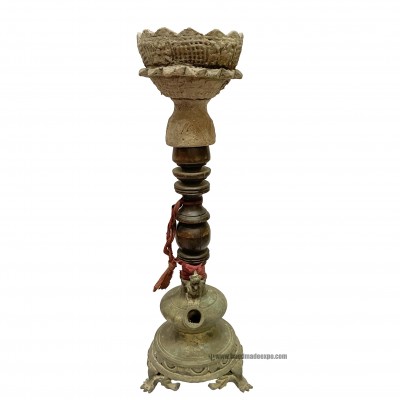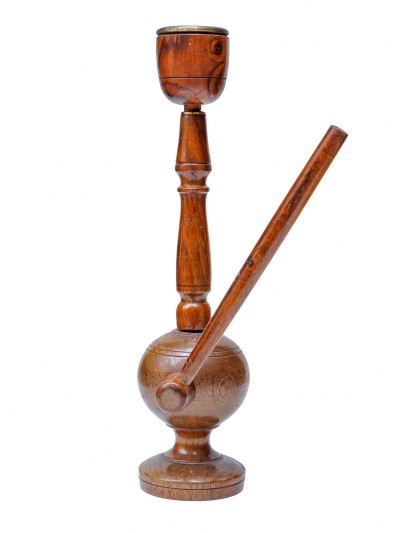
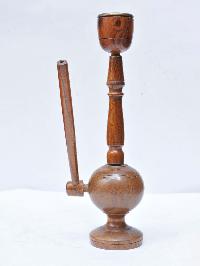
Handmade Wooden Hookah [Tambakhu] for Decoration
| Dimensions: | 29x10x8 cm (11.4 × 3.9 × 3.1 inches) |
| Gross Weight: | 0.25 kg (0.55 lbs) |
| Material: | Wood |
| Iconography / Artist: | Hookah |
| Craft Origin: | Kathmandu Valley, Nepal • Ancient Heritage Technique |
| Cataloged On: | Mar 07, 2023 |
Hookah
The health risks of smoking through a hookah include exposure to toxic chemicals that are not filtered out by the water and risk of infectious disease when hookahs are shared.
There are two theories regarding the origin of the hookah. The first is that following the introduction of tobacco to medieval India by the Jesuits, and since then tobacco use became widespread. The hookah or waterpipe was invented by Abu’l-Fath Gilani, a Persian physician of Akbar, in the Indian city of Fatehpur Sikri during Mughal India; the hookah spread from the Indian subcontinent to Persia first, where the mechanism was modified to its current shape, and then to the Near East. Alternatively, it could have originated in the Safavid dynasty of Persia, from where it eventually spread to the Indian subcontinent.
Despite tobacco and drug use being considered a taboo when the hookah was first conceived, its use became increasingly popular among nobility and subsequently widely accepted. Gradually, burned tobacco has been commonly replaced by vaporizing flavored shisha. Still the original hookah is often used in rural South Asia, which continues to use Tumbak (a pure and coarse form of unflavored tobacco leaves) and smoked by burning it directly with charcoal. While this method delivers a much higher content of tobacco and nicotine, it also imposes more adverse health effects compared to vaporized shisha hookahs.[citation needed]
The word hookah is a derivative of "huqqa", a Hindustani word, of Arabic origin (derived from حُقَّة ḥuqqa, "casket, bottle, water pipe"). Outside its native region, hookah smoking has gained popularity throughout the world, especially among younger people.A hookah (Hindustani: हुक़्क़ा (Devanagari), حقّہ (Nastaleeq), IPA: [ˈɦʊqːa]; also see other names), or shisha, is a single- or multi-stemmed instrument for heating or vaporizing and then smoking either tobacco, flavored tobacco (often Mu‘assel), or sometimes cannabis, hashish, and in the past opium. The smoke is passed through a water basin—often glass-based—before inhalation.
The health risks of smoking through a hookah include exposure to toxic chemicals that are not filtered out by the water and risk of infectious disease when hookahs are shared.
There are two theories regarding the origin of the hookah. The first is that following the introduction of tobacco to medieval India by the Jesuits, and since then tobacco use became widespread. The hookah or waterpipe was invented by Abu’l-Fath Gilani, a Persian physician of Akbar, in the Indian city of Fatehpur Sikri during Mughal India; the hookah spread from the Indian subcontinent to Persia first, where the mechanism was modified to its current shape, and then to the Near East. Alternatively, it could have originated in the Safavid dynasty of Persia, from where it eventually spread to the Indian subcontinent.
Despite tobacco and drug use being considered a taboo when the hookah was first conceived, its use became increasingly popular among nobility and subsequently widely accepted. Gradually, burned tobacco has been commonly replaced by vaporizing flavored shisha. Still the original hookah is often used in rural South Asia, which continues to use Tumbak (a pure and coarse form of unflavored tobacco leaves) and smoked by burning it directly with charcoal. While this method delivers a much higher content of tobacco and nicotine, it also imposes more adverse health effects compared to vaporized shisha hookahs.[citation needed]
The word hookah is a derivative of "huqqa", a Hindustani word, of Arabic origin (derived from حُقَّة ḥuqqa, "casket, bottle, water pipe"). Outside its native region, hookah smoking has gained popularity throughout the world, especially among younger people.
Centuries-Old Lost-Wax Metal Casting
Each sculpture at Handmade Handicraft is crafted using the ancient cire-perdue (lost-wax) technique, a craft perfected over a millennium by the Newar artisans of Patan. The process begins with sculpting beeswax and Himalayan tree resin by hand. A multi-layered clay mold is formed around the wax, which is melted away in the furnace, creating a void that is filled with molten red copper or bronze.
24K Mercury Gilding
Applied with pure gold leaf and fused using fire gilding for an ethereal sheen that endures for generations.
Cold-Gold Face Painting
The sacred facial features and serene gaze of deities are carefully rendered with powdered cold gold and natural pigments.
Hand-Chiseled Detailing
Intricate robes, mandalas, and jewels are carved by hand with miniature steel chisels and devotion.
Door-to-Door Worldwide Express Delivery
Since 1976, we have shipped thousands of delicate sacred statues and handicrafts across North America, Europe, Australia, and Asia with an exceptional track record of safe delivery.
-
Express Carriers: We partner with DHL Express, FedEx International, and licensed Air Cargo freighters with end-to-end tracking.
-
Museum-Grade Packaging: Each piece is wrapped in moisture-resistant vapor barriers, thick high-density foam cushioning, and reinforced export cartons or custom wooden crates for large statues.
-
100% Transit Insurance: All international shipments are fully insured against loss or damage during transit.
-
Customs Clearance & Documentation: Includes official Nepal Archaeological Department export clearances certifying modern non-antique artisan status for hassle-free customs clearance.
Related Artisan Masterpieces