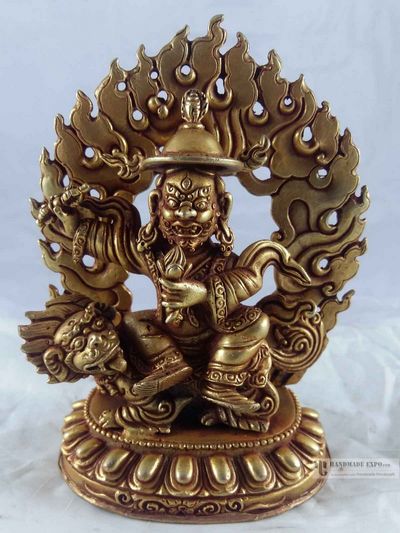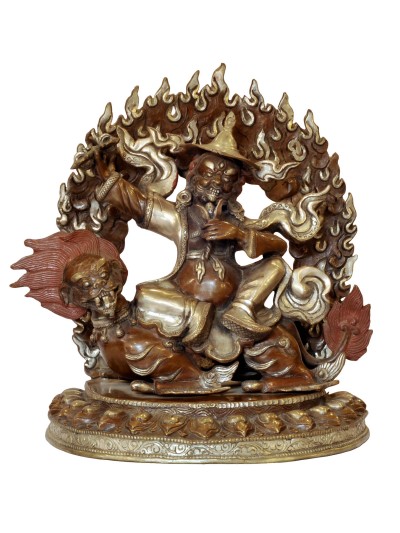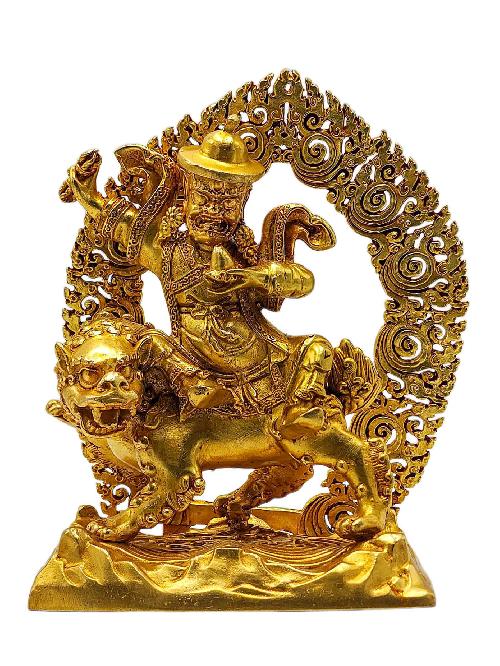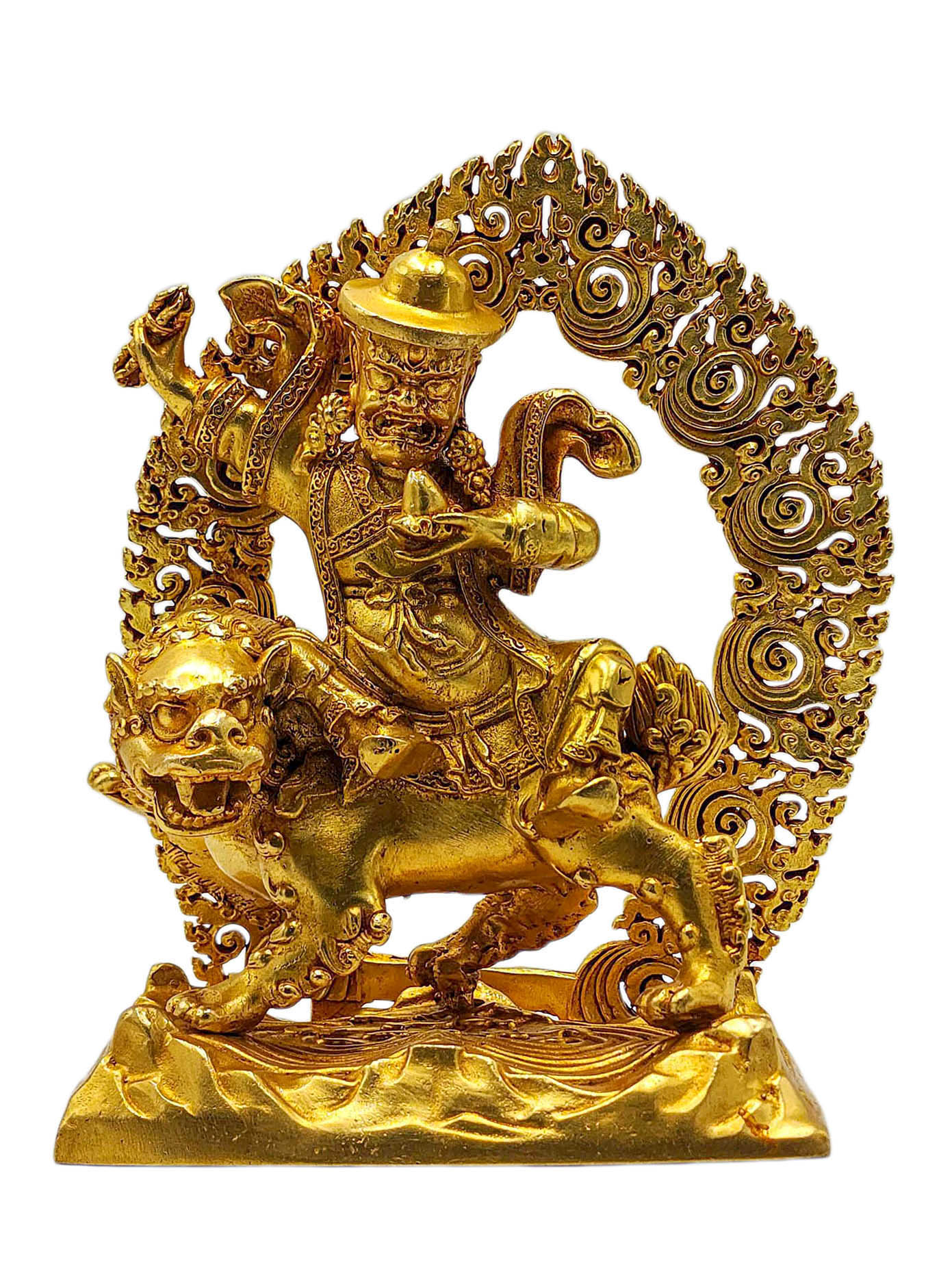
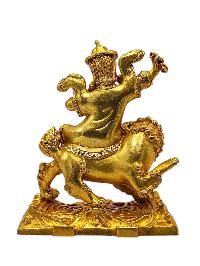
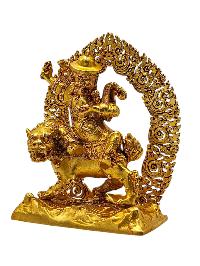
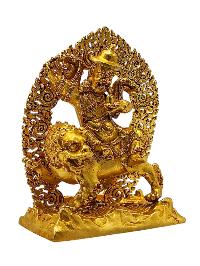
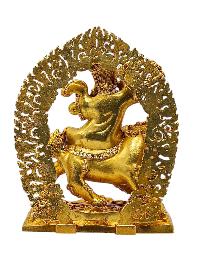
[Dorje Legpa], Buddhist Miniature Statue, [Full Gold Plated]
| Dimensions: | 15x11x7 cm (5.9 × 4.3 × 2.8 inches) |
| Gross Weight: | 0.73 kg (1.61 lbs) |
| Material: | Copper |
| Iconography / Artist: | Dorje Legpa |
| Craft Origin: | Kathmandu Valley, Nepal • Ancient Heritage Technique |
| Cataloged On: | Jul 28, 2025 |
Dorje Legpa
This form where Dorje legpa is seen riding a snow lion is a 'majestic yogi form who rides the vast tracks of sky beyond the mountain peaks. The snow lion represents youthful energy , a type of power which is enlivened by humour. The humour of the snow lion is the non dual humour which transcends seriousness and non-seriousness. There is a wide awake, wide open, wide-eyed quality to the youthful 'emotional astuteness' of the snow lion. The snow lion carries Dorje Legpa on her back in a graceful yet precise manner, not needing to be 'swift to the kil with regard to tracking down our deviousness with regard to our vows. The snow lion mount, simply allows Dorje Legpa the space of vajra humour in which all deviations are hoist on their respected petards. Neuroses simply run from the gaze of the Dorje Legpa and his snow lion until they exhaust themselves. This is their field of power.
Right after this, to the northwest of Mount Meru, a mu demon who was the embodiment of hatred, and a female mara who was the embodiment of lust, had sex. Seven months later on the first day of the last winter month of a tiger year, the mother produced an iron placental sack which fell at the base of a poison tree. When the mu father picked it up and looked inside, he saw a single child made out of iron, who immediately flew up to Mount Meru and reduced the four continents of our world system to ash. He bound the gods and demons who lived on Meru under his power. The lords of the mu, za, naga, and tsen demons all offered him their life essence. With these four as his retinue, the iron child began harming all living beings. Angered that they could not control him, the parents prayed that he would be enslaved by an "even greater power....from the realm of space." And so he apparently was, though no specific subjugating deity is mentioned in this account.
In another version of the myth of Dorje Lekpa's birth, Shri Heruka, in the form of a rakshasa, and Krodhishvari, in the form of a rakshasi, produced five daughters. The eldest of these mated with the king of the maras, and from their union was born Dorje Lekpa on the seventeenth day of the twelfth month. His mother urged him to eat the hearts of tigers, goats, and cats, and to protect the teachings of Shri Heruka. Because the boy had a birthmark in the shape of a vajra at his heart, he was determined to be part of the Vajra Buddha Family, and consequently received empowerment by Vajrapani. It is said that he was enthroned as the great yaksha that has power over our world system until the teachings of 5,000 buddhas disappear.
In yet another version of the myth, the "Ten Chapter Tantra of Dorje Lekpa Garwa Nagpo," the deity's parents were a cat-headed rakshasa and a monkey-headed female mara. They lived in a cube-shaped stone castle in a city of yamas in India. It was surrounded by swirling dust storms, whirling sword-blades, blazing fire, lightening, thunder, and hail. The rakshasa and mara lived there, eating the flesh and blood of sentient beings and having sex. From their union came five children. The main one was born with the head of a wolf and he had four siblings that had the teeth of tigers, lions, and jackals, claws like vulture talons, and the horns of scorpions. They were black demons of the charnel ground that attacked the life-force of all living things.
One day, the wolf-headed demon killed a goat that belonged to the sage Tramena. Tramena went to the Buddha and told him that there was a terrible hungry ghost that was preying on the beings of the three worlds, and needed to be subdued, which he promptly was by Vajrapani. Another source asserts that Dorje Lekpa manifested as an iron hawk to kill beings in the sky, an iron wolf to kill those on earth, and a solitary iron man who caused much injury and violence. This being angered Hayagriva who promptly split his head into pieces, before resurrecting and empowering him as the lord of the gods and demons who arise from the eight classes of consciousness.
Also, according to the "Ten Chapter Tantra," Dorje Lekpa took on different deity forms in each of the different realms of rebirth. He was born first as "All-Joyful" the king of the wealth gods. Then he was born as an asura lord of death who had a rat's head, took cat hearts as offerings, and made weapons, called Garwa Nagpo, or "Black Ironsmith." He was also born as the son of the King of Lanka, and named "Tiger Tamer," who took tiger hearts as offerings. Born as animal, he was called "Blue Iron Wolf," a wolf who killed flocks of goats to eat. As this deity he received goat hearts as offerings. As a hungry ghost, he was a tsen who lived in a maroon-colored castle in a rocky crag.
Centuries-Old Lost-Wax Metal Casting
Each sculpture at Handmade Handicraft is crafted using the ancient cire-perdue (lost-wax) technique, a craft perfected over a millennium by the Newar artisans of Patan. The process begins with sculpting beeswax and Himalayan tree resin by hand. A multi-layered clay mold is formed around the wax, which is melted away in the furnace, creating a void that is filled with molten red copper or bronze.
24K Mercury Gilding
Applied with pure gold leaf and fused using fire gilding for an ethereal sheen that endures for generations.
Cold-Gold Face Painting
The sacred facial features and serene gaze of deities are carefully rendered with powdered cold gold and natural pigments.
Hand-Chiseled Detailing
Intricate robes, mandalas, and jewels are carved by hand with miniature steel chisels and devotion.
Door-to-Door Worldwide Express Delivery
Since 1976, we have shipped thousands of delicate sacred statues and handicrafts across North America, Europe, Australia, and Asia with an exceptional track record of safe delivery.
-
Express Carriers: We partner with DHL Express, FedEx International, and licensed Air Cargo freighters with end-to-end tracking.
-
Museum-Grade Packaging: Each piece is wrapped in moisture-resistant vapor barriers, thick high-density foam cushioning, and reinforced export cartons or custom wooden crates for large statues.
-
100% Transit Insurance: All international shipments are fully insured against loss or damage during transit.
-
Customs Clearance & Documentation: Includes official Nepal Archaeological Department export clearances certifying modern non-antique artisan status for hassle-free customs clearance.
Related Artisan Masterpieces